WJAR: Does your body clock cause binge eating?
UC researcher explores melatonin, light therapy to treat binge eating behavior

Researchers at the University of Cincinnati are exploring how the body's sleep-wake cycles of circadian rhythms affect patients with binge eating disorder.
"Binge eating disorder is the most prevalent eating disorder, and unfortunately there's still very limited options or targeted options,” said Francisco Romo-Nava, MD, assistant professor in the Department of Psychiatry and Behavioral Neurosciences at UC, associate chief research officer for the Research Institute at the Lindner Center of HOPE and a UC Health physician scientist.
Romo-Nava said about 5% of the population is categorized as a true "night owl," and past research suggests this group might be more susceptible to binge eating behavior since binge eating tends to occur in the evening and night.
Romo-Nava and his team are studying if readjusting the circadian rhythms of people with binge eating disorder through melatonin or light therapy could be an effective treatment.
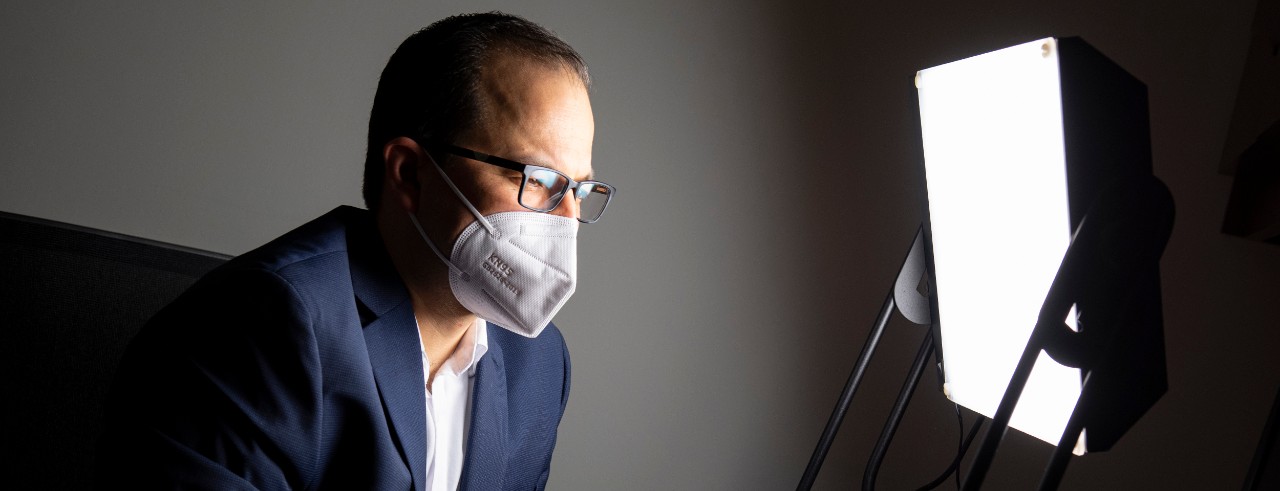
Featured photo at top of Dr. Romo-Nava. Photo/Colleen Kelley/University of Cincinnati.
Related Stories
‘Designer drug’ shows early neuroprotective signal in acute ischemic stroke
October 28, 2025

Medscape highlighted new trial results led by the University of Cincinnati's Eva Mistry that found an experimental drug shows promise in protecting injured brain cells for patients with acute ischemic stroke.
UC Board votes to fund design for YMCA renovation
October 28, 2025
At its October 28, 2025 meeting, the University of Cincinnati Board of Trustees approved $5 million in funding to complete all design and pre-construction services required to renovate the interior of a former YMCA building located at 270 Calhoun Street.
Is menstrual fluid ‘the most overlooked opportunity’ in women’s health?
October 27, 2025

The Guardian recently reported that period blood has long been thought of as ‘stinky and useless’, but startups are exploring using the fluid to test for a wide range of health conditions — including endometriosis.