Medical News Today: Parabens may increase breast cancer risk in Black women
UC expert comments on implications of recent study

Black women in the United States are 39% more likely to die from breast cancer compared to white women and are more likely to develop breast cancer under the age of 40.
A recent study conducted by researchers at City of Hope in Los Angeles found that compounds called parabens, which are used as preservatives in hair and personal care products, increased the growth of a Black breast cancer cell line but did not increase growth in a white breast cancer cell line.
Xiaoting Zhang, PhD, professor and Thomas Boat Endowed Chair in the University of Cincinnati's Department of Cancer Biology, director of the Breast Cancer Research Program and member of the University of Cincinnati Cancer Center, was not involved in the study but commented on it for Medical News Today.
Zhang said the study findings were interesting and suggest that at least part of the reason why parabens affect cancer cells differently is due to genetic or epigenetic differences.
"It will be highly critical to further study its effect not only in cultured breast cancer cells but also in animal models and eventually in humans,” Zhang said.
Read the Medical News Today story.
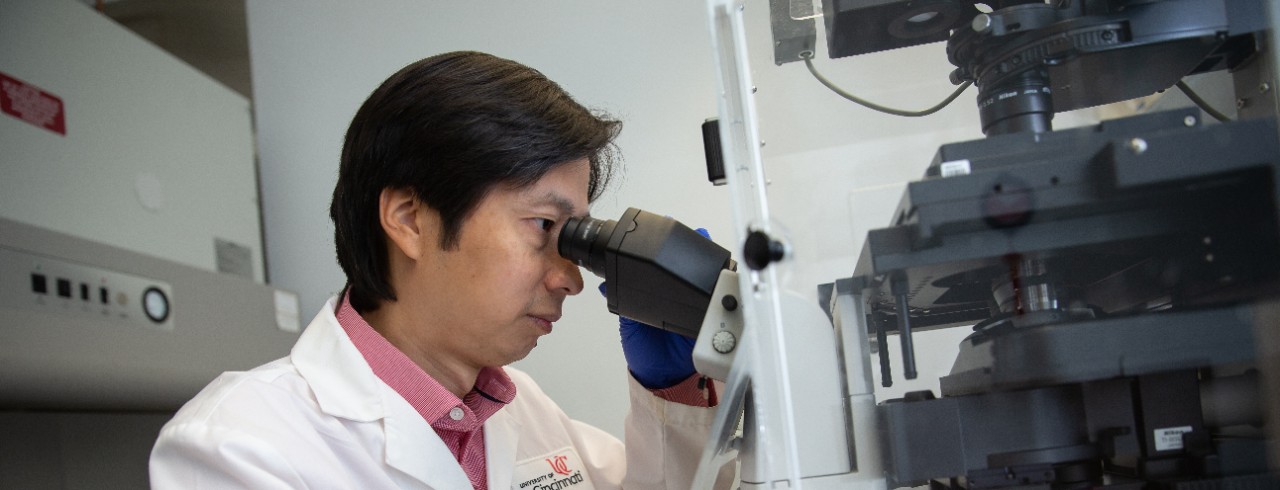
Featured photo at top of Dr. Zhang at microscope. Photo/Andrew Higley/UC Marketing + Brand
Related Stories
‘Designer drug’ shows early neuroprotective signal in acute ischemic stroke
October 28, 2025

Medscape highlighted new trial results led by the University of Cincinnati's Eva Mistry that found an experimental drug shows promise in protecting injured brain cells for patients with acute ischemic stroke.
UC Board votes to fund design for YMCA renovation
October 28, 2025
At its October 28, 2025 meeting, the University of Cincinnati Board of Trustees approved $5 million in funding to complete all design and pre-construction services required to renovate the interior of a former YMCA building located at 270 Calhoun Street.
Is menstrual fluid ‘the most overlooked opportunity’ in women’s health?
October 27, 2025

The Guardian recently reported that period blood has long been thought of as ‘stinky and useless’, but startups are exploring using the fluid to test for a wide range of health conditions — including endometriosis.