
WVXU: Has COVID become another routine respiratory infection?
WVXU: Has COVID become another routine respiratory infection?
UC expert says there are two important aspects of the new guidance to keep in mind

According to some recent reports in the media, the Centers for Disease Control and Prevention could soon change its isolation guidance for people who have tested positive for COVID. The agency is considering new guidelines where workers and school-aged children would not be required to isolate before returning to school or work if they have been fever-free for at least 24 hours without medication and if their symptoms are mild or resolving.
WVXU interviewed Carl Fichtenbaum, MD, of the Division of Infectious Diseases in the UC College of Medicine to get his expert perspective.
"The current guidance remains in place but there are some discussions behind the scenes talking about changing guidance from the five-day rule that currently exists where if you are infected with COVID and you have no symptoms, you’re supposed to wait five days until you go back in public," Fichtenbaum said. "If you’re symptomatic, you’re supposed to wait five days until your symptoms are improving and you’ve had no fever for a day or two."
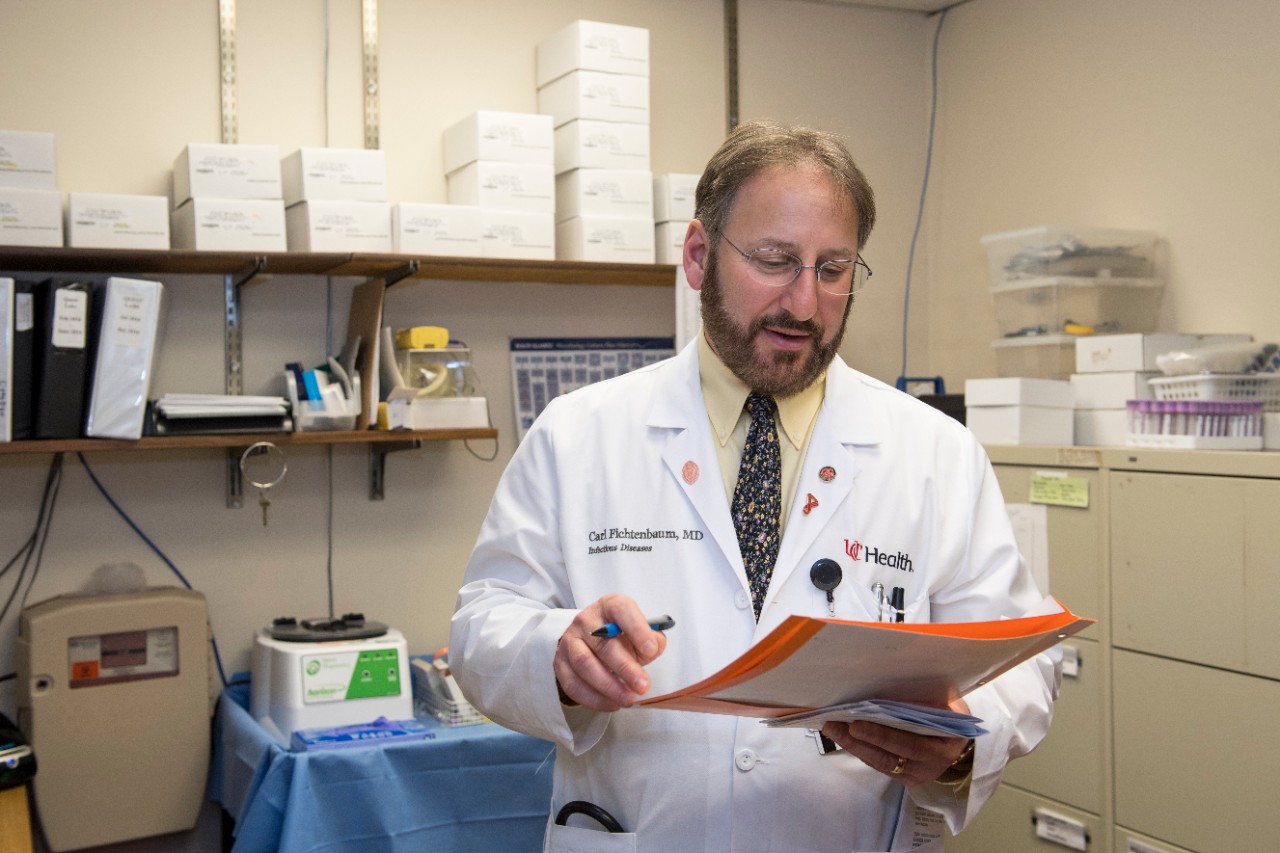
Carl Fichtenbaum, MD, of the Division of Infectious Diseases at the UC College of Medicine/Photo/Joe Fuqua II/UC Marketing + Brand
Fichtenbaum said the new guidance is exactly like the current guidance for RSV or respiratory syncytial virus or influenza.
"The new guidance would sort of change that a little bit to say if you’re symptomatic but your symptoms are better and you haven’t had a fever for a day, it doesn’t matter if it’s been five days, you can go back and go back out in the public and go back to work," he said.
Fichtenbaum added that he thinks there are two parts to the story.
"First of all, I think that making COVID more routine like other respiratory viruses makes perfect sense," he said. "At this point in time, it does not appear to be any more dangerous than influenza in terms of hospitalizations and leading to mortality. The other part of this whole story is we don’t do a terrific job of public health prevention. There still remain a number of vulnerable populations throughout the age spectrum. Very young children, older Americans and also people who have immune deficiencies, they may have cancer treatment, HIV, they may be a transplant patient or on some other fancy biologic agent that changes their immune system. We don’t very good job with our public health of protecting people from getting common viral illnesses because it’s not really in our culture and in our public health system ingrained that when you’re sick, you stay home, and there’s a lot of barriers to that."
Hear the entire interview here.
Lead photo/Matt Rourke/AP
Next Lives Here
The University of Cincinnati is classified as a Research 1 institution by the Carnegie Commission and is ranked in the National Science Foundation's Top-35 public research universities. UC's graduate students and faculty investigate problems and innovate solutions with real-world impact. Next Lives Here.
Related Stories
UC launches Bearcats Affordability Grant
January 7, 2026
The University of Cincinnati is making college more attainable for students across Ohio with the creation of the Bearcats Affordability Grant. The new grant will provide a pathway to tuition-free college for students of families who make less than $75,000 per year. Beginning in fall 2026, the Bearcats Affordability Grant will cover the remaining cost of tuition for Ohio residents who are Pell eligible.
‘Designer drug’ shows early neuroprotective signal in acute ischemic stroke
October 28, 2025

Medscape highlighted new trial results led by the University of Cincinnati's Eva Mistry that found an experimental drug shows promise in protecting injured brain cells for patients with acute ischemic stroke.
Is menstrual fluid ‘the most overlooked opportunity’ in women’s health?
October 27, 2025

The Guardian recently reported that period blood has long been thought of as ‘stinky and useless’, but startups are exploring using the fluid to test for a wide range of health conditions — including endometriosis.