Cancer runs in my family. How can I cut my risk?
Cancer Center expert featured in New York Times article

The University of Cincinnati Cancer Center's Syed Ahmad was featured in a New York Times article discussing ways to reduce your risk of cancer when it runs in your family.
Ahmad said patients may be referred to a genetic specialist to check for gene changes that increase your risk if your doctor deems it necessary.
“A lot of times, patients are scared to go to a genetic counselor” because of “fear of the unknown,” said Ahmad, interim director of the Cancer Center, professor, Hayden Family Endowed Chair for Cancer Research, section chief of surgical oncology and vice chair for faculty development in the Department of Surgery in UC's College of Medicine.
Ahmad added that having genetic variants doesn't guarantee you will develop cancer. But common genes tested for include the BRCA1 and BRCA2 genes if several family members have had breast cancer, or Lynch syndrome if multiple relatives have had colon cancer. Lynch syndrome is an inheritable genetic condition that can increase colon cancer risk by up to 80% for men and 60% for women.
Read the New York Times article.
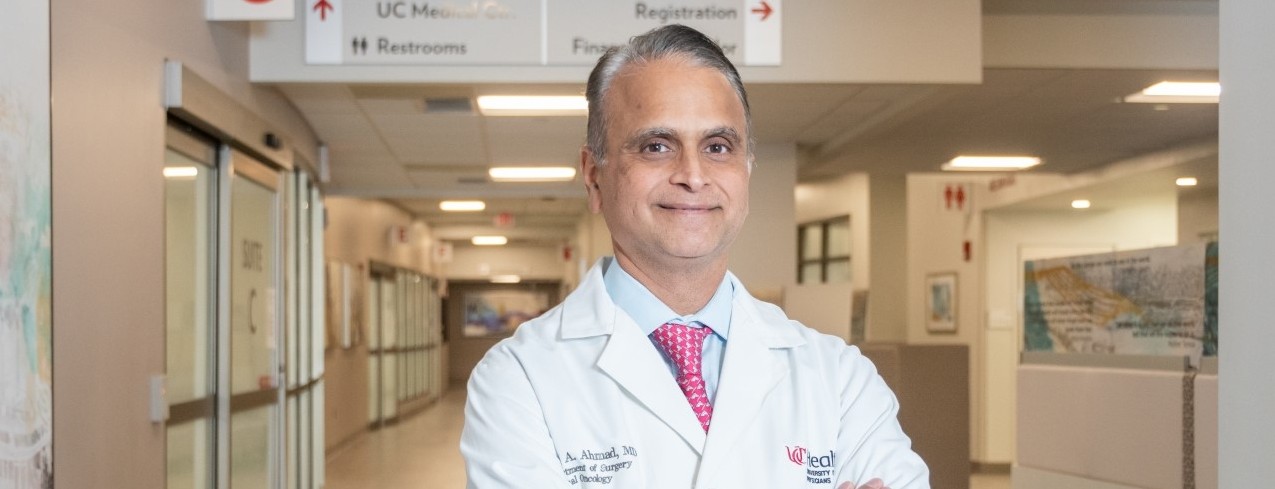
Featured photo at top of Dr. Ahmad. Photo/University of Cincinnati Cancer Center.
Related Stories
‘Designer drug’ shows early neuroprotective signal in acute ischemic stroke
October 28, 2025

Medscape highlighted new trial results led by the University of Cincinnati's Eva Mistry that found an experimental drug shows promise in protecting injured brain cells for patients with acute ischemic stroke.
UC Board votes to fund design for YMCA renovation
October 28, 2025
At its October 28, 2025 meeting, the University of Cincinnati Board of Trustees approved $5 million in funding to complete all design and pre-construction services required to renovate the interior of a former YMCA building located at 270 Calhoun Street.
Is menstrual fluid ‘the most overlooked opportunity’ in women’s health?
October 27, 2025

The Guardian recently reported that period blood has long been thought of as ‘stinky and useless’, but startups are exploring using the fluid to test for a wide range of health conditions — including endometriosis.