UC professors practice science outreach at museum

Fifteen professors from the University of Cincinnati participated in a science communication workshop last week at the Cincinnati Museum Center.
An interdisciplinary grant from UC's Office of the Provost and the McMicken College of Arts and Sciences funded the event, “Sharing Science Workshop and Practicum,” which included presentations, discussions and hands-on demonstrations with museum guests, many of whom were children.
The event reflected the academic excellence and urban impact platforms of UC’s strategic direction, Next Lives Here.

UC Senior Grant Administrator Cindy Treacy and professor Theresa Culley assist a child with a rocket launch demonstration at the Cincinnati Museum Center. An interdisciplinary grant from the Office of the Provost and the College of Arts and Sciences funded the day. Photo/Brandon Pytel/CEAS Marketing
“The goal is to improve science skills, and one way to do that is by doing science outreach,” said Brian Pollock, manager of museum experience at the Museum of Natural History and Science. “Science takes this really broad experience, and the public gets to see that.”

UC physics professors Colin Bischoff and Joachim Brod put on a temperature mapping demonstration for children. Photo/Brandon Pytel/CEAS Marketing
Pollock highlighted the difference between communicating with peers and broader audiences. Understanding this context can drive engagement and even encourage science as a future career for many children.
“Scientists don’t all wear lab coats and have big white beards,” Pollock said. “Science outreach allows us to put scientists out in the public, so people can get an accurate representation of what a scientist is and see themselves as one.”
UC faculty and staff from biological sciences, chemistry, psychology, physics, communication and philosophy shared their own experiences and challenges in communicating science and picked up tips to improve their approach. By the end of the day, they faced the ultimate test of learning: putting on demonstrations for children.
In a room open to all museum guests, professors used interactive science kits to explain difficult concepts like the expanding universe, static electricity and temperature mapping. To engage with the children, the UC professors applied strategies they learned earlier in the day, like asking open-ended questions, using positive language and relating science to everyday experience.

UC professor Dieter Vanderelst instructs a child for a static electricity demonstration. Photo/Brandon Pytel/CEAS Marketing
“I loved the enthusiasm of the kids,” said one of the professors, who put on a rocket launch demonstration.
The day ended with a conversation on how to maintain and increase science outreach efforts, especially with the changing interests and methods of communication of younger generations. Professors also talked about how to bridge the gaps between science and humanities for future projects.
Universities and museums have a responsibility to educate the public. Workshops between UC and the Cincinnati Museum Center can help fulfill this goal while empowering the next generation of scientists and engineers.
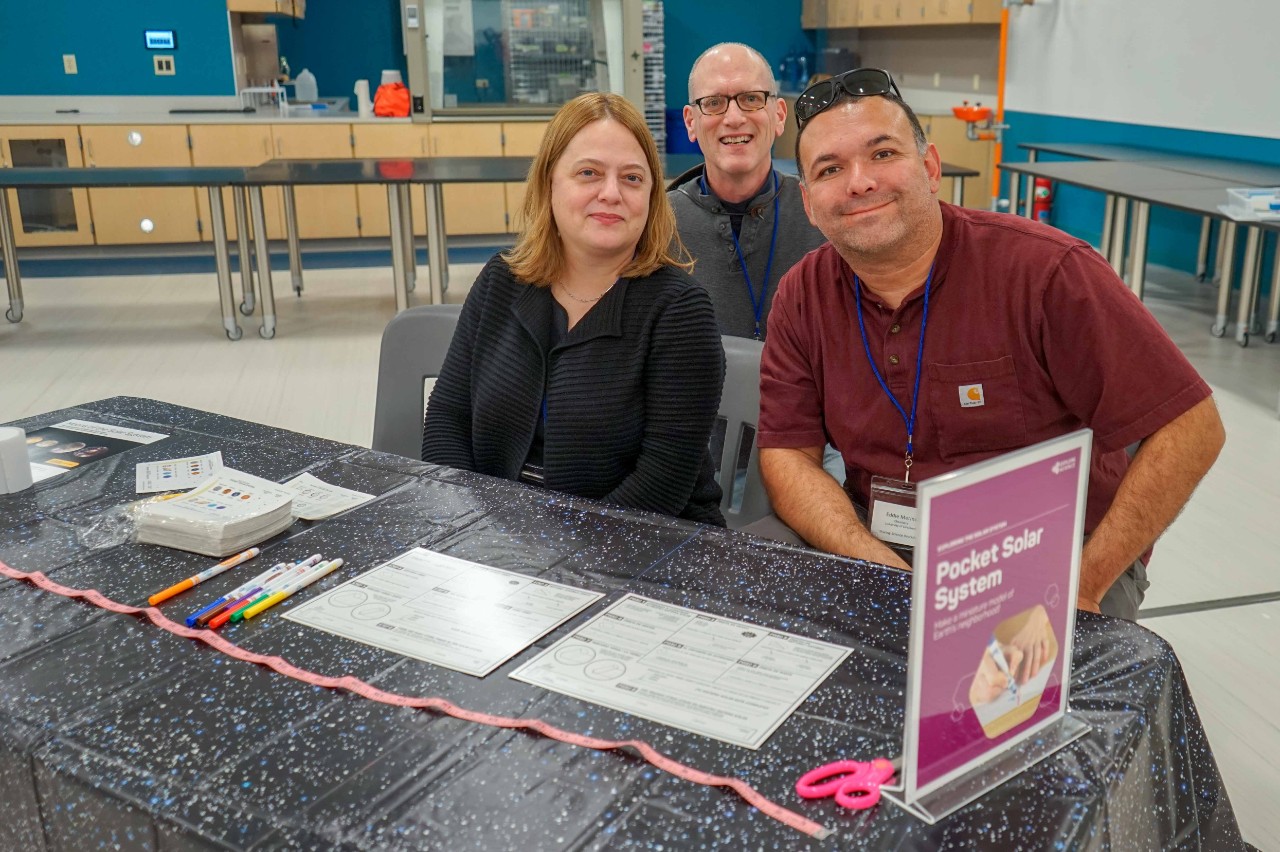
Featured image at top: UC professors Stephanie Rollman, Steve Depoe and Eddie Merino pose at the Sharing Science Workshop event at the Cincinnati Museum Center. Photo/Brandon Pytel/CEAS Marketing

UC postdoctoral researcher Melissa Jacquart and UC professor Adam Aurisano engage with children at the Science Sharing Workshop. Photo/Brandon Pytel/CEAS Marketing
Next Lives Here
The Sharing Science Workshop and Practicum event reflected the academic excellence and urban impact platforms of UC’s strategic direction, Next Lives Here.
Related Stories
‘Designer drug’ shows early neuroprotective signal in acute ischemic stroke
October 28, 2025

Medscape highlighted new trial results led by the University of Cincinnati's Eva Mistry that found an experimental drug shows promise in protecting injured brain cells for patients with acute ischemic stroke.
Is menstrual fluid ‘the most overlooked opportunity’ in women’s health?
October 27, 2025

The Guardian recently reported that period blood has long been thought of as ‘stinky and useless’, but startups are exploring using the fluid to test for a wide range of health conditions — including endometriosis.
Tackling children’s health
October 27, 2025
Randi Bates, assistant professor in the UC College of Nursing, focuses on advancing childhood health and wellbeing in her research. This month she was honored with a Crane Excellence in Early Childhood Award from The Ohio State University. Bates is also the recipient of the 2025 Distinguished Nurse Researcher Award from Mount St. Joseph University.