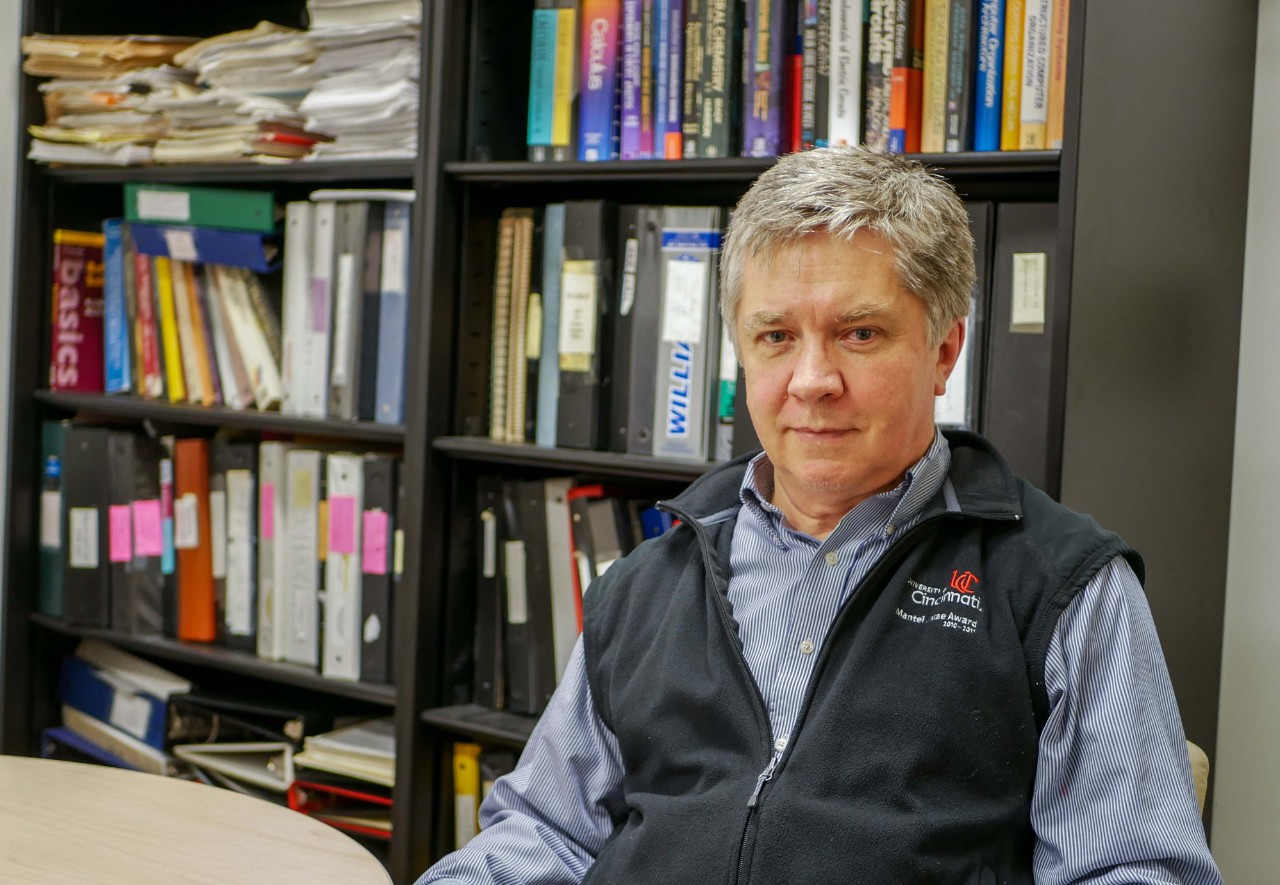
UC professor brings novel approach to quantum mechanics

Quantum mechanics is one of the most effective approaches for understanding the workings of atoms and subatomic particles.
But it’s also one of the most abstract.
Marc Cahay, professor and department head at the University of Cincinnati, is using a number system called quaternions to deepen our understanding of quantum mechanics. Cahay, with colleagues Dennis Morris from England and George Purdy from UC, published the results of the work in Physica Scripta.
The work reflects the university’s innovation agenda, a platform of UC’s strategic direction, Next Lives Here.
Cahay’s quaternion approach focuses on one of quantum mechanics’ most fundamental concepts: the spin of an electron. The spin of an electron tells us not only about the workings of atoms and subatomic particles but also of chemical bonds, the periodic table and other physical phenomena.

UC professor Marc Cahay stands next to a portrait of renowned mathematician, Paul Erdős. Cahay recently published a paper with the late George Purdy, who published several papers with Erdős. Photo/Corrie Stookey/CEAS Marketing
Traditionally, to calculate the spin of an electron, people use equations with complex numbers. Cahay, however, is using quaternions. While complex numbers are expressed by two components, quaternions are expressed by four. This quaternion number matches the dimensions of space-time, with its three spatial and one time-based dimensions.
“As engineers and physicists, we are used to complex numbers to analyze and model a lot of fundamental and practical systems,” said Cahay. “You have to back up a little bit and do the math properly when you deal with quaternions. It’s a rather tricky business.”
But quaternions aren’t completely perplexing. Aerospace engineers often use quaternions to track the orientation and rotation of an object, like a rocket or a satellite. The paper’s novelty is in the application of this approach to study the spin of subatomic particles in quantum mechanics.
This work teaches the students a very versatile way of attacking widely different problems in quantum mechanics.
Marc Cahay, UC professor and department head

UC professor Marc Cahay holds a plaque that honors the late George Purdy. Purdy, known for the Purdy polynomials in math and computer science circles, first introduced Cahay to applying quaternions to quantum mechanics. Photo/Corrie Stookey/CEAS Marketing
Cahay’s publication only deals with the spin of the electron, but Cahay hopes to eventually use the quaternion approach as a universal tool for solving quantum mechanics problems.
“This work teaches the students a very versatile way of attacking widely different problems in quantum mechanics,” said Cahay. “Many different phenomena can be analyzed using quaternions and their associated algebra”
Cahay dedicated the work to friend and colleague, the late UC professor George Purdy, who first introduced Cahay to applying quaternions to quantum mechanics. Purdy, known for the Purdy polynomials in cryptography, was an expert in fundamental quantum mechanics and a co-author of several papers with renowned mathematician Paul Erdős.
“I cannot tell you how many times I wish George would still be around to shine light on the many questions about quaternions I have come across since he left us,” said Cahay. “But what is most important for me with this paper is that I am able to honor George’s memory.”
Featured image at top: Marc Cahay sits at a table in his office. Cahay is using a number system called quaternions to deepen our understanding of quantum mechanics. Photo/Corrie Stookey/CEAS Marketing
Bending the Future
The University of Cincinnati is the region's destination for thinking, making, doing, discovery and delivery. Next Lives Here.
Related Stories
UC Foundation reveals 2025 philanthropy winners
October 27, 2025
The University of Cincinnati Foundation recognized its Outstanding Philanthropic Volunteer Award honorees at the George Rieveschl Recognition Dinner on Oct. 23, 2025.
Moth-like drone navigates autonomously without AI
October 22, 2025
Engineering researchers at the University of Cincinnati developed a moth-like drone that flies autonomously using extremum-seeking feedback systems instead of artificial intelligence. The research could help explain how tiny insects with small brains are such adroit flyers.
UC engineers want to muffle roar of jets
October 21, 2025
Researchers at the University of Cincinnati are working to muffle the sound of jet aircraft without sacrificing engine performance.