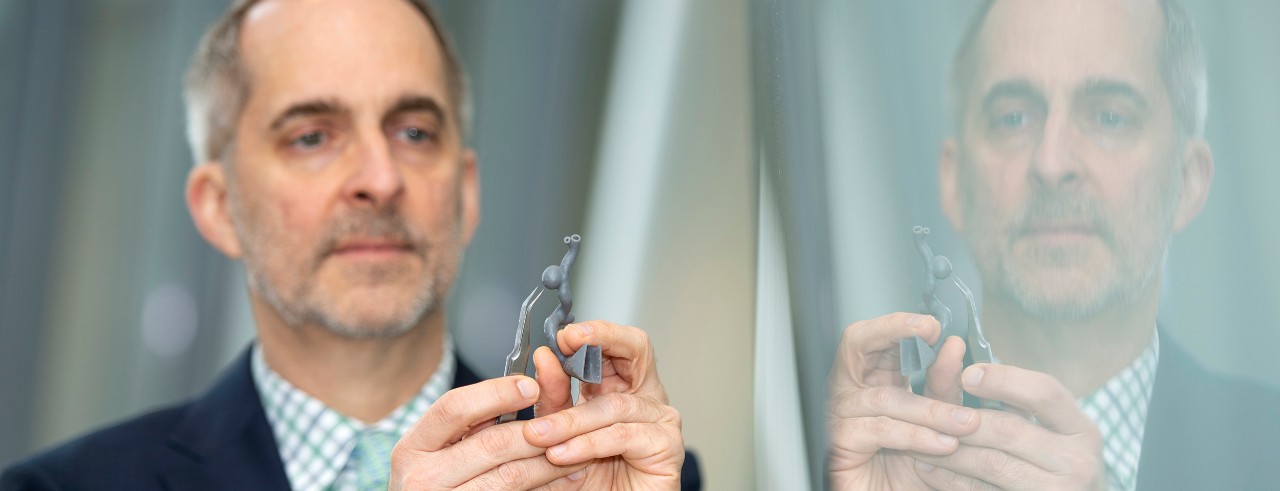
More than meets the eye
3D printing is helping UC doctors further personalize care, helps patients visualize treatment plans

Today, 3D printing is being used for everything from jewelry creation to producing food.
But the ways in which Dr. Frank Rybicki and the University of Cincinnati Department of Radiology are using the technology are directly impacting the way patients receive care at UC Health, improving their experiences and overall outcomes.
Rybicki, professor in the department, came to UC this year with a decade of medical 3D-printing experience under his belt.
He was part of the team at Brigham and Women’s Hospital and Harvard Medical School, both located in Boston, Massachusetts, that used 3D models for the first U.S. full face transplant in 2011.
"I immediately realized that 3D printing was going to be a game changer for radiology and medicine as a whole,” he says.

3D model of an artery. Photo credit: Colleen Kelley / UC Creative Services
Using CT, MRI or other forms of medical scans, Rybicki and his team make 3D models of what those scans show, such as tumors or clogged arteries. This then helps physicians make decisions on the best, personalized treatment for the patient as well as explain those plans. These models also help students and residents learn more about anatomy.
The team recently created their first model at UC used for care: a patient’s artery in the liver with an aneurysm.
“We bring the patient’s model directly to the patient,” he says. “It is truly groundbreaking to be able to deliver this personalized care — to show the patient their own disease. This includes tumors, problems from birth or, in the case of blood vessels, blockages. Patient advocacy and personalized medicine are at the center of medical 3D printing. Patients, health care providers and medical organizations strongly embrace the ability for a patient to ‘hold in their hand’ their own anatomy. It increases understanding which promotes communication and the quality of care delivered.”

Dr. Arafat Ali, resident physician, assessing scans and inputting images for printing. Photo credit: Colleen Kelley / UC Creative Services
Rybicki is considered a pioneer regarding research on ways to use this technology to help in diagnosis and treatment of patients, in addition to the cost benefit. He’s also working closely with teams at Cincinnati Children’s Hospital Medical Center, which are using the technology to better treat pediatric patients with congenital heart defects.
“It’s an exciting way to meld a technology which is already entrenched in the nonmedical sciences into the medical world,” he says.
Featured photo at top: Dr. Frank Rybicki by Colleen Kelley/UC Creative Services.
Next Lives Here
The University of Cincinnati is classified as a Research 1 institution by the Carnegie Commission and is ranked in the National Science Foundation's Top-35 public research universities. UC's graduate students and faculty investigate problems and innovate solutions with real-world impact. Next Lives Here.
Related Stories
‘Designer drug’ shows early neuroprotective signal in acute ischemic stroke
October 28, 2025

Medscape highlighted new trial results led by the University of Cincinnati's Eva Mistry that found an experimental drug shows promise in protecting injured brain cells for patients with acute ischemic stroke.
Meet the young talent reshaping Cincinnati’s startup scene
October 28, 2025
Five University of Cincinnati students were honored for their impactful entrepreneurship on the Cincy Inno Under 25 list. We’ll explain what makes each student – and their startup – stand out.
UC Board votes to fund design for YMCA renovation
October 28, 2025
At its October 28, 2025 meeting, the University of Cincinnati Board of Trustees approved $5 million in funding to complete all design and pre-construction services required to renovate the interior of a former YMCA building located at 270 Calhoun Street.