LiveScience: UC research shows spider butts look like faces
The spider's abdomen looks like a wasp's or mantis' head. Researchers say it fools computers, too.

LiveScience examined University of Cincinnati biology research into why some jumping spiders use biomimicry in mating dances.
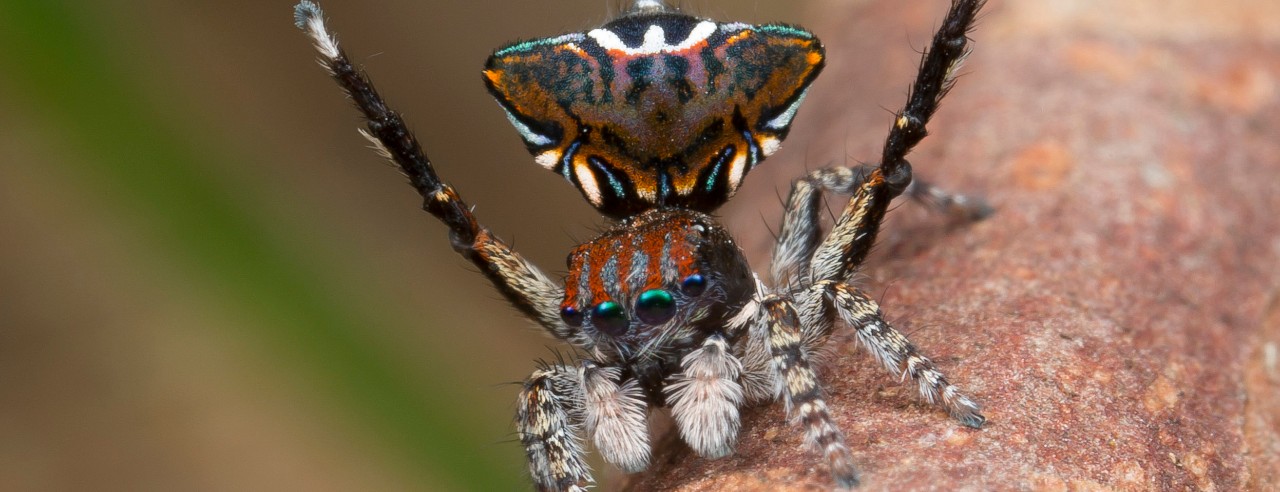
UC biology student Olivia Harris observed that the raised abdomens of peacock jumping spiders during their courting dance looked to her like the angular head and eyes of predators that eat spiders — wasps and preying mantises.
But to determine if what she was seeing was just her imagination, she enlisted the help of artificial intelligence to see if it was fooled, too.
She used images of peacock jumping spiders taken by internationally renowned photographer and Australian scientist Jurgen Otto, whose stunning photos and videos of the colorful spiders have appeared in National Geographic and Smithsonian.

A jumping spider in UC professor Nathan Morehouse's lab. Photo/Joseph Fuqua II/UC Creative Services
Harris asked artificial intelligence to tell the spiders apart from images of preying mantises, wasps and other insects. The spider abdomens fooled the computer about 5 percent of the time.
"One of the species is actually named Maratus vespa," she said. "Vespa is Latin for wasp. So we're not the first scientists to see the faces of invertebrate predators in these little spiders."
Spiders are notoriously cannibalistic. Courting males walk a fine line between seducing females and ending up as a snack.
Harris said mimicking a predator might give females just enough pause to halt a deadly ambush so the male can begin his courting display.
"Our hypothesis is the males are trying to exploit the females' anti-predator response of freezing when scared. This would help him capture the female's attention without immediately becoming prey himself," Harris said.
Harris presented her findings at the Society of Integrative and Comparative Biology conference this month.
Featured image at top: A jumping spider's raised abdomen looks so much like the angular head of a preying mantis or wasp that it fooled a computer some of the time. Photo/Jurgen Otto/www.peacockspider.org
Next Lives Here
The University of Cincinnati is classified as a Research 1 institution by the Carnegie Commission and is ranked in the National Science Foundation's Top-35 public research universities. UC's graduate students and faculty investigate problems and innovate solutions with real-world impact. Next Lives Here.
Become a Bearcat
- Apply online or get more information about undergraduate enrollment by calling 513-556-1100.
- Learn more about UC's many undergraduate and graduate programs.
Related Stories
UC Foundation reveals 2025 philanthropy winners
October 27, 2025
The University of Cincinnati Foundation recognized its Outstanding Philanthropic Volunteer Award honorees at the George Rieveschl Recognition Dinner on Oct. 23, 2025.
UC team unveils Wyandot Removal Trail across Ohio
October 24, 2025

Rebecca Wingo, an associate professor of history and director of the public history program in the University of Cincinnati’s College of Arts and Sciences, is featured in a WVXU story about new historical markers honoring the Wyandot people—the last Indigenous nation forcibly removed from Ohio.
John Updike called his letters dull. They’re anything but.
October 23, 2025

James A. Schiff, founding editor of The John Updike Review and UC English professor, edited Selected Letters of John Updike, the first comprehensive collection of the author’s correspondence. Drawing from thousands of letters spanning Updike’s life, Schiff offers new insight into the writer’s personal and literary world. The volume was edited by The New York Times.