Fierce Biotech: Making 'cold' tumors responsive to immunotherapy
UC research points to combination therapy involving the immune system for breast cancer

Some cancers create a hostile environment that allows them to evade immune attacks. That's why many patients with cancer don't respond to immuno-oncology treatments. Scientists are looking for ways to turn these so-called “cold” tumors into “hot” ones that are susceptible to immunotherapy.
A research study by scientists at the University of Cincinnati have discovered proteins that can be targeted to overcome resistance to cancer immunotherapy in animal models.
Syn Kok Yeo, PhD, research instructor in the department of cancer biology at the UC College of Medicine and a member in the lab of Jun-Lin Guan, PhD, the Francis Brunning Professor and Cancer Biology Department Chair, describes his research. He is a member of the UC Cancer Center.
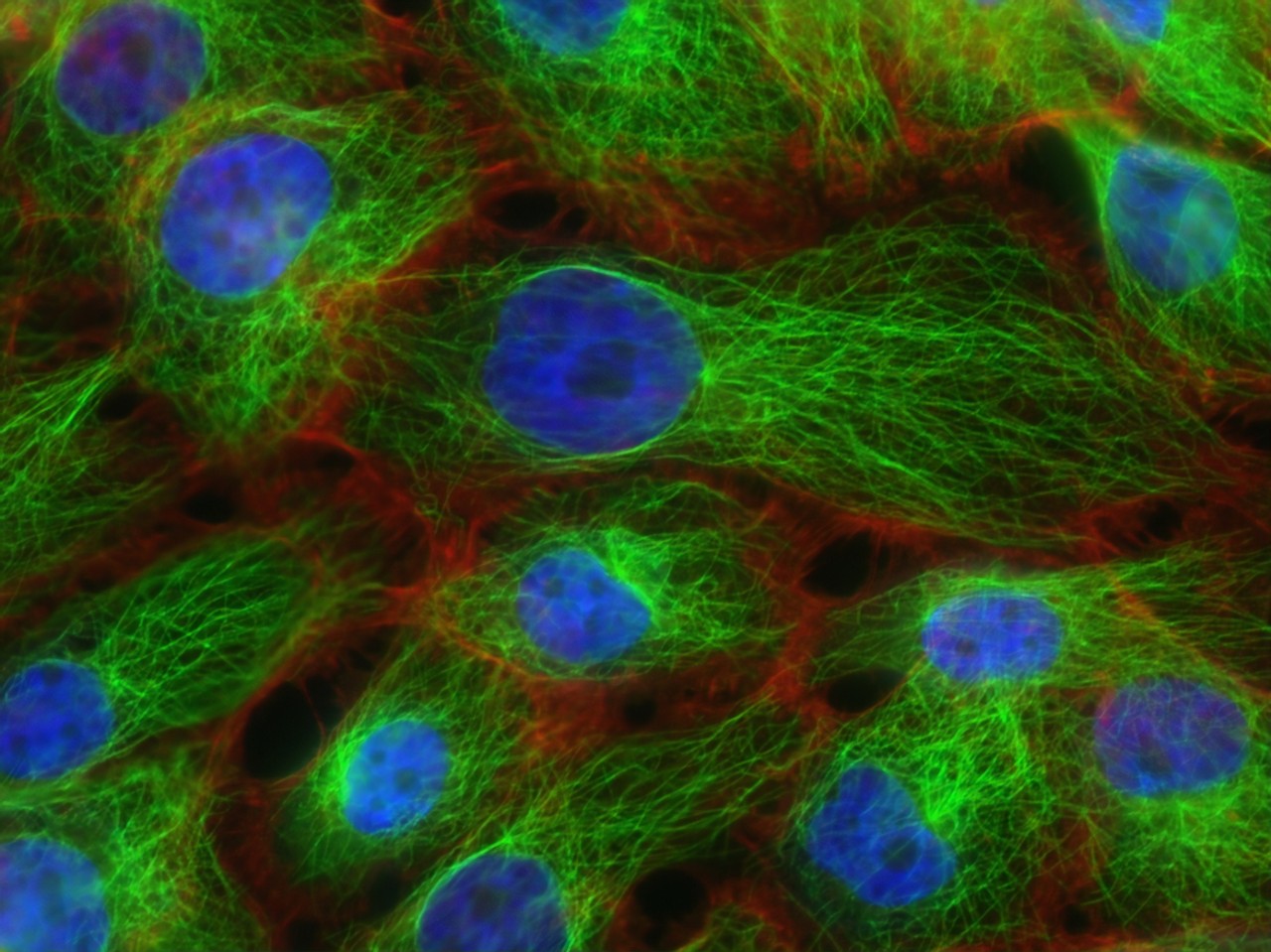
Featured photo of stress fibers and microtubules in human breast cancer cells. Courtesy of the National Cancer Institute.
Next Lives Here
The University of Cincinnati is classified as a Research 1 institution by the Carnegie Commission and is ranked in the National Science Foundation's Top-35 public research universities. UC's graduate students and faculty investigate problems and innovate solutions with real-world impact. Next Lives Here.
Related Stories
‘Designer drug’ shows early neuroprotective signal in acute ischemic stroke
October 28, 2025

Medscape highlighted new trial results led by the University of Cincinnati's Eva Mistry that found an experimental drug shows promise in protecting injured brain cells for patients with acute ischemic stroke.
Meet the young talent reshaping Cincinnati’s startup scene
October 28, 2025
Five University of Cincinnati students were honored for their impactful entrepreneurship on the Cincy Inno Under 25 list. We’ll explain what makes each student – and their startup – stand out.
Is menstrual fluid ‘the most overlooked opportunity’ in women’s health?
October 27, 2025

The Guardian recently reported that period blood has long been thought of as ‘stinky and useless’, but startups are exploring using the fluid to test for a wide range of health conditions — including endometriosis.