CBS News: Physicists discover galaxy formed in early universe
UC physics professor Matthew Bayliss co-authored study on billions-year-old galaxy

CBS News in Chicago highlighted a physics study that identified a galaxy that formed in the early formation of the universe.
The international discovery was confirmed by observations from the Magellan telescopes in Chile and the Gemini North telescope in Hawaii.
University of Cincinnati physicist Matthew Bayliss, an assistant professor in UC's College of Arts and Sciences, was a study co-author. The lead author, Gourav Khullar, is a physics student at the University of Chicago.
Bayliss got his doctoral and master's degrees from the University of Chicago, where he worked as a research and teaching assistant before joining Harvard University as a research fellow.
Bayliss said they date the galaxy to when the universe was 1.2 billion years old – or about 10% of the universe's current age.
"This means that we will be able to use this galaxy to make much-higher-quality measurements of the properties of galaxies at such early times than had previously been possible," Bayliss said. "Finding a highly magnified galaxy like this gives us a great place to point our best observatories."
Researchers expect to get more data on this ancient galaxy from the Hubble Space Telescope and Chandra X-ray Observatory, Bayliss said.
The study was published in the Astrophysical Journal.
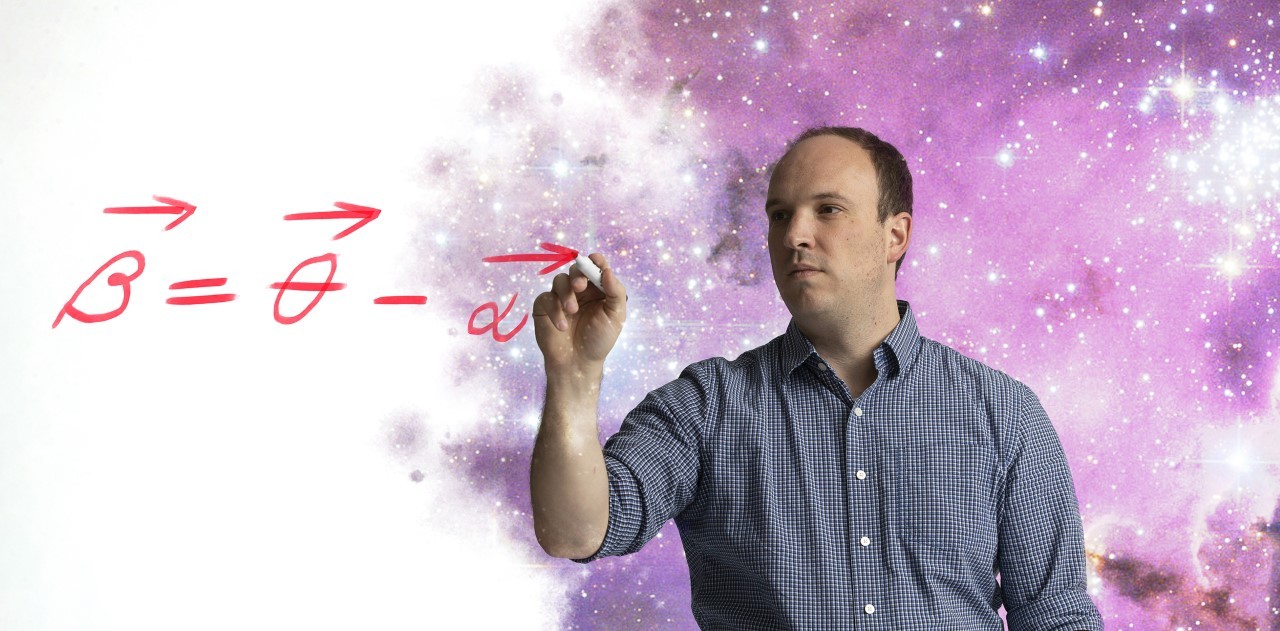
Featured image at top: UC astrophysicist Matthew Bayliss took part in the discovery of a galaxy that formed in the early creation of the universe. Photo illustration/Margaret Weiner and Lisa Ventre/UC Creative + Brand
Next Lives Here
The University of Cincinnati is leading public urban universities into a new era of innovation and impact. Our faculty, staff and students are saving lives, changing outcomes and bending the future in our city's direction. Next Lives Here.
Related Stories
‘Designer drug’ shows early neuroprotective signal in acute ischemic stroke
October 28, 2025

Medscape highlighted new trial results led by the University of Cincinnati's Eva Mistry that found an experimental drug shows promise in protecting injured brain cells for patients with acute ischemic stroke.
Is menstrual fluid ‘the most overlooked opportunity’ in women’s health?
October 27, 2025

The Guardian recently reported that period blood has long been thought of as ‘stinky and useless’, but startups are exploring using the fluid to test for a wide range of health conditions — including endometriosis.
What is squalane, and how does it work to moisturize skin?
October 27, 2025

The University of Cincinnati's Kelly Dobos was featured in a Women's Health article discussing squalane, an ingredient being increasingly used in moisturizing skincare products.