WCPO: UC expert warns to look out for lanternflies
Invasive species is showing up on Ohio trees

WCPO turned to a University of Cincinnati biologist to explain why homeowners should keep watch for an invasive insect that is showing up in the Midwest.
The spotted lanternfly was first observed in the United States in 2014. Today, it's found in 11 states, including Ohio. It feeds on fruiting trees, among others, and can cause extensive damage, according to the U.S. Department of Agriculture.
The insect is native to parts of Asia but has been introduced to several other countries around the world.

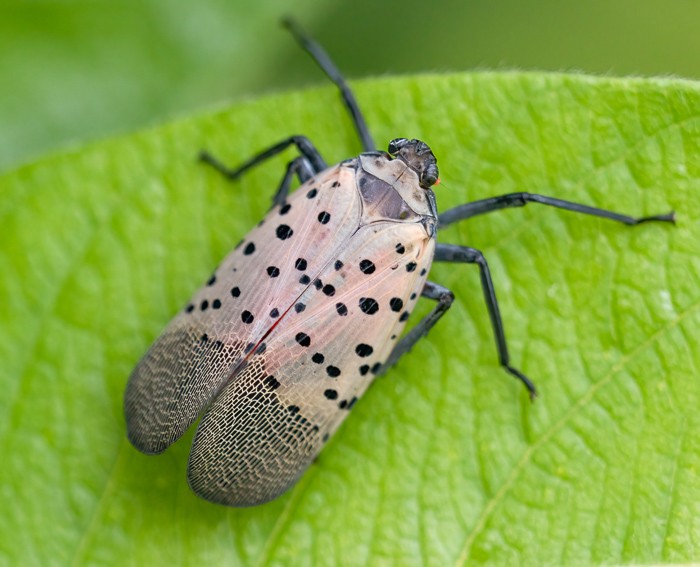
A spotted lanternfly. Photo/Walthery/Wikimedia Commons
Pennsylvania instituted a products quarantine across much of the state, requiring permitting for residents or businesses to transport landscaping, logs, grapevines, nursery stock and other items that could harbor insects in the affected counties.
UC associate professor Joshua Benoit told WCPO that some plants have better natural defenses than others to new insect threats.
"Usually when a new invasive pest shows up, what will happen is a lot of the plants here are adapted to fight them off," Benoit said. "And so you end up with a lot of jumping to new hosts and a lot more damage. They're not necessarily expecting it."
Anyone who sees a spotted lanternfly is advised to kill it and notify the Ohio Department of Agriculture.
Featured image at top: A spotted lanternfly. Photo/Rhododendrites/Wikimedia Commons

Students in UC associate professor Joshua Benoit's lab study insect physiology in species found around the world. Photo/Joseph Fuqua II/UC Creative + Brand
Related Stories
‘Designer drug’ shows early neuroprotective signal in acute ischemic stroke
October 28, 2025

Medscape highlighted new trial results led by the University of Cincinnati's Eva Mistry that found an experimental drug shows promise in protecting injured brain cells for patients with acute ischemic stroke.
Is menstrual fluid ‘the most overlooked opportunity’ in women’s health?
October 27, 2025

The Guardian recently reported that period blood has long been thought of as ‘stinky and useless’, but startups are exploring using the fluid to test for a wide range of health conditions — including endometriosis.
What is squalane, and how does it work to moisturize skin?
October 27, 2025

The University of Cincinnati's Kelly Dobos was featured in a Women's Health article discussing squalane, an ingredient being increasingly used in moisturizing skincare products.