UC professor’s method to treating cocaine addiction highlighted
WVXU, Local 12 report on researcher’s unique approach

The work of University of Cincinnati pharmacology professor Andrew Norman to treat cocaine addiction has been featured by WVXU and Local 12.
Norman and his team at UC and Cincinnati Children's Hospital Medical Center have developed a human-made protein that acts like a regular antibody in the immune system, called a monoclonal antibody, in an effort to treat cocaine addiction. The antibody binds to cocaine and prevents it from entering the brain.
The approach, which is awaiting Food and Drug Administration approval to proceed with first‐in‐human trials, offers hope of a potential treatment for people addicted to cocaine.
“They have to be motivated to want to quit and the cocaine and the antibody will help them quit by having no effect of cocaine," Norman told WVXU. "So they take the cocaine and the cocaine is neutralized and has no effect. And in that way, because it’s not having its effect it won’t induce a relapse response.”
Norman's approach is one that has been successful for other therapies, including COVID-19 vaccines.
“We came up with the idea of taking a so-called monoclonal antibody, and these are specific antibodies, and they are used therapeutically a lot these days for various things, including COVID-19,” Norman told Local 12.
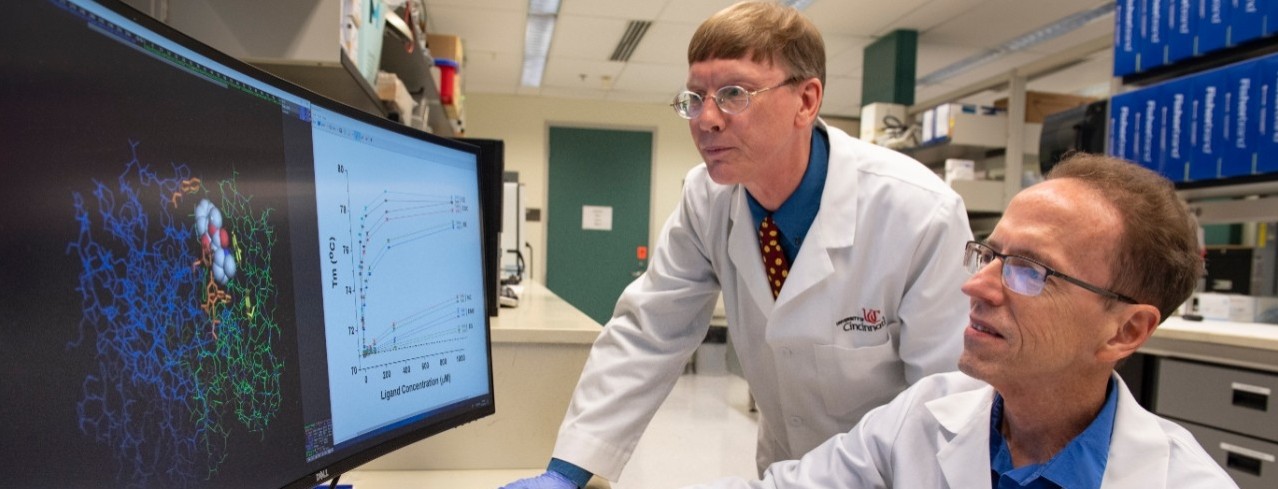
Featured image at top: University of Cincinnati professor Andrew Norman, left, works in his lab. Photo/Colleen Kelley/UC Creative Services.
Impact Lives Here
The University of Cincinnati is leading public urban universities into a new era of innovation and impact. Our faculty, staff and students are saving lives, changing outcomes and bending the future in our city's direction. Next Lives Here.
Related Stories
‘Designer drug’ shows early neuroprotective signal in acute ischemic stroke
October 28, 2025

Medscape highlighted new trial results led by the University of Cincinnati's Eva Mistry that found an experimental drug shows promise in protecting injured brain cells for patients with acute ischemic stroke.
Is menstrual fluid ‘the most overlooked opportunity’ in women’s health?
October 27, 2025

The Guardian recently reported that period blood has long been thought of as ‘stinky and useless’, but startups are exploring using the fluid to test for a wide range of health conditions — including endometriosis.
What is squalane, and how does it work to moisturize skin?
October 27, 2025

The University of Cincinnati's Kelly Dobos was featured in a Women's Health article discussing squalane, an ingredient being increasingly used in moisturizing skincare products.