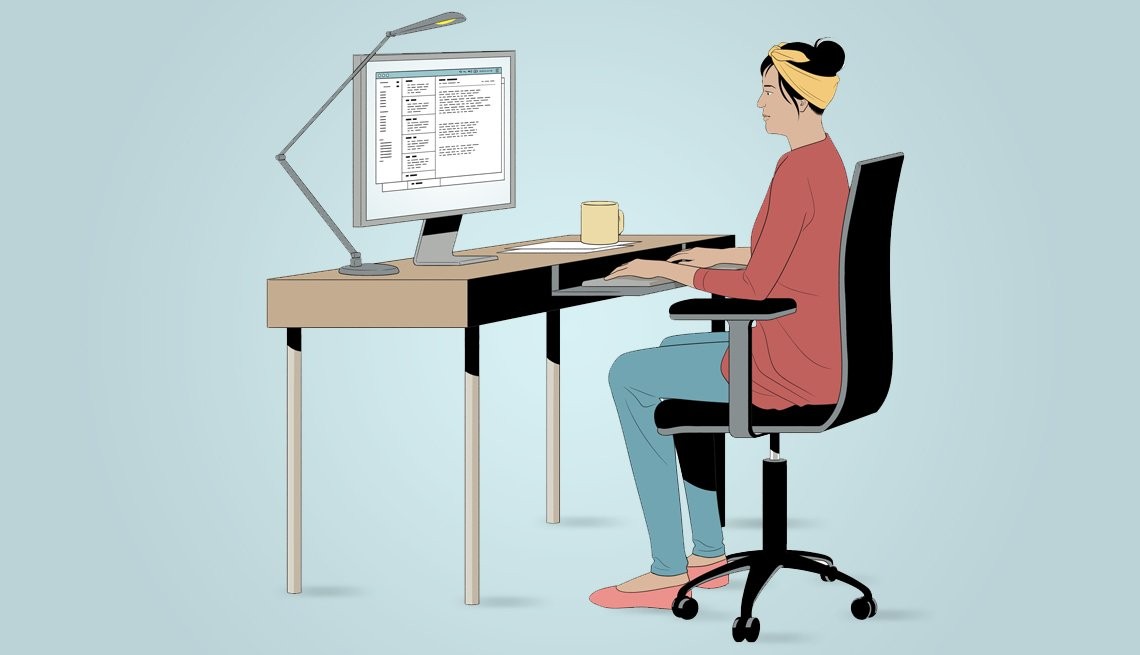
AARP: How to improve your pandemic posture
UC expert offers tips on monitor positioning and workspace lighting

Working in the pandemic over the last two years has meant developing a space to work at home for most of us. An article published by AARP takes a look at some potential problems that can crop up working at home in the way of pandemic posture habits. Susan Kotowski, PhD, of the Department of Rehabilitation, Exercise and Nutrition Sciences in the UC College of Allied Health Sciences, is cited as an expert for the story.

Susan Kotowski, PhD, of the Department of Rehabilitation, Exercise and Nutrition Sciences in the UC College of Allied Health Sciences/Photo/Colleen Kelley/UC Creative + Brand
The top edge of your screen should be directly in line with your eye level, Kotowski told AARP. If it’s too low, you’ll hunch over, creating neck pain. If you use dual monitors, put the most-used monitor directly in front of you.
Aging eyes need more light than younger ones. Kotowski recommends task lighting — an individual light, such as a reading or desk lamp, that you can aim at a specific spot.
The article also mentions the importance of setting the correct desk height. With your chair at your work surface, you should be able to comfortably maintain the recommended 90-degree angles. If your desk is too high, add an ergonomic step stool under your desk to rest your feet on. If it’s too low, use furniture risers to raise it.
Lead image/Anuj Shrestha
Next Lives Here
The University of Cincinnati is classified as a Research 1 institution by the Carnegie Commission and is ranked in the National Science Foundation's Top-35 public research universities. UC's medical, graduate and undergraduate students and faculty investigate problems and innovate solutions with real-world impact. Next Lives Here.
Related Stories
‘Designer drug’ shows early neuroprotective signal in acute ischemic stroke
October 28, 2025

Medscape highlighted new trial results led by the University of Cincinnati's Eva Mistry that found an experimental drug shows promise in protecting injured brain cells for patients with acute ischemic stroke.
Is menstrual fluid ‘the most overlooked opportunity’ in women’s health?
October 27, 2025

The Guardian recently reported that period blood has long been thought of as ‘stinky and useless’, but startups are exploring using the fluid to test for a wide range of health conditions — including endometriosis.
What is squalane, and how does it work to moisturize skin?
October 27, 2025

The University of Cincinnati's Kelly Dobos was featured in a Women's Health article discussing squalane, an ingredient being increasingly used in moisturizing skincare products.