Smithsonian highlights UC Classics' early work at Troy
UC Classics professor Carl Blegen led excavations at site mentioned by Homer

Smithsonian magazine highlighted the University of Cincinnati's earliest archaeological work at Troy, the ancient city made famous by Homer.

Carl Blegen at Troy. Photo/UC Classics
UC Classics professor Carl Blegen led excavations at Troy from 1932-38 in what is now Turkey. According to Smithsonian, Blegen's work revealed evidence of a siege of Troy mentioned in Homer's famed Iliad:
"In the 1930s, the American archaeologist Carl Blegen found compelling evidence of a protracted siege consistent with the late Bronze Age: Large buildings were subdivided to take in numerous families, presumably to accommodate people seeking protection during a period of conflict outside the city walls; in addition, the city's storage capacity was increased by burying giant vessels for food or other supplies in the ground. Blegen also found the remains of several unburied bodies, along with blackened debris and other signs of fire, as well as Greek-style arrowheads and what appeared to be several stockpiles of stones, apparently to repel invaders."
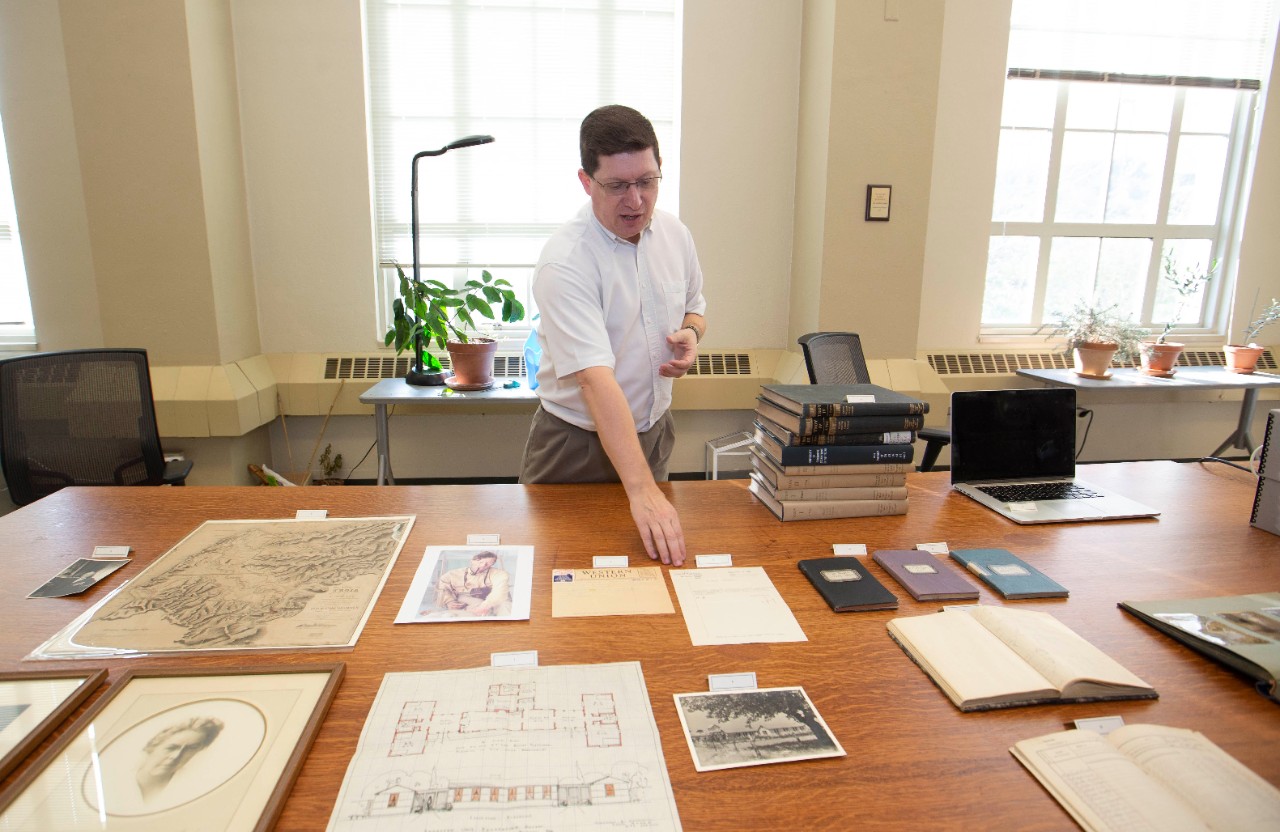
Today, UC's Classics Department maintains an extensive digital archive of the Troy excavation, featuring Blegen's journals, government permits and the expedition's accounting ledgers along with thousands of images captured by Blegen and collaborator and UC archaeologist Marion Rawson.
UC has continued its groundbreaking work at Troy over the years. Former UC Classics professor Brian Rose partnered with a German university for archaeological study of Troy in 1989. Today, he teaches at the University of Pennsylvania.
Researchers such as UC Classics professor Kathleen Lynch and senior research associate John Wallrodt continue to study artifacts and pottery from Troy and other historical sites around the world.
Researchers such as Rustem Aslan, a professor at Çanakkale Onsekiz Mart University who is leading archaeology at Troy, continue to study the ancient city hoping it will reveal more secrets.
"I am 100 percent sure that something marvelous will be found," Aslan told Smithsonian.
Featured image at top: UC Classics archivist Jeff Kramer talks about some of the journals, photos and documents associated with UC's excavations of Troy. Photo/Joseph Fuqua II/UC Creative + Brand
Related Stories
‘Designer drug’ shows early neuroprotective signal in acute ischemic stroke
October 28, 2025

Medscape highlighted new trial results led by the University of Cincinnati's Eva Mistry that found an experimental drug shows promise in protecting injured brain cells for patients with acute ischemic stroke.
Is menstrual fluid ‘the most overlooked opportunity’ in women’s health?
October 27, 2025

The Guardian recently reported that period blood has long been thought of as ‘stinky and useless’, but startups are exploring using the fluid to test for a wide range of health conditions — including endometriosis.
What is squalane, and how does it work to moisturize skin?
October 27, 2025

The University of Cincinnati's Kelly Dobos was featured in a Women's Health article discussing squalane, an ingredient being increasingly used in moisturizing skincare products.