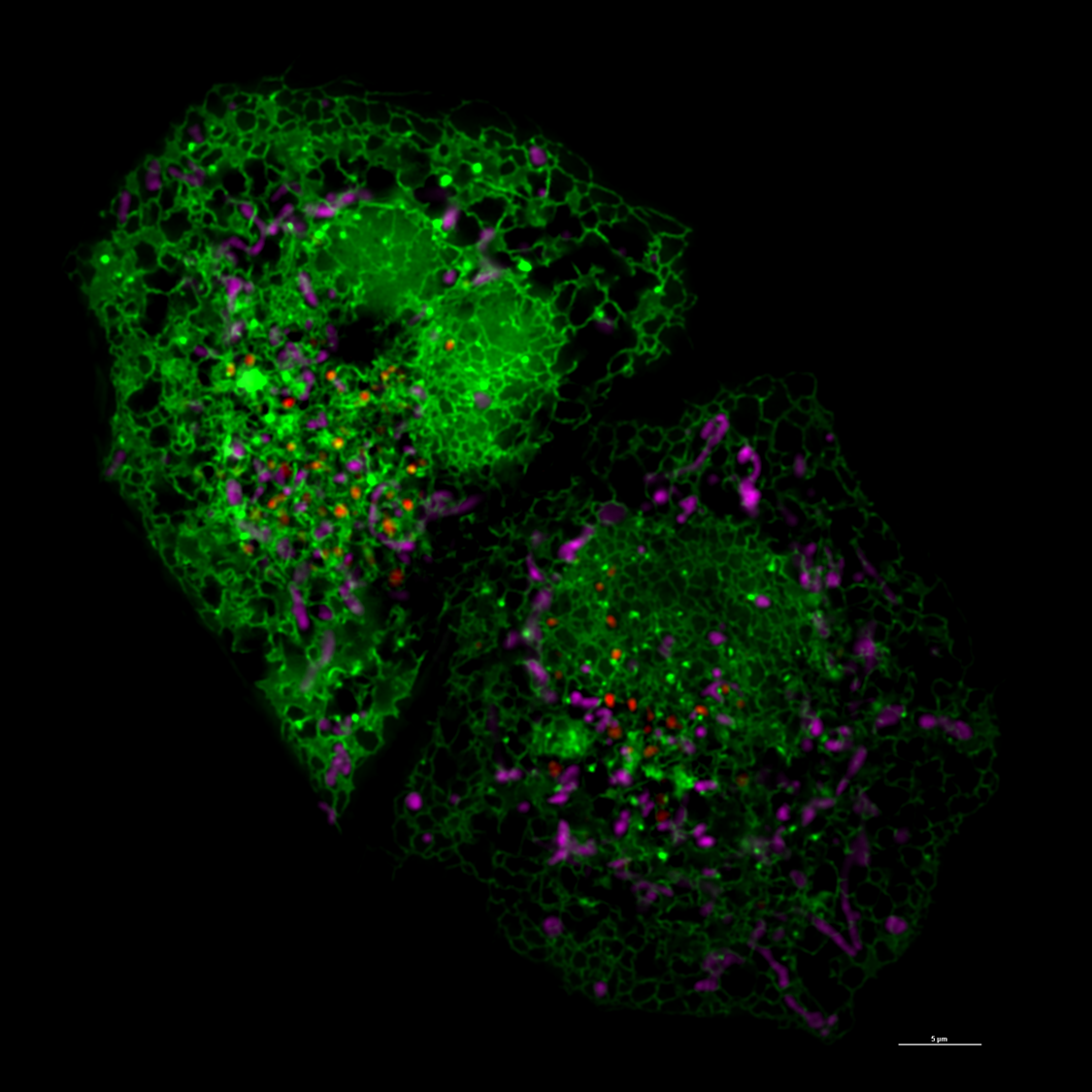
55KRC: UC research advances view at the subcellular level

University of Cincinnati cancer biologists have developed a new piece of technology and a new imaging technique that will help researchers glean more detailed data points and see cells in more precise detail when studying the development of cancer and neurodegenerative diseases.
Jiajie Diao, PhD, associate professor in the Department of Cancer Biology in UC’s College of Medicine, told 55KRC's Simply Medicine that a new probe his team developed helps give more details about the cellular environment, such as pH level.
The probe, combined with a new imaging technique that helps measure the shape, distance and location of tiny parts within cells called organelles. Seeing how the organelles interact can provide more information to how these interactions lead to the development of diseases, he said.
"We are actually working with the most advanced image technique to develop new analysis methods, trying to understand and trying to review subtle changes, changes you couldn’t even notice by your eyes," Diao said. "We’re trying to catch diseases at a very early, early stage."
Listen to the Simply Medicine segment. (Note: Segment begins around 23:40 mark.)
Featured photo at top of super resolution image of cell courtesy of Jiajie Diao.
Related Stories
‘Designer drug’ shows early neuroprotective signal in acute ischemic stroke
October 28, 2025

Medscape highlighted new trial results led by the University of Cincinnati's Eva Mistry that found an experimental drug shows promise in protecting injured brain cells for patients with acute ischemic stroke.
UC Board votes to fund design for YMCA renovation
October 28, 2025
At its October 28, 2025 meeting, the University of Cincinnati Board of Trustees approved $5 million in funding to complete all design and pre-construction services required to renovate the interior of a former YMCA building located at 270 Calhoun Street.
Is menstrual fluid ‘the most overlooked opportunity’ in women’s health?
October 27, 2025

The Guardian recently reported that period blood has long been thought of as ‘stinky and useless’, but startups are exploring using the fluid to test for a wide range of health conditions — including endometriosis.