Parade: What are Joro spiders?
UC biologist talks about enormous invasive spider that has been seen in southern states

Parade magazine talked to University of Cincinnati biologist Nathan Morehouse about an enormous invasive spider that is spreading across the American Southeast.
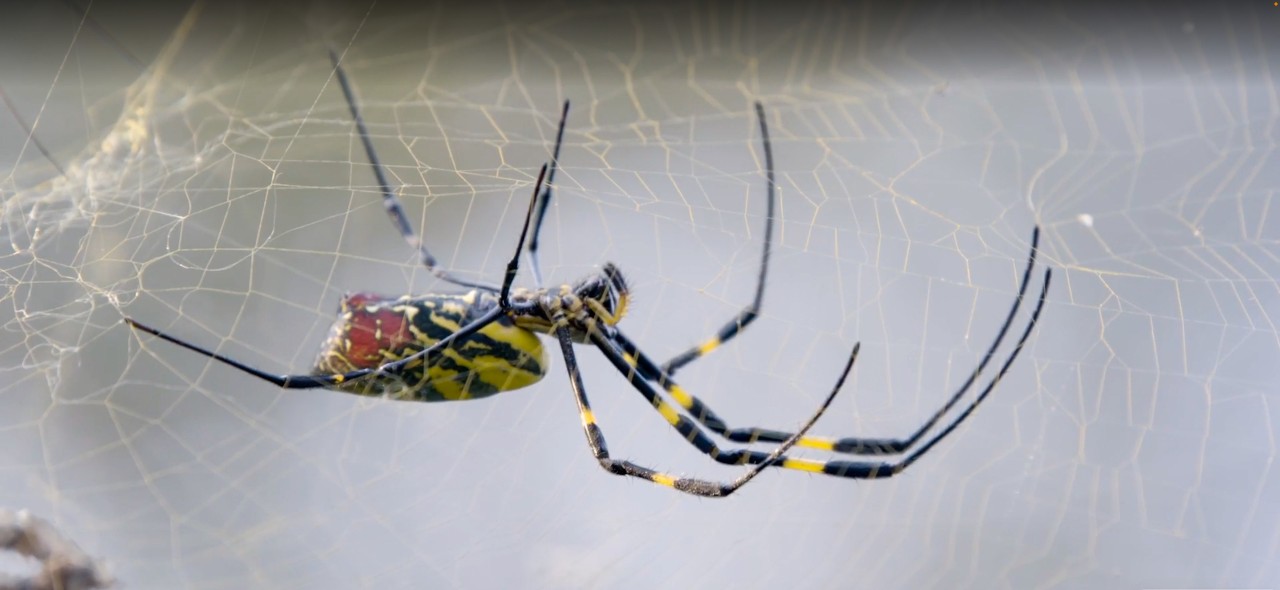
The Joro spider grows nearly as big as your palm. Normally found in Japan, the spiders were introduced to the United States in 2013. They expand their range as baby spiders when they release little parachutes that help them sail on the wind to new territories.

Invasive Joro spiders are spreading across the American Southeast. Photo/Carly Mirabile/Courtesy the University of Georgia College of Agricultural and Environmental Sciences
Morehouse, an associate professor of biology in UC's College of Arts and Sciences, told Parade magazine that the spiders got their name from Jorōgumo, a mythical creature from Japanese folklore.
"Jorōgumo are shapeshifting spiders that can turn into beautiful women to ensnare and eat young men," Morehouse told Parade. "The name in modern kanji translates literally to 'entangling bride.'"
Morehouse has studied the vision of spiders around the world and serves as director of UC's Institute for Research in Sensing.
Scientists say Joro spiders are more tolerant of cold temperatures than other spiders, which could help them spread farther north than native orb-weaving spiders found in the South.
The good news is Joro spiders are docile and have little interest in making a home in people's homes, he said.
And their enormous webs can trap plenty of biting flies or mosquitoes if people are willing to tolerate their colorful garden guests, Morehouse said.
"My best advice is to adopt a stance of curiosity toward these newcomers, which live fascinating and surprisingly beautiful lives, all while eating lots of insects every day and night," Morehouse said.
Featured image at top: Invasive Joro spiders have been seen in some southeastern states. Photo/Anthony Barkdoll/Courtesy the University of Georgia College of Agricultural and Environmental Sciences

UC associate professor Nathan Morehouse talked to Parade magazine about enormous Joro spiders that have been found in the Southeast. Photo/Jay Yocis/UC Creative + Brand
More UC biology news

UC chemistry student Melissa Kelley works in a biology lab. Photo/Andrew Higley/UC Creative + Brand
Related Stories
‘Designer drug’ shows early neuroprotective signal in acute ischemic stroke
October 28, 2025

Medscape highlighted new trial results led by the University of Cincinnati's Eva Mistry that found an experimental drug shows promise in protecting injured brain cells for patients with acute ischemic stroke.
Is menstrual fluid ‘the most overlooked opportunity’ in women’s health?
October 27, 2025

The Guardian recently reported that period blood has long been thought of as ‘stinky and useless’, but startups are exploring using the fluid to test for a wide range of health conditions — including endometriosis.
What is squalane, and how does it work to moisturize skin?
October 27, 2025

The University of Cincinnati's Kelly Dobos was featured in a Women's Health article discussing squalane, an ingredient being increasingly used in moisturizing skincare products.