Yahoo! News: Electricity cap used to treat brain tumors

The University of Cincinnati is one of the trial sites for the TRIDENT clinical trial, testing the effectiveness of electrical field treatment for glioblastoma patients earlier in treatment regimens.
Kyle Wang, MD, a University of Cincinnati Cancer Center member and assistant professor of clinical radiation oncology in the UC College of Medicine, explained that human cells naturally use electricity to line up certain cellular structures, including materials called mitotic spindles, that are used for cell division and growth. To prevent tumor cells from growing, an alternating electric field can be focused at the tumor to disrupt this process.
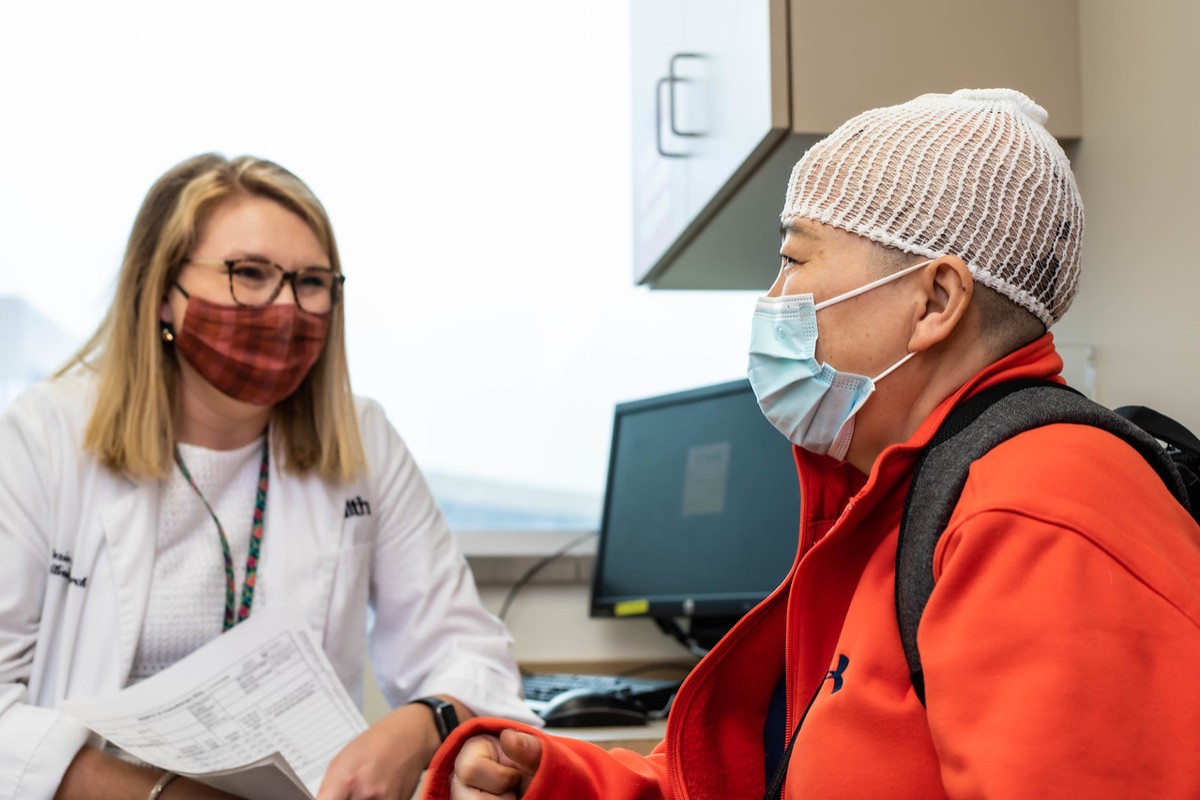
The treatment is delivered through a group of electrical arrays, a configuration of electrodes that looks like a mesh cap worn on the head, called an Optune device.
A number of local TV stations across the country, as well as Yahoo! News, have featured the research in recent segments.
Watch the Yahoo! News segment, originally aired on NewsChannel 5 Nashville.
Featured photo at top of patient Siyun Huang, right, wearing an Optune device while talking with University of Cincinnati clinical research professional Alexis Brenner, left. Photo/Leigh Vukov/UC Health.
Related Stories
‘Designer drug’ shows early neuroprotective signal in acute ischemic stroke
October 28, 2025

Medscape highlighted new trial results led by the University of Cincinnati's Eva Mistry that found an experimental drug shows promise in protecting injured brain cells for patients with acute ischemic stroke.
UC Board votes to fund design for YMCA renovation
October 28, 2025
At its October 28, 2025 meeting, the University of Cincinnati Board of Trustees approved $5 million in funding to complete all design and pre-construction services required to renovate the interior of a former YMCA building located at 270 Calhoun Street.
Is menstrual fluid ‘the most overlooked opportunity’ in women’s health?
October 27, 2025

The Guardian recently reported that period blood has long been thought of as ‘stinky and useless’, but startups are exploring using the fluid to test for a wide range of health conditions — including endometriosis.