Earth.com: Sleep-deprived mosquitoes are less interested in food
UC biologists found that tired mosquitoes would rather catch up on sleep than bite you

Earth.com highlighted a study by the University of Cincinnati that found that tired mosquitoes are more interested in catching up on sleep than looking for food.
By understanding the mosquitoes' circadian rhythms, researchers hope to find effective, nontoxic ways to prevent mosquito-borne illness.

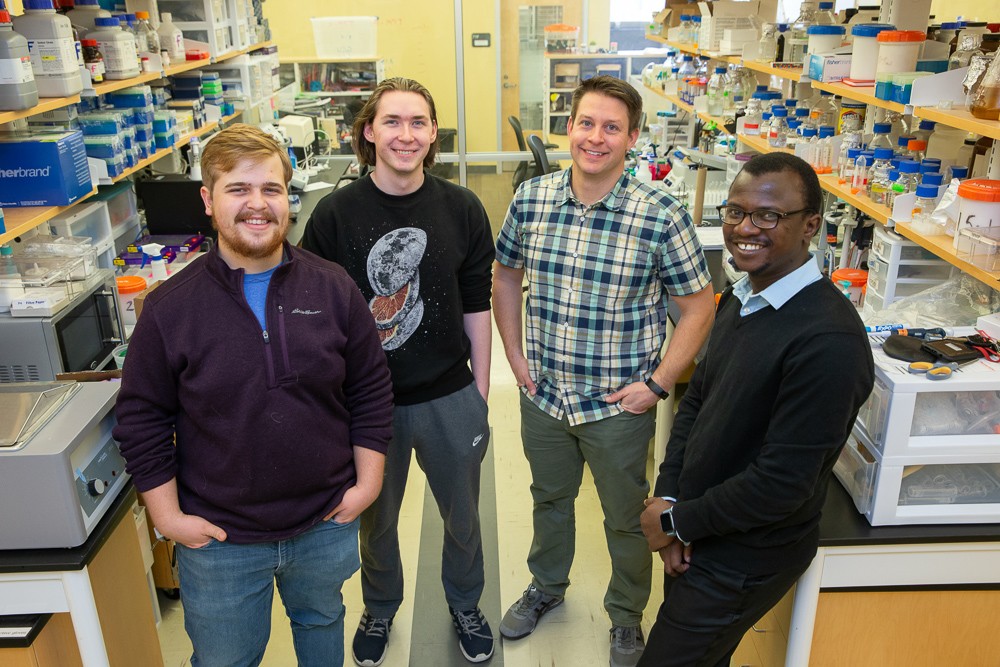
UC doctoral student Oluwaseun Ajayi, lead author of the study, said even for insects, sleep is a vital biological function. Photo/Andrew Higley/UC Marketing + Brand
“It was a bit surprising. Sleep deprived or not, a blood meal should appeal to them,” UC doctoral student and study lead author Oluwaseun Ajayi said.
The study was published in the Journal of Experimental Biology.
The researchers from UC’s College of Arts and Sciences and Virginia Tech’s Department of Biochemistry, found it challenging to study sleep patterns in mosquitoes. They spent more than a year developing protocols to study the phenomenon effectively – mosquitoes are easily disturbed by the presence of an observer, whom they detect as a potential host. This means that any experiments on mosquito sleep are likely to be confounded by the presence of the observer — a phenomenon called the observer effect — according to UC biologist Joshua Benoit.
“It’s really hard to quantify sleep in mosquitoes when, as soon as you walk in the room, you’re considered their Thanksgiving dinner,” Benoit said.
Featured image at top: UC assistant professor Joshua Benoit and his students examined the role sleep plays in three species of mosquitoes. Pictured from left are Lucas Gleitz, Evan Smith, Benoit and UC student Oluwaseun Ajayi. Photo/Andrew Higley/UC Marketing + Brand
Related Stories
‘Designer drug’ shows early neuroprotective signal in acute ischemic stroke
October 28, 2025

Medscape highlighted new trial results led by the University of Cincinnati's Eva Mistry that found an experimental drug shows promise in protecting injured brain cells for patients with acute ischemic stroke.
Is menstrual fluid ‘the most overlooked opportunity’ in women’s health?
October 27, 2025

The Guardian recently reported that period blood has long been thought of as ‘stinky and useless’, but startups are exploring using the fluid to test for a wide range of health conditions — including endometriosis.
What is squalane, and how does it work to moisturize skin?
October 27, 2025

The University of Cincinnati's Kelly Dobos was featured in a Women's Health article discussing squalane, an ingredient being increasingly used in moisturizing skincare products.