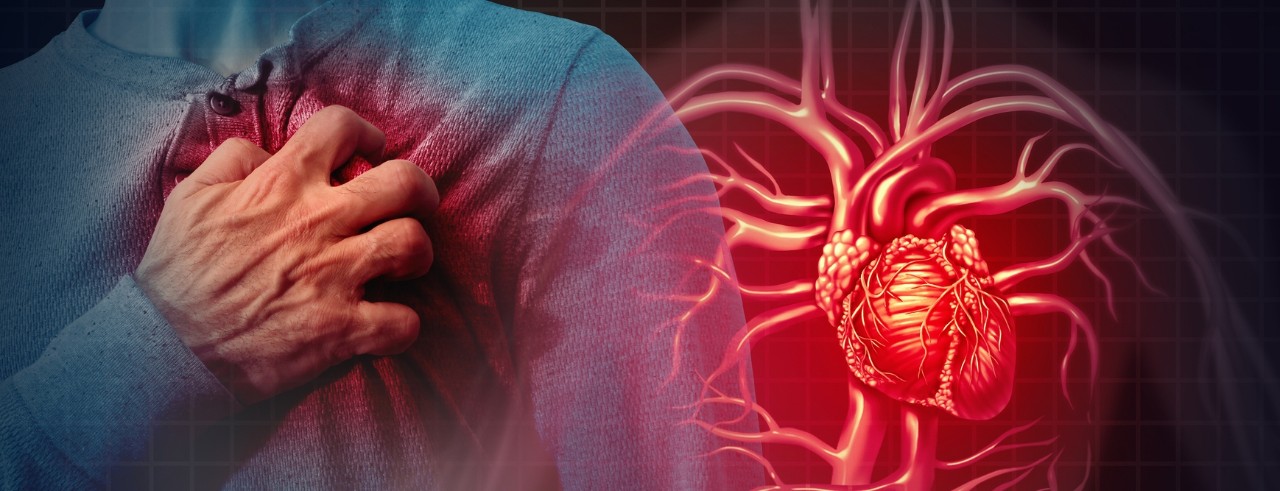
Everyday Health: Does chest pain always mean a heart attack?
UC expert says immediate attention is critical

The American Heart Association says that chest pain accounts for more than 6.5 million emergency room visits each year in the United States, plus nearly 4 million outpatient visits. While not all episodes of chest discomfort turn out to be life-threatening, chest pain is the most common symptom of a heart attack in adults of all ages, so it needs to be taken seriously. In a story posted by Everyday Health, Richard Becker, MD, professor of medicine in the UC College of Medicine is one of the experts quoted.

Richard Becker, MD, professor of medicine in the UC Division of Cardiovascular Health and Disease at the UC College of Medicine/Photo/Colleen Kelley/UC Marketing + Brand
Becker described to Everyday Health the variety of symptoms that may indicate a possible heart attack.
“New onset or worsening chest pain located in the center of the chest, particularly when radiating to the neck, jaw, shoulder, or arm, and accompanied by sudden or rapidly progressive weakness, shortness of breath, sweating, or lightheadedness, nausea, or vomiting can signal a heart emergency and requires evaluation by a medical provider,” says Becker.
If a person experiences serious symptoms, time is of the essence, Everyday Health reported. Cedars-Sinai Medical Center in Los Angeles stresses that about half the deaths due to a heart attack occur in the first three to four hours after symptoms begin. More than 90% of heart attack victims can survive if treated quickly, Harvard Medical School reports.
“Delays in care not only place people with a heart attack at risk of death but also lessen the overall benefit of well-established treatments,” says Becker. “The key message is: Having heart attack symptoms? Don’t wait. Don’t hesitate.”
Next Lives Here
The University of Cincinnati is classified as a Research 1 institution by the Carnegie Commission and is ranked in the National Science Foundation's Top-35 public research universities. UC's graduate students and faculty investigate problems and innovate solutions with real-world impact. Next Lives Here.
Related Stories
‘Designer drug’ shows early neuroprotective signal in acute ischemic stroke
October 28, 2025

Medscape highlighted new trial results led by the University of Cincinnati's Eva Mistry that found an experimental drug shows promise in protecting injured brain cells for patients with acute ischemic stroke.
Is menstrual fluid ‘the most overlooked opportunity’ in women’s health?
October 27, 2025

The Guardian recently reported that period blood has long been thought of as ‘stinky and useless’, but startups are exploring using the fluid to test for a wide range of health conditions — including endometriosis.
What is squalane, and how does it work to moisturize skin?
October 27, 2025

The University of Cincinnati's Kelly Dobos was featured in a Women's Health article discussing squalane, an ingredient being increasingly used in moisturizing skincare products.