Forbes: When did mammoths go extinct?
Environmental DNA can be misleading, UC paleontologist says

Forbes talked to a University of Cincinnati paleontologist about why environmental DNA is not the best barometer for dating extinctions.
UC College of Arts and Sciences assistant professor Joshua Miller was lead author of a paper published in Nature titled “When did mammoths go extinct?” that refuted a previous study suggesting mammoths went extinct much more recently than believed.
“We can radiocarbon date all kinds of things: bones, teeth, charcoal, leaves. That’s very powerful. But currently, we can’t independently date DNA found in sediments,” Miller told Forbes.
Miller said environmental DNA can persist for thousands of years in arctic climates, making it unreliable for dating extinctions.
Miller said mammoths probably went extinct between 10,000 and 13,000 years ago. Some island populations survived longer.
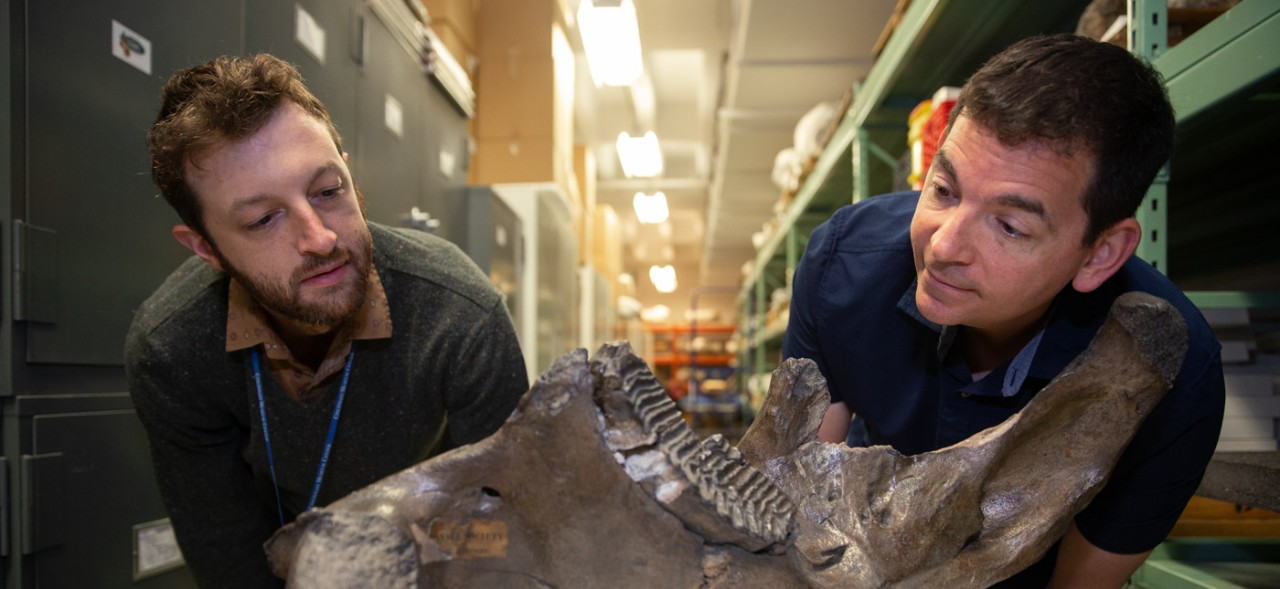
Featured image at top: Cameron Schwalbach, paleontology collections manager for the Cincinnati Museum Center’s Geier Collections and Research Center, and UC assistant professor Joshua Miller examine a mammoth skull. Photo/Andrew Higley/UC Marketing + Brand

UC assistant professor Joshua Miller poses with a bronze mammoth outside the Cincinnati Museum Center's Geier Collections and Research Center. Photo/Andrew Higley/UC Marketing + Brand
UC Geosciences in the News

UC associate professor Joshua Miller examines a mammoth tusk at the Cincinnati Museum Center's Geier Collections and Research Center. Photo/Andrew Higley/UC Marketing + Brand
- Spectrum News: Paleontologist disputes date when mammoths went extinct
- European Times: New study refutes timeline of mammoth extinction
- Science Times: When did mammoth extinction take place?
Related Stories
‘Designer drug’ shows early neuroprotective signal in acute ischemic stroke
October 28, 2025

Medscape highlighted new trial results led by the University of Cincinnati's Eva Mistry that found an experimental drug shows promise in protecting injured brain cells for patients with acute ischemic stroke.
Is menstrual fluid ‘the most overlooked opportunity’ in women’s health?
October 27, 2025

The Guardian recently reported that period blood has long been thought of as ‘stinky and useless’, but startups are exploring using the fluid to test for a wide range of health conditions — including endometriosis.
What is squalane, and how does it work to moisturize skin?
October 27, 2025

The University of Cincinnati's Kelly Dobos was featured in a Women's Health article discussing squalane, an ingredient being increasingly used in moisturizing skincare products.