Optometry Today: Jumping spiders lose vision when hungry
UC researchers show how nutrition affects vision

Optometry Today, the magazine of the Association of Optometrists, shared a study by University of Cincinnati biologists who studied the role nutrition plays in the vision of bold jumping spiders.
UC College of Arts and Sciences Professor Elke Buschbeck and her co-authors studied photoreceptors in the eyes of bold jumping spiders, tiny eight-legged predators found across North America. The little hunters rely on their keen vision to stalk prey.
But researchers found that underfed spiders begin to lose photoreceptors that give them such good eyesight. Their findings could improve our understanding of the role that nutrition plays in common age-related vision problems such as macular degeneration.
The study was published in the journal Vision Research.
“Photoreceptors are energetically costly. It’s hard to keep up with their energy needs. If you deprive them of nutrition, the system fails,” Buschbeck said.
Read the Optometry Today story.
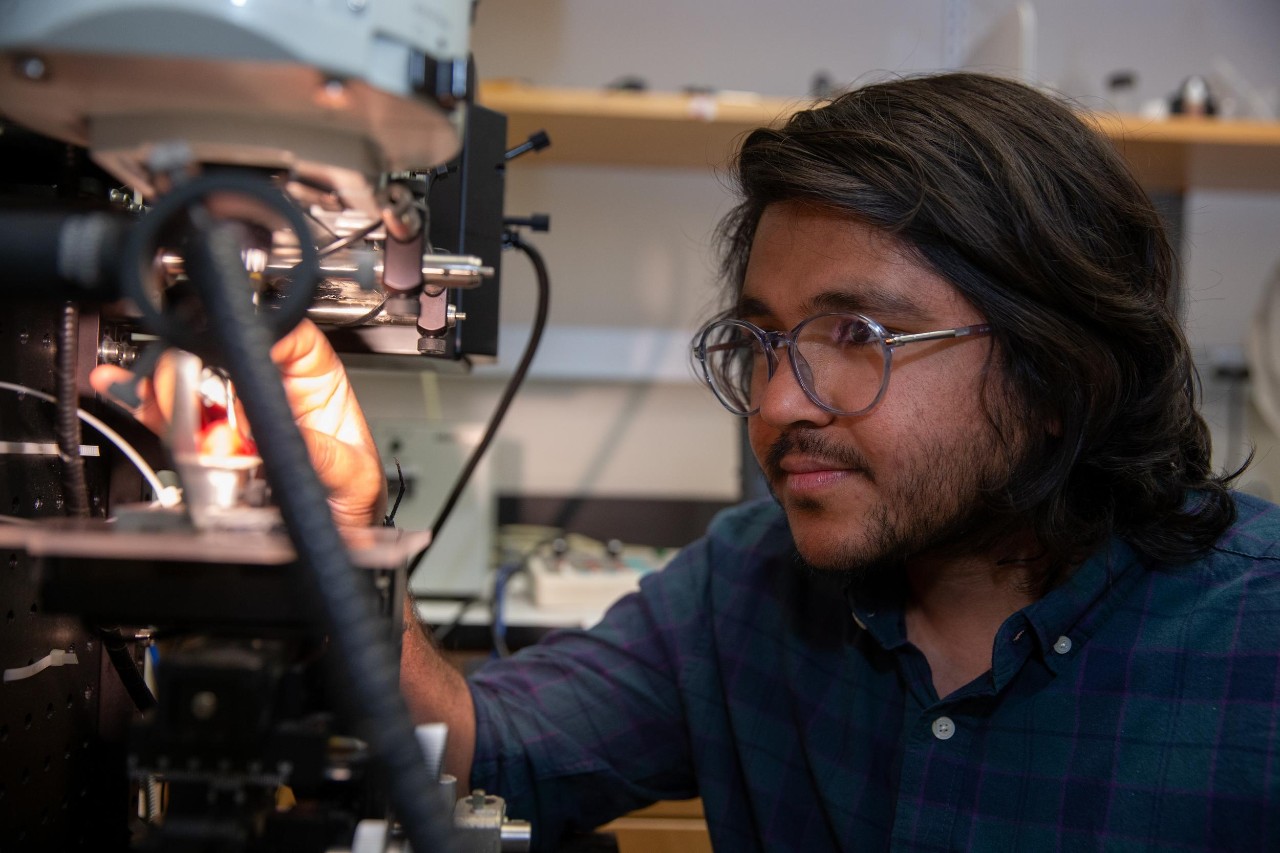
Featured image at top: UC doctoral student Shubham Rathore uses a custom ophthalmoscope in Professor Elke Buschbeck's lab. Photo/Andrew Higley/UC Marketing + Brand
More UC biology in the news

UC Professor Elke Buschbeck studies the vision of insects and spiders in her lab. Photo/Andrew Higley/UC Marketing + Brand
- Science Daily: Hungry Eyes: Spiders lose vision when they're starving
- New Atlas: Hungry spiders offer insights into nutrition
- Newswise: Hungry spiders lose vision, study shows
- Nature World News: Undernourished spiders lose important light-sensitive cells for vision
Related Stories
‘Designer drug’ shows early neuroprotective signal in acute ischemic stroke
October 28, 2025

Medscape highlighted new trial results led by the University of Cincinnati's Eva Mistry that found an experimental drug shows promise in protecting injured brain cells for patients with acute ischemic stroke.
Is menstrual fluid ‘the most overlooked opportunity’ in women’s health?
October 27, 2025

The Guardian recently reported that period blood has long been thought of as ‘stinky and useless’, but startups are exploring using the fluid to test for a wide range of health conditions — including endometriosis.
What is squalane, and how does it work to moisturize skin?
October 27, 2025

The University of Cincinnati's Kelly Dobos was featured in a Women's Health article discussing squalane, an ingredient being increasingly used in moisturizing skincare products.