NYT: Collective force increases odds of football concussions
UC biomedical engineer talks about latest study on chronic traumatic encephalopathy

The New York Times turned to a University of Cincinnati biomedical engineer to explain the significance of a new study linking the collective force of hits in football to concussions.
In his lab, UC College of Engineering and Applied Science Professor Eric Nauman studies ways to prevent concussions in contact sports, particularly football.
The Times reported on a study by Harvard Medical School published this month in Nature Communications that found that repeated small hits, not just a single devastating one, can lead to chronic traumatic encephalopathy. The study also found that the intensity of hits is a better predictor of concussion than counting the number of hits.
“Yes, all these hits matter. They all add up,” Nauman told the Times.

UC student Christopher Boles uses a modal hammer to strike a helmet. Photo/Andrew Higley/UC Marketing + Brand
Nauman said the findings also demonstrate the need for better safety equipment and policies such as no-contact practices that could reduce the risk of injury.
He co-authored a study this year in the Journal of Biomedical Engineering with his former students at Purdue University that tested how well helmets made by four leading manufacturers minimized the impact of hits to the head.
“None of the helmets was uniformly good or uniformly bad, except on the back of the helmet where they were all uniformly bad,” Nauman said.
“The helmets are generally designed to withstand the maximum possible impact. But that’s a 99th percentile type of hit. If you can design a helmet to protect players from the smaller, more typical hits, that would be ideal.”
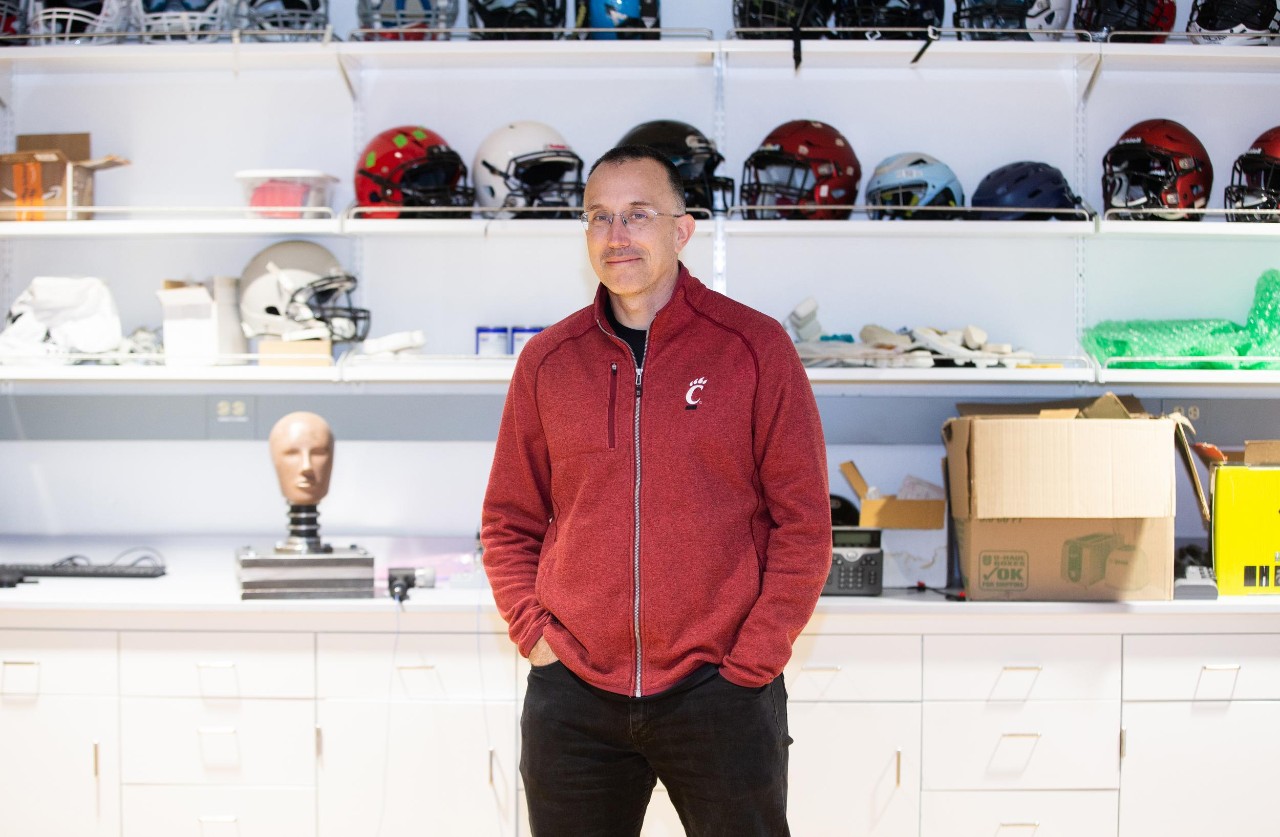
Featured image at top: UC College of Engineering and Applied Science Professor Eric Nauman studies ways to prevent concussions from contact sports in his biomedical engineering lab. Photo/Andrew Higley/UC Marketing + Brand
Related Stories
‘Designer drug’ shows early neuroprotective signal in acute ischemic stroke
October 28, 2025

Medscape highlighted new trial results led by the University of Cincinnati's Eva Mistry that found an experimental drug shows promise in protecting injured brain cells for patients with acute ischemic stroke.
Meet the young talent reshaping Cincinnati’s startup scene
October 28, 2025
Five University of Cincinnati students were honored for their impactful entrepreneurship on the Cincy Inno Under 25 list. We’ll explain what makes each student – and their startup – stand out.
Is menstrual fluid ‘the most overlooked opportunity’ in women’s health?
October 27, 2025

The Guardian recently reported that period blood has long been thought of as ‘stinky and useless’, but startups are exploring using the fluid to test for a wide range of health conditions — including endometriosis.