Inside the wild ways many creatures make milk
UC biologist Joshua Benoit tells Smithsonian that some cockroaches make an equivalent

Smithsonian magazine turned to a University of Cincinnati biologist to explain the weird and surprising ways that animals make milk for their young.
UC College of Arts and Sciences Professor Joshua Benoit told Smithsonian that it's not just goats, cows and other mammals that produce fat-rich milk for their babies.

UC Professor Joshua Benoit spoke to Smithsonian about animals other than mammals that produce milk. Photo/Joseph Fuqua/UC
Scientists once thought that milk production was a characteristic exclusive to mammals. The name is derived from the Latin word for “breast.”
But Benoit said scientists are finding that this isn't necessarily the case.
Everything from jumping spiders to penguins to some amphibians produce a milky, protein-rich secretion to feed their young. And while it doesn't share the same evolutionary origin, it has a similar function, Benoit said.
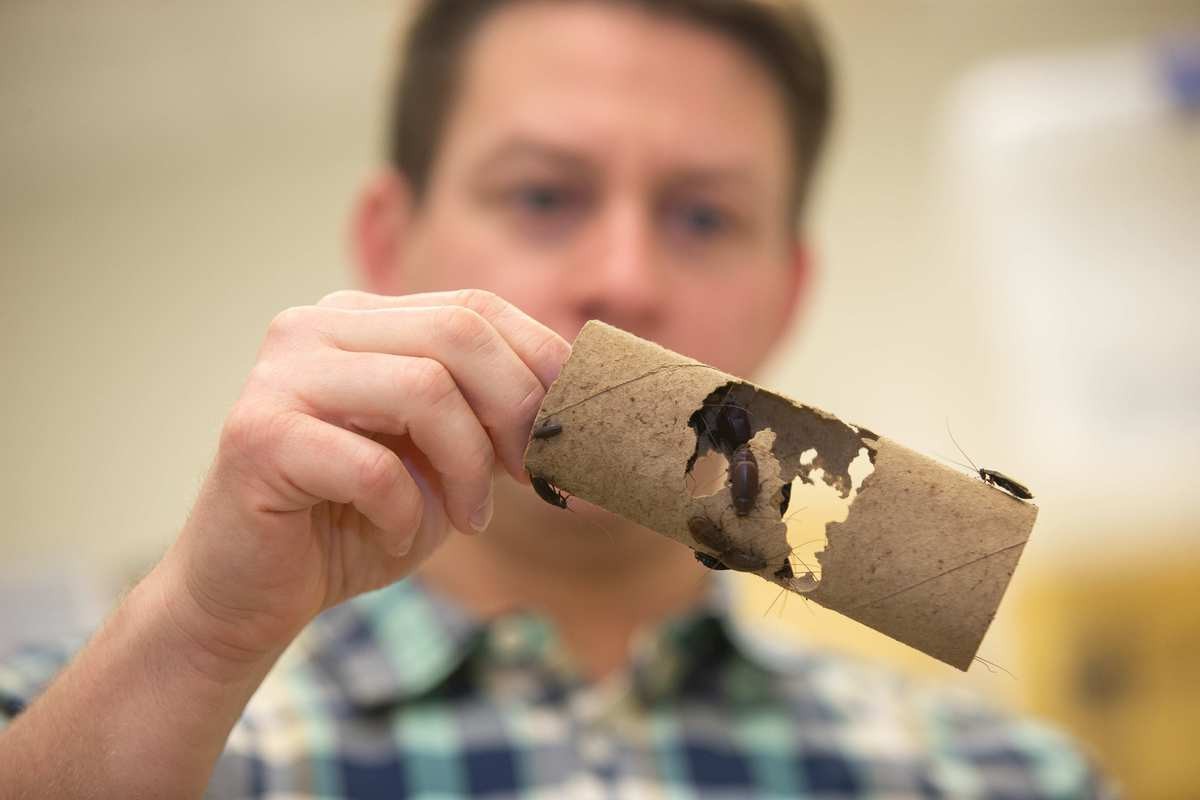
In his biology lab, he has studied insects such as beetle-mimic cockroaches that feed milk to their newborn babies.
“We usually call it a milk-like substance,” he told Smithsonian. “For all intents, it does the same thing, and even some of the proteins present are similar.”
Benoit said tsetse flies along with some ants and spiders, too, secrete a nourishing milk-like substance for their babies. And each species arrived at this survival strategy for raising babies independently, which demonstrates its benefits across the animal kingdom, he said.
Featured image at top: UC Professor Joshua Benoit holds up beetle-mimic cockroaches in his biology lab. Photo/Andrew Higley/UC Marketing + Brand
Related Stories
‘Designer drug’ shows early neuroprotective signal in acute ischemic stroke
October 28, 2025

Medscape highlighted new trial results led by the University of Cincinnati's Eva Mistry that found an experimental drug shows promise in protecting injured brain cells for patients with acute ischemic stroke.
Is menstrual fluid ‘the most overlooked opportunity’ in women’s health?
October 27, 2025

The Guardian recently reported that period blood has long been thought of as ‘stinky and useless’, but startups are exploring using the fluid to test for a wide range of health conditions — including endometriosis.
What is squalane, and how does it work to moisturize skin?
October 27, 2025

The University of Cincinnati's Kelly Dobos was featured in a Women's Health article discussing squalane, an ingredient being increasingly used in moisturizing skincare products.