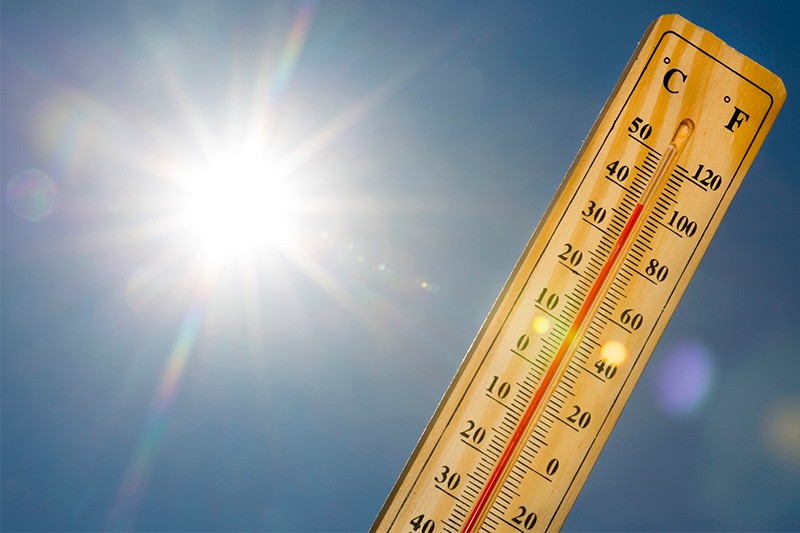
Heat waves in the U.S. kill more people in their homes than anywhere else
UC nursing professor speaks with The Cincinnati Enquirer about heat-related deaths

Summer is officially here.
The Summer Solstice began on Thursday, June 20, 2024, but for many of us the hotter than normal temperatures would suggest The Old Farmer’s Almanac is a bit late with its announcement.
Millions of Americans are battling a punishing heat dome that has settled over the northeastern United States creating the potential for record-breaking high temperatures this week that stretch from the Queen City in Cincinnati to Portland, Maine.
That puts some populations - households without air conditioning - at grave risk.
The Cincinnati Enquirer conducted an analysis of National Weather Service data and found that almost half the 3,142 people who died from heat-related ailments in the past 20 years died at home. Many people who die in heat waves lack air conditioning or have health problems that can be fatal in excessive heat, the Enquirer found.

Associate Professor Tasha Turner-Bicknell
Tasha Turner-Bicknell, an associate professor in the UC College of Nursing, spoke with the Enquirer about its findings. She is also director of advanced public health nursing programs at UC.
“When the weather gets this extreme, there's a definite risk,” Turner-Bicknell, told the Enquirer.
She says lack of air conditioning in the home is a factor for so many people dying of these heat-related deaths.
“Most of us take for granted that we live and work in air-conditioned environments,” she explains. "But we have a lot of members of our community that do not have air conditioning.”
Social isolation can be especially dangerous for those with disabilities or mobility-restrictions, according to Turner-Bicknell, who rely on others to leave their homes.
“Maybe they use a walker or a cane or a wheelchair, and maybe their caregivers are not available," she says. "They might be unable to get out of their house without assistance.”
Read the full Cincinnati Enquirer story online.
Learn more about Associate Professor Tasha Turner-Bicknell online.
Related Stories
‘Designer drug’ shows early neuroprotective signal in acute ischemic stroke
October 28, 2025

Medscape highlighted new trial results led by the University of Cincinnati's Eva Mistry that found an experimental drug shows promise in protecting injured brain cells for patients with acute ischemic stroke.
Is menstrual fluid ‘the most overlooked opportunity’ in women’s health?
October 27, 2025

The Guardian recently reported that period blood has long been thought of as ‘stinky and useless’, but startups are exploring using the fluid to test for a wide range of health conditions — including endometriosis.
What is squalane, and how does it work to moisturize skin?
October 27, 2025

The University of Cincinnati's Kelly Dobos was featured in a Women's Health article discussing squalane, an ingredient being increasingly used in moisturizing skincare products.