UC students unearth history at Tharros archaeological dig
UC Classics provides undergraduates with unique opportunity for hands-on research
Every summer, a group of undergraduate students from the UC Department of Classics make the journey from Cincinnati to Tharros, Italy.
However, these students won’t be sipping lemonade and lounging by the Mediterranean Sea all summer. They will be participating in experiential, hands-on learning, working as archaeologists on an important excavation.

Excavation team working in Tharros. Photos/Provided
Tharros is an historic city on the western shore of Sardinia, an island that makes up one of the 20 regions of Italy. The city played an important role in trade routes between Spain, Carthage and Massalia from the 7th century BC through the 6th century AD.
UC students in the Classics department, a part of UC’s College of Arts and Sciences, work alongside several Italian organizations to conduct archaeological research in the residential and retail areas of Tharros, a region known for its tombs and graves dating back to the Punic period.
Steven Ellis, Roman archaeologist and UC Classics professor, directs the Tharros excavation project.

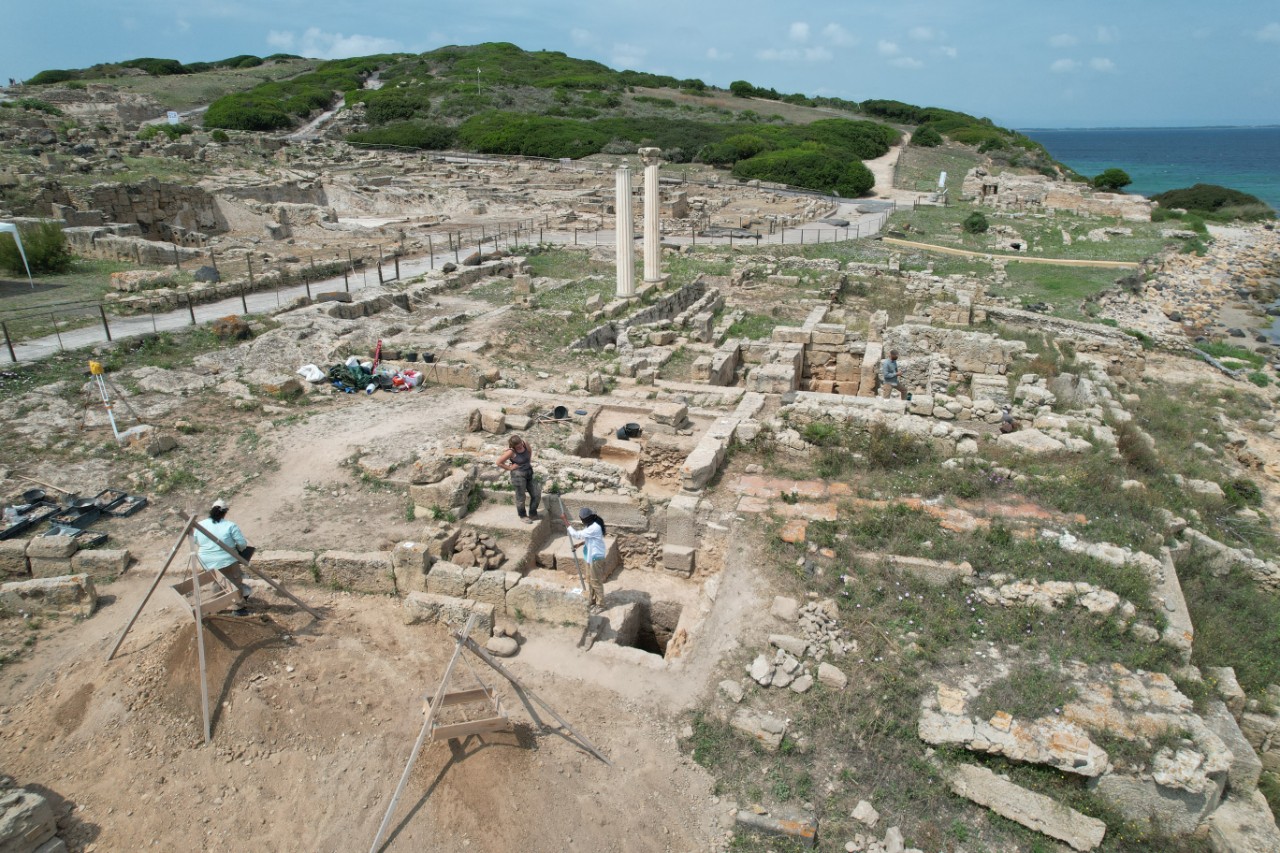
Aerial view of excavation site in Tharros. Photos/Provided
"The project is a great opportunity to learn a lot about a place that we didn't know enough about,” Ellis says. “It’s quite fascinating to watch the students because not only are they learning the specific skills of an archeological excavation, they're also learning how to work in an international research team in a very foreign place.”
Ellis is also the director of the university’s ongoing excavation in Pompeii. Undergraduate student Leslie Monhollen heard about the Pompeii excavation project when she was in high school, and it was the reason she chose to attend UC.
Monhollen, who majors in Classical Civilization with a certificate in Mediterranean archaeology, has now been part of the Tharros archaeological team twice. Each summer, students work in Tharros for five weeks, doing a variety of hands-on tasks with their team.
“When people envision archaeological work, they naturally think about digging in trenches,” Monhollen says. “Of course we excavate, but there is a whole side of archaeology that often gets overlooked: the lab.

Sorting archeological fragments from the dig. Photos/Provided
“My job was to organize, clean, date, and catalog the artifacts after they came out of the ground. This meant that most of my job was gathering data and recording important details. Systematic analysis like this is the foundation of archaeological research.”
Her trips to Tharros have inspired Monhollen to continue her path in archaeology, and she hopes to study Roman pottery all around the Mediterranean Sea.
“I use my experiences to create meaningful discussions in the classroom and apply them to my research,” Monhollen says. “It has truly been a gift to work at Tharros. Continuing archaeological research is my dream.”

Surveying the site of Tharros. Photos/Provided
Matt Wabler is another Classics student who worked on the Tharros project twice, once in 2022 and once this past summer. Wabler spent much of his recent trip in the lab processing the pottery and architectural fragments found during this year’s dig. This past summer, Wabler also got the opportunity to travel across the island to a museum that houses coins found in Tharros during the 1950s.
Both Wabler and Monhollen plan on continuing their Classics education at UC, hoping to obtain their PhDs.
“Getting to travel to amazing places and learn Roman archaeology in the field is one of the experiences I’m most grateful for at UC,” Wabler says. “There’s really nothing that compares with doing real-world research and helping to uncover how people lived in the ancient world.”
Ellis says there’s still a lot of work to be done at Tharros and anticipates this project continuing in the years to come—especially as they rebuild the program after the pandemic put a stop to traveling in 2020.
“There's a lot more to be found out about this ancient Roman city that we're working on. There are more things to learn and more opportunities for our students,” Ellis says.
Featured image at top: Excavation site in Tharros where UC students get hands on experience. Photos/Provided

By Pieper Buckley
Student Journalist , College of Arts and Sciences, Department of Marketing and Communication
artscinews@uc.edu
Related Stories
UC Foundation reveals 2025 philanthropy winners
October 27, 2025
The University of Cincinnati Foundation recognized its Outstanding Philanthropic Volunteer Award honorees at the George Rieveschl Recognition Dinner on Oct. 23, 2025.
UC team unveils Wyandot Removal Trail across Ohio
October 24, 2025

Rebecca Wingo, an associate professor of history and director of the public history program in the University of Cincinnati’s College of Arts and Sciences, is featured in a WVXU story about new historical markers honoring the Wyandot people—the last Indigenous nation forcibly removed from Ohio.
Grad student Joey Yong found leadership, networking opportunities at UC
October 23, 2025
Joey Yong is a graduate student in the UC School of Information Technology's Master of Science in Information Technology (MSIT) program. As she nears graduation this December, the central Kentucky native looks back on the invaluable instruction, networking opportunities and leadership lessons she gained during her time at UC.