UC language studies program adopts new technologies
CEDAR center offers VR experiences to enhance language knowledge

Cultural immersion is a tried-and-true method for teaching languages. Typically, U.S. students travel abroad—to Europe, Latin America, Asia and beyond, to take a deep dive into the customs, mores, daily life and conversational language that can be challenging to master from home.
For those students who can't take advantage of the study-abroad experience, there's another option to gain similar learnings.
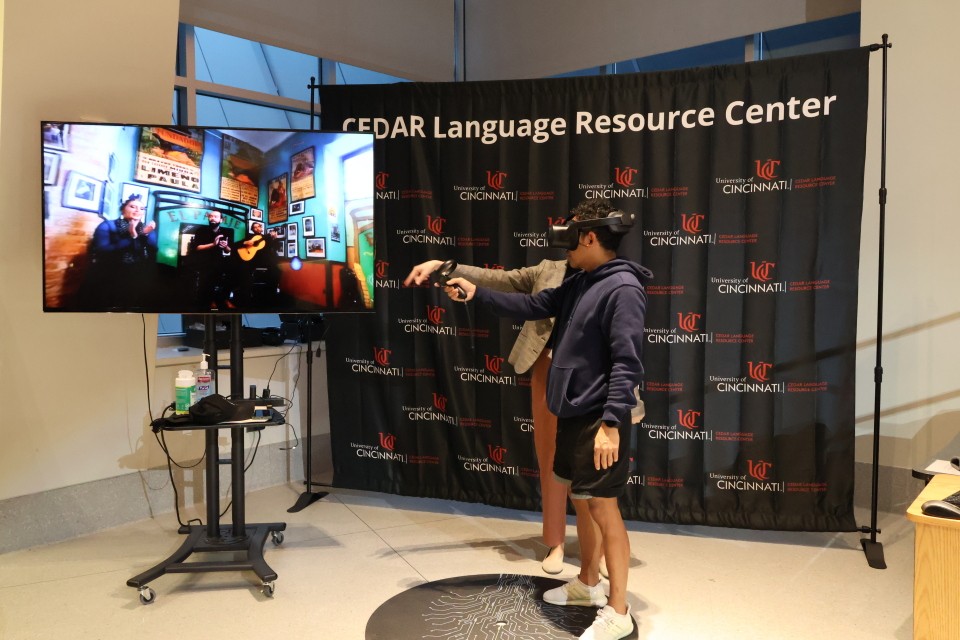
At UC, the Curricular Enhancement, Development, Access and Research Language Resource Center (CEDAR) has developed a curriculum that features virtual reality (VR) technology to give students a similar opportunity right in the classroom.

UC's CEDAR co-director Kara Moranski. Photo/Provided
"The 'A' in CEDAR stands for access," said Kara Moranski, co-director of CEDAR and assistant professor of Romance and Arabic Languages and Literatures (RALL) in UC's College of Arts and Sciences.
"The VR experiences that we are creating provide access to highly immersive, interactive cultural learning experiences," she said. "As language educators, we have seen how transformative this type of learning can be for our students, and wanted to make them more widely available, aligning closely with the A&S mission of Discovery In Action."
Said CEDAR co-director Juan Godoy-Peñas: "As we become more globally connected every day, we feel it is our duty as educators to use technology to get our students ready to be part of what the future may bring to them."
A history of innovation
UC's Department of Romance and Arabic Languages and Literatures is no stranger to curricular innovation.
In early 2021, with travel restrictions still in place due to the COVID-19 pandemic, the department developed a way for students to experience language immersion even though they were stuck stateside.

Co-director of UC's CEDAR language lab, and director of the project U.S. Latinxs Virtual Narratives in the Spanish Language Program, Juan Godoy-Peñas. Photo/Provided
Moranski and Godoy-Peñas, along with members of the RALL department, created a Spanish summer-immersion program. The idea was originally proposed by professor Carlos Gutiérrez, who had a vision for students to have an opportunity to experience Hispanic culture locally.
The course included ways for students to relax after a long day of working and studying through workshops and co-curricular activities. Also, the program featured activities such as cooking Hispanic dishes, creating artwork and documenting current events in the Hispanic community.
In addition to co-curricular activities, students were expected to have conversations only in Spanish.
Innovation today
To create its VR program, the CEDAR team followed a model inspired by Harvard University professor Nicole Mills, who had developed a similar program based in Paris.
"We wanted to transfer that model to the U.S. to focus on the plurilingual landscape we find here,' said Godoy-Peñas. "So, we decided to base our VR projects on the Hispanic American and the Arab American communities.
"That way, we aim to promote a better understanding of the globalized communities we find in this country nowadays."
The CEDAR team designed and created all aspects of the VR language experience in UC's curriculum. Content creators such as RALL professor Nuria López-Ortega have worked with original footage, such as recordings of daily life in Jerez de la Frontera, a small town in the south of Spain.
The content creators have also worked with researchers locally to record videos for their projects here in greater Cincinnati.
Testing and refining
While the curriculum is being developed, research is ongoing to understand the efficacy of the program, and ways it might be adapted going forward, as program directors and CEDAR's postdoctoral fellow Yulia Khoruzhaya study VR for classroom use.
Working with UC's Center for Simulation and Virtual Environments Research (UCSIM) and others, the team continues to study and refine the impact of these materials for language learners and share that knowledge with educators throughout the country, Moranski says.
Featured image at top: People demonstrate the VR capabilities available through UC's CEDAR language center. Photo/Lauren Carr
Related Stories
UC Foundation reveals 2025 philanthropy winners
October 27, 2025
The University of Cincinnati Foundation recognized its Outstanding Philanthropic Volunteer Award honorees at the George Rieveschl Recognition Dinner on Oct. 23, 2025.
UC team unveils Wyandot Removal Trail across Ohio
October 24, 2025

Rebecca Wingo, an associate professor of history and director of the public history program in the University of Cincinnati’s College of Arts and Sciences, is featured in a WVXU story about new historical markers honoring the Wyandot people—the last Indigenous nation forcibly removed from Ohio.
John Updike called his letters dull. They’re anything but.
October 23, 2025

James A. Schiff, founding editor of The John Updike Review and UC English professor, edited Selected Letters of John Updike, the first comprehensive collection of the author’s correspondence. Drawing from thousands of letters spanning Updike’s life, Schiff offers new insight into the writer’s personal and literary world. The volume was edited by The New York Times.