Is dark energy born inside black holes?
UC physicist talks to Scientific American about dark energy mystery

Scientific American turned to a University of Cincinnati physicist to help explain a new theory for why cosmologists say the universe is expanding at an accelerating rate.
An international team of researchers say black holes might explain it. As these dying stars collapse into supermassive black holes, they spew dark energy into the universe, they said in a study published in the journal Physical Review Letters.

UC Assistant Professor Jessie Muir. Photo/Provided
“I view this black hole paper as an interesting entry in this growing canon of people testing out, ‘What if I add these physics — does that reconcile these tensions?’” UC Assistant Professor Jessie Muir told Scientific American.
Muir was not a co-author of the paper but studies dark energy as part of an international collaboration that examines fundamental issues relating to the distribution of matter in the universe.
Researchers based their theory on data collected from Arizona's Dark Energy Spectroscopic Instrument.
The theory would help explain the discrepancy in the cosmological constant postulated by Albert Einstein in his general relativity equation that says the energy density of space is constant and intrinsic.
“It is interesting that this can fit the data,” Muir told Scientific American. “It is a point in favor of maybe this being not a thing to dismiss.”
Read the Scientific American story.
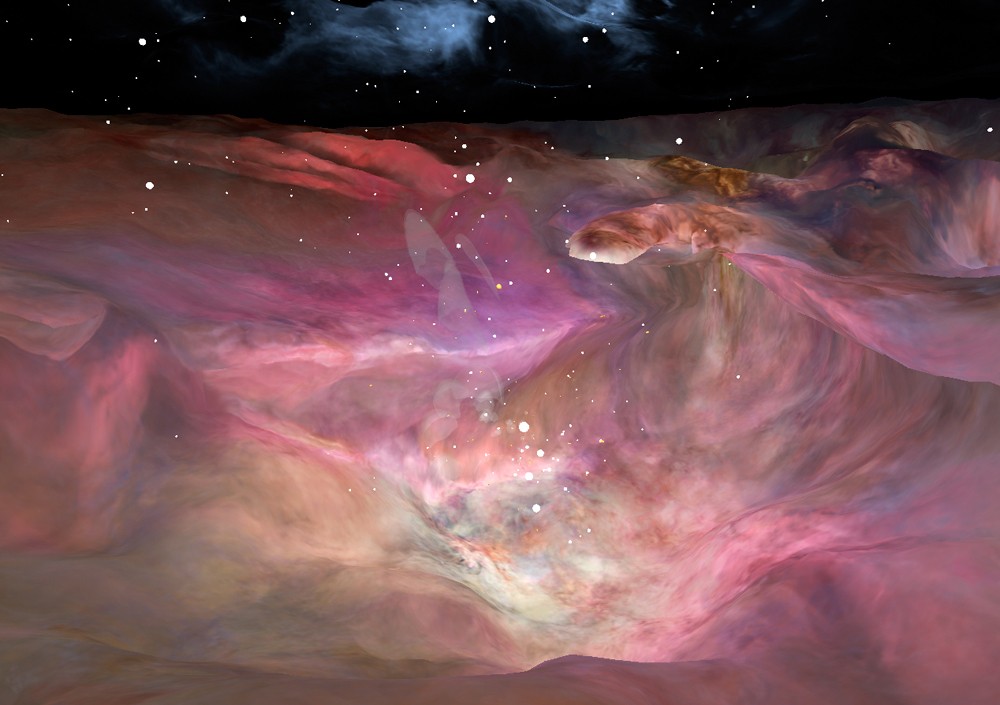
Featured image at top: A gas cloud in the Orion Nebula as captured by the Hubble Space Telescope. Photo/G. Bacon, L. Frattare, Z. Levay and F. Summers/NASA
Related Stories
UC launches Bearcats Affordability Grant
January 7, 2026
The University of Cincinnati is making college more attainable for students across Ohio with the creation of the Bearcats Affordability Grant. The new grant will provide a pathway to tuition-free college for students of families who make less than $75,000 per year. Beginning in fall 2026, the Bearcats Affordability Grant will cover the remaining cost of tuition for Ohio residents who are Pell eligible.
‘Designer drug’ shows early neuroprotective signal in acute ischemic stroke
October 28, 2025

Medscape highlighted new trial results led by the University of Cincinnati's Eva Mistry that found an experimental drug shows promise in protecting injured brain cells for patients with acute ischemic stroke.
Is menstrual fluid ‘the most overlooked opportunity’ in women’s health?
October 27, 2025

The Guardian recently reported that period blood has long been thought of as ‘stinky and useless’, but startups are exploring using the fluid to test for a wide range of health conditions — including endometriosis.