WVXU: Cincinnati-designed ventilators on their way to Brazil and beyond
Nonprofit started by former P&G scientists had input from UC

WVXU recently reported on Venti-Now, a Cincinnati-based nonprofit that developed a simple automated ventilator. Some of those ventilators will soon be on the way to Brazil, which has a high number of COVID-19 cases, as well as Tanzania.
Venti-Now was launched early in the pandemic by two P&G scientists, John Molander and Art Koehler, with the aim to create an affordable, easy-to-use ventilator for low-resource countries. The company enlisted input from various University of Cincinnati experts, including Peter Campbell, professor of biomedical engineering at UC, along with two of his students, whose work was featured here.

Biomedical engineering students, Johnathan Wisecarver and Jacquelyn Chapman, pose with the Venti-Now ventilator they helped create. Photo/provided.
WVXU reports that Venti-Now began to manufacture the ventilator devices at PMC Smart Solutions based in Blue Ash early in July. The units feature a simple bag-valve-mask design similar to what is used to manually help people breath on an ambulance ride. Venti-Now’s product automates the inflation of the bag.
Unlike most ventilators, Venti-Now’s device doesn’t require expensive oxygen tanks. Instead, it can be run off of compressor air, which makes it suitable for temporary emergency facilities and hospitals with or without air hookups. Many standard ventilators require trained personnel to operate, calibrate or fix the machines.
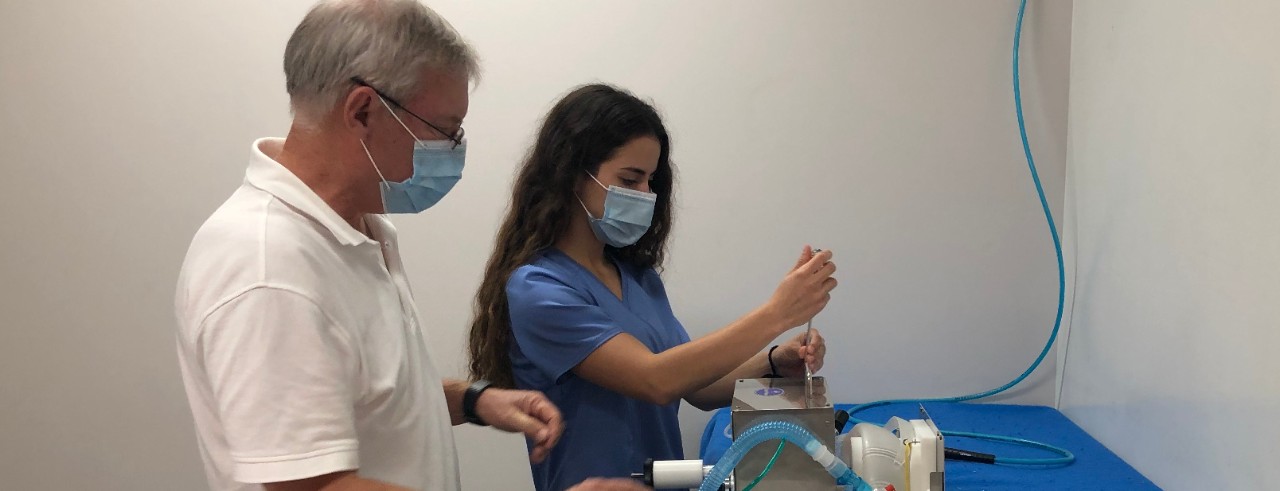
Featured image at top: Venti-Now founder John Molander and UC student Jacquelyn Chapman examine the ventilator. Photo/provided.
Related Stories
‘Designer drug’ shows early neuroprotective signal in acute ischemic stroke
October 28, 2025

Medscape highlighted new trial results led by the University of Cincinnati's Eva Mistry that found an experimental drug shows promise in protecting injured brain cells for patients with acute ischemic stroke.
Is menstrual fluid ‘the most overlooked opportunity’ in women’s health?
October 27, 2025

The Guardian recently reported that period blood has long been thought of as ‘stinky and useless’, but startups are exploring using the fluid to test for a wide range of health conditions — including endometriosis.
What is squalane, and how does it work to moisturize skin?
October 27, 2025

The University of Cincinnati's Kelly Dobos was featured in a Women's Health article discussing squalane, an ingredient being increasingly used in moisturizing skincare products.