Smithsonian: UC student interprets bison 'mummy'
Smithsonian turns to UC researchers to explain significance of extinct bison find

Smithsonian Magazine turned to a University of Cincinnati paleoecologist and his student to help interpret the significance of a rare mummified steppe bison found in Alaska.
The dessicated carcass of the now extinct bison was preserved in the permafrost until it was discovered in 1951. It's on display at the Smithsonian National Museum of Natural History.
Researchers using modern technology are keenly interested in these preserved specimens, which can unlock secrets about life on Earth 28,000 years ago.

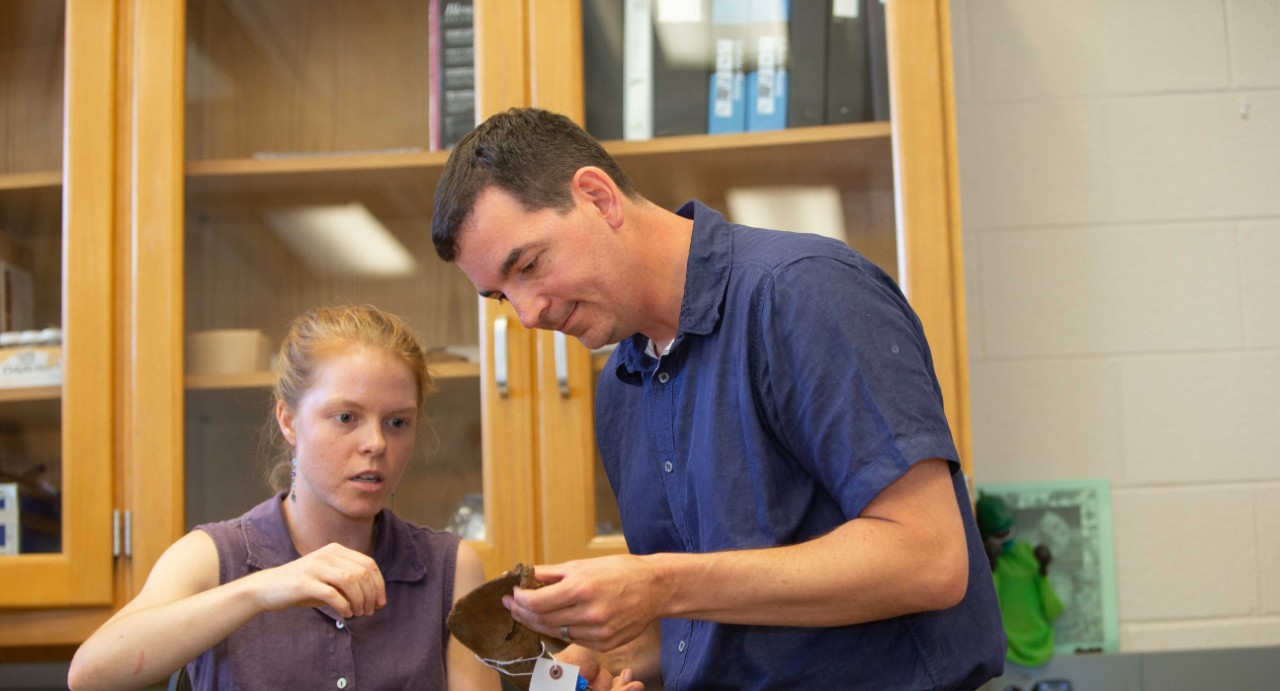
UC doctoral student Abby Kelly examines a horse jawbone in a geology lab. Photo/Andrew Higley/UC Creative + Brand
Smithsonian talked to Joshua Miller, an assistant professor of geology in UC's College of Arts and Sciences, and UC doctoral student Abby Kelly. They are using isotopic analysis and other tools to study extinct populations of animals that lived during the Pleistocene's ice ages.
Miller has studied ancient ecosystems around the world, from Yellowstone National Park in Wyoming to Amboseli National Park in Kenya.
"By studying mummies and fossils from periods prior to the Anthropocene, we can track how populations and ecosystems changed through time in the absence of outsize human impacts,” Miller told Smithsonian. “This allows us to think more critically about how we impact living populations and informs strategies for how we preserve species and ecosystems today.”
Researchers are interested in the Pleistocene in part because it was a time of dramatic changes in climate.
"Bison are relative newcomers to North America, having migrated across the Bering Land Bridge about 200,000 to 170,000 years ago," Kelly told Smithsonian.
Today, North America is home to wood bison and American bison.
Featured image at top: UC student Abby Kelly and UC assistant professor Joshua Miller study an ancient horse jawbone in a geology lab. Photo/Andrew Higley/UC Creative + Brand
Related Stories
‘Designer drug’ shows early neuroprotective signal in acute ischemic stroke
October 28, 2025

Medscape highlighted new trial results led by the University of Cincinnati's Eva Mistry that found an experimental drug shows promise in protecting injured brain cells for patients with acute ischemic stroke.
Is menstrual fluid ‘the most overlooked opportunity’ in women’s health?
October 27, 2025

The Guardian recently reported that period blood has long been thought of as ‘stinky and useless’, but startups are exploring using the fluid to test for a wide range of health conditions — including endometriosis.
What is squalane, and how does it work to moisturize skin?
October 27, 2025

The University of Cincinnati's Kelly Dobos was featured in a Women's Health article discussing squalane, an ingredient being increasingly used in moisturizing skincare products.