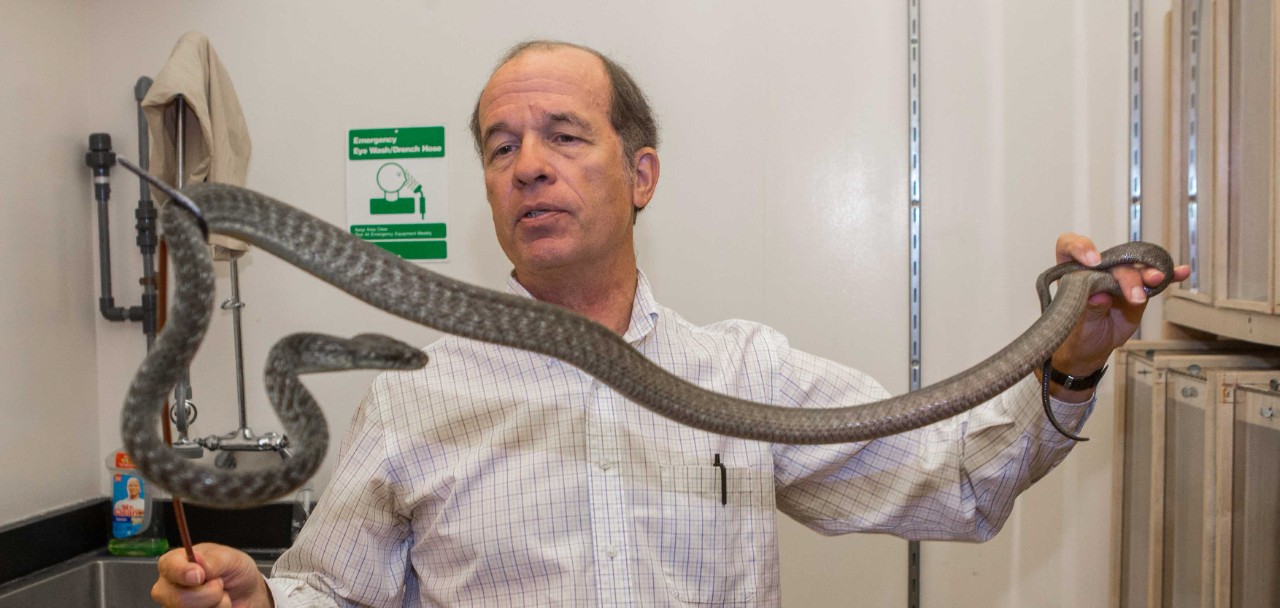
Scientific American: Tree snakes create 'lasso' to climb
UC biologist Bruce Jayne helped discover a new way that snakes can move

Scientific American talked to University of Cincinnati professor Bruce Jayne about the startling discovery of a new kind of snake movement he and his collaborators are calling "lasso locomotion."
Jayne and biologists Julie Savidge and Thomas Seibert from Colorado State University described a new form of snake movement in an article published Jan. 11 in the journal Current Biology.
Jayne previously described in detail the mechanics behind the other ways that snakes slither, climb, reach and burrow. But this discovery was extraordinary, he told Scientific American.
"This lasso locomotion is just from outer space compared to all of the other variations," Jayne said. "I've been studying the locomotion of snakes on and off for more than 40 years and I was absolutely stunned."
More locally, WVXU also spoke to Jayne about his startling discovery.
"It is a really bizarre way of moving that allows snakes to climb big cylindrical surfaces," Jayne told WVXU.
UC and CSU's discovery in the news

UC biology professor Bruce Jayne attempts to get a brown tree snake to climb a wide cylinder using lasso locomotion. He and researchers from CSU described this behavior for the first time. Photo/Bruce Jayne
National Geographic: Invasive snakes move their bodies like lassos, a totally new mode of locomotion
CNN: Snake turns its body into a lasso to climb smooth surfaces
Science: Guam's invasive tree snakes loop themselves into lassos to reach feathered prey
New York Times: These Snakes Found a New Way to Slither
The Times of London: Snake turns into lasso to climb trees
Huffington Post: Oh, Good, Scientists Discovered Snakes Can Turn Their Bodies Into 'Lassos' To Climb
Gizmodo: Snakes Invented an Incredibly Creepy Way to Climb Trees
Science Daily: This tree snake climbs with a lasso-like motion
Le Monde: The snake that hunts with a lasso
WVXU: 'It's Bizarre': Scientists Discover A New Way Snakes Can Climb
Related Stories
‘Designer drug’ shows early neuroprotective signal in acute ischemic stroke
October 28, 2025

Medscape highlighted new trial results led by the University of Cincinnati's Eva Mistry that found an experimental drug shows promise in protecting injured brain cells for patients with acute ischemic stroke.
Is menstrual fluid ‘the most overlooked opportunity’ in women’s health?
October 27, 2025

The Guardian recently reported that period blood has long been thought of as ‘stinky and useless’, but startups are exploring using the fluid to test for a wide range of health conditions — including endometriosis.
What is squalane, and how does it work to moisturize skin?
October 27, 2025

The University of Cincinnati's Kelly Dobos was featured in a Women's Health article discussing squalane, an ingredient being increasingly used in moisturizing skincare products.