Discover: UC professor explains 'slow doom that swept planet'
UC geologist shares theory on one of Earth's biggest mass extinctions

Scientists are still puzzling over one of the the Earth's biggest mass extinction 380 million years ago during the Devonian that killed three-quarteres of species on Earth.
University of Cincinnati geologist Thomas Algeo shared his theory for this mass extinction with Discover Magazine. Scientists don't think it was a meteor or comet like the one believed to have killed off the dinosaurs 65 million years ago.
But Algeo, a professor of geology in UC's College of Arts and Sciences, said a surprising culprit might have spelled the Earth's doom. According to Algeo, the proliferation of vascular plants across the Earth released massive nutrients and minerals that fueled toxic algae blooms that robbed the oceans of oxygen.
“There’s been a lot of searching for a plausible candidate,” Algeo told Discover.
Algeo and his research collaborators published their theory in 1995 in the Geological Society of America.
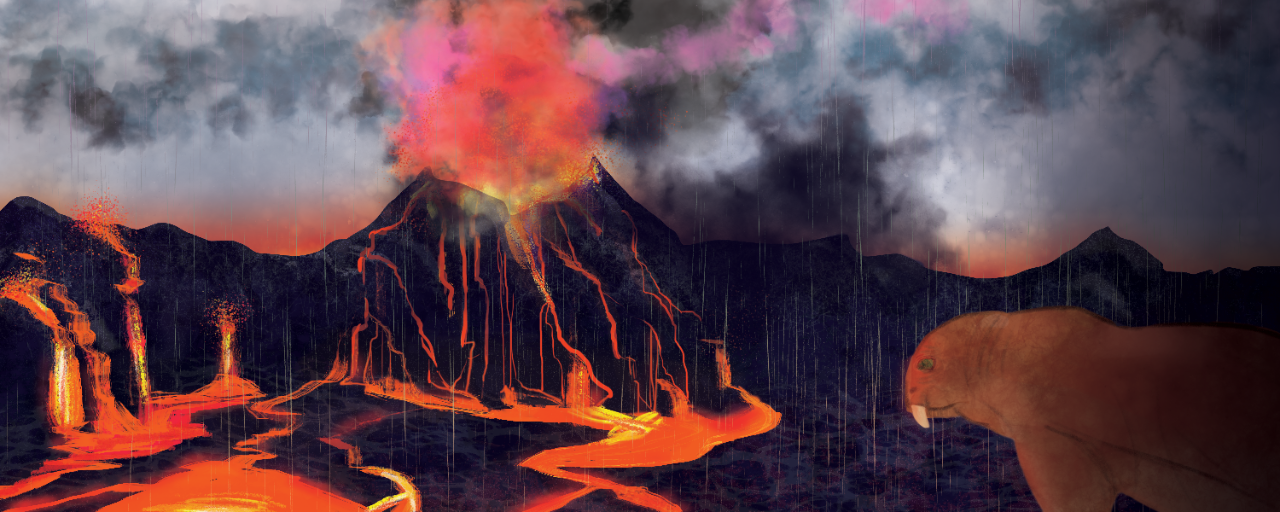
Featured illustration at top: A predatory gorgonopsid surveys a volcanic eruption that spells its doom during one of the Earth's five biggest mass extinctions. Illustration/Margaret Weiner/UC Creative + Brand

UC geology professor Thomas Algeo has been studying evidence of the mass extinction that wiped out most life on Earth 252 million years ago. Photo/Joseph Fuqua II/UC Creative + Brand
More UC geology news
Related Stories
‘Designer drug’ shows early neuroprotective signal in acute ischemic stroke
October 28, 2025

Medscape highlighted new trial results led by the University of Cincinnati's Eva Mistry that found an experimental drug shows promise in protecting injured brain cells for patients with acute ischemic stroke.
Is menstrual fluid ‘the most overlooked opportunity’ in women’s health?
October 27, 2025

The Guardian recently reported that period blood has long been thought of as ‘stinky and useless’, but startups are exploring using the fluid to test for a wide range of health conditions — including endometriosis.
What is squalane, and how does it work to moisturize skin?
October 27, 2025

The University of Cincinnati's Kelly Dobos was featured in a Women's Health article discussing squalane, an ingredient being increasingly used in moisturizing skincare products.