WVXU: UC researchers invents lab-on-a-chip device for cancer
UC College of Engineering and Applied Science professor is improving point of care

WVXU talked to a University of Cincinnati researcher who developed a noninvasive, point-of-care device for early cancer screening using a small amount of a patient’s body fluid such as saliva or blood.
Leyla Esfandiari, an assistant professor of biomedical and electrical engineering in UC's College of Engineering and Applied Science, has a patent pending on a small lab-on-a-chip device that can help doctors get accurate results without invasive biopsies.
"It's going to be faster, cheaper and more reliable," Esfandiari told WVXU. "The most important thing from the patient's point of view is that it's going to be minimally invasive. They are not going to take a tissue biopsy. They are going to get some blood or saliva."
Esfandiari and her research team in her Integrative Biosensing Laboratory at UC discovered a way to make that process faster, easier and more cost effective. Esfandiari frequently collaborates with colleagues from the UC College of Medicine and Cincinnati Children’s Hospital Medical Center. Conversations with those in the medical profession led her to explore a better way to isolate exosomes from the body fluids utilizing a novel label-free electrokinetic device.
Exosomes, or cell-secreted nanoscale extracellular vesicles, contain important gene regulatory contents and are highly abundant in all body fluids. They carry with them RNA and protein markers that indicate cancer and other diseases. While it’s easy to collect the body fluids, it’s challenging to extract exosomes from the fluid to identify the biomarkers.
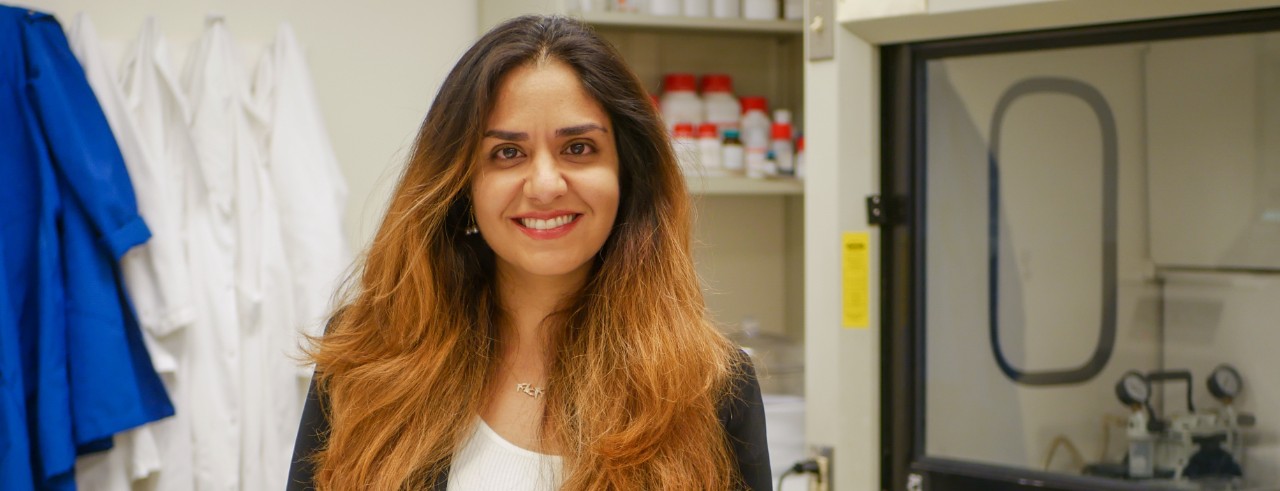
Featured image at top: UC assistant professor Leyla Esfandiari develops point-of-care devices in her lab in UC's College of Engineering and Applied Science. Photo/Corrie Mayer/CEAS Marketing

UC assistant professor Leyla Esfandiari and her research team created a lab-on-a-chip device for the early testing of cancer. Photos/Corrie Mayer/CEAS Marketing.
Related Stories
‘Designer drug’ shows early neuroprotective signal in acute ischemic stroke
October 28, 2025

Medscape highlighted new trial results led by the University of Cincinnati's Eva Mistry that found an experimental drug shows promise in protecting injured brain cells for patients with acute ischemic stroke.
Is menstrual fluid ‘the most overlooked opportunity’ in women’s health?
October 27, 2025

The Guardian recently reported that period blood has long been thought of as ‘stinky and useless’, but startups are exploring using the fluid to test for a wide range of health conditions — including endometriosis.
What is squalane, and how does it work to moisturize skin?
October 27, 2025

The University of Cincinnati's Kelly Dobos was featured in a Women's Health article discussing squalane, an ingredient being increasingly used in moisturizing skincare products.