WVXU: One year on: Why do people with COVID-19 lose smell and taste?
UC expert specializing in the ear, nose and throat weighs in on the pandemic’s impact on the senses

Often similar symptoms can make it difficult for individuals to know whether they are experiencing allergies, the flu or something more serious such as COVID-19. But researchers have determined that a link between COVID-19 and a decreased sense of smell and taste is among the key indicators that suggest infection with the novel coronavirus SARS-CoV-2. Ahmad Sedaghat, MD, PhD, associate professor in the UC Department of Otolaryngology-Head and Neck Surgery and UC Health physician, spoke with WVXU about this topic.
A study authored by Sedaghat of 103 patients in Aarau, Switzerland diagnosed with COVID-19 over a six-week period were asked how many days they had COVID-19 symptoms and to describe the timing and severity of loss or reduced sense of smell along with other symptoms. At least 61 percent of the patients reported reduced or lost sense of smell. The mean onset for reduction or loss in sense of smell was 3.4 days.
"Things like cough and fever are non-specific symptoms that don't allow us to really differentiate COVID-19 from some other viral illness but this smell loss that seems to be one of the first symptoms is a very specific tip-off that someone might be experiencing COVID-19,” Sedaghat told WVXU.
Listen to his interview and read the online story.
Learn more about research studies Sedaghat published last April, May and July.
Also view Sedaghat's latest lecture on COVID-19 and the sense of smell.
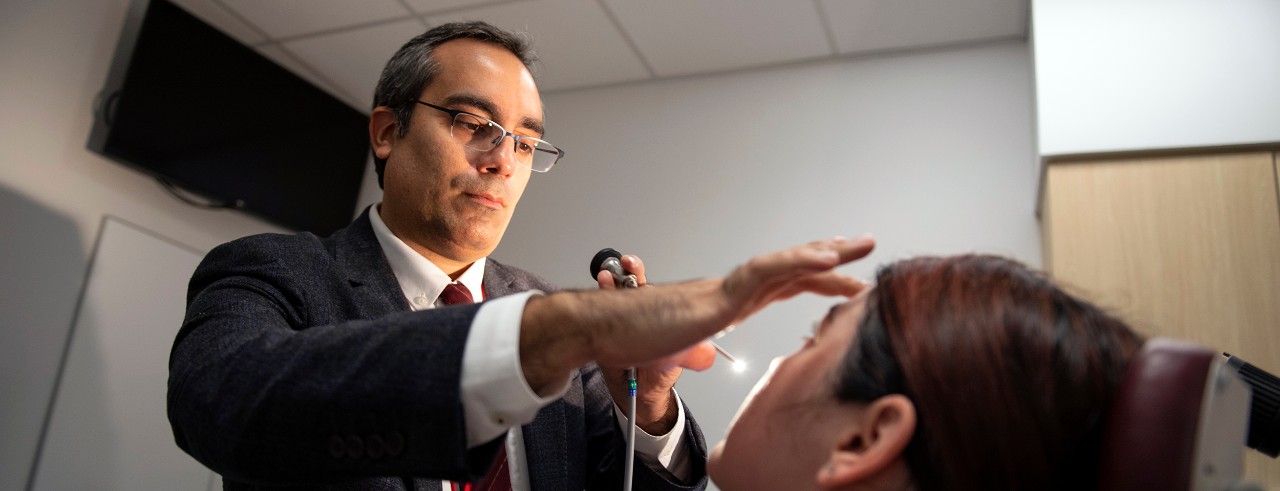
Featured images of Ahmad Sedaghat, MD, PhD, taken by Colleen Kelley/UC Creative + Brand.
Related Stories
‘Designer drug’ shows early neuroprotective signal in acute ischemic stroke
October 28, 2025

Medscape highlighted new trial results led by the University of Cincinnati's Eva Mistry that found an experimental drug shows promise in protecting injured brain cells for patients with acute ischemic stroke.
Is menstrual fluid ‘the most overlooked opportunity’ in women’s health?
October 27, 2025

The Guardian recently reported that period blood has long been thought of as ‘stinky and useless’, but startups are exploring using the fluid to test for a wide range of health conditions — including endometriosis.
What is squalane, and how does it work to moisturize skin?
October 27, 2025

The University of Cincinnati's Kelly Dobos was featured in a Women's Health article discussing squalane, an ingredient being increasingly used in moisturizing skincare products.