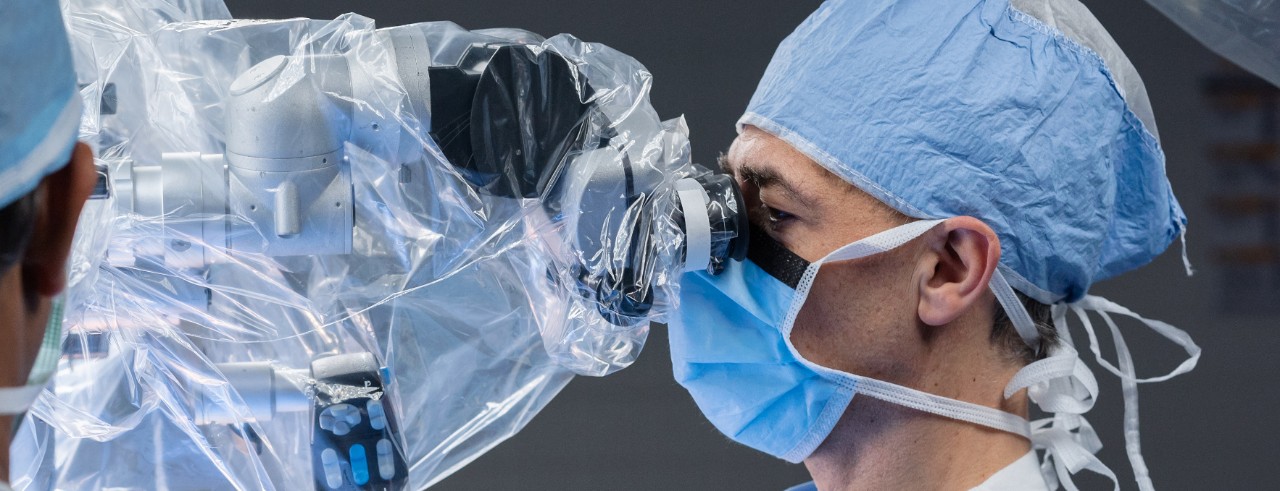
UC neurosurgeon developing software to guide surgeons in the operating room
Norberto Andaluz, MD, awarded for research that will improve surgical technique

The North American Skull Base Society recognized the work of Dr. Norberto Andaluz during its annual conference, this year held virtually.
The abstract entitled, "Piriform Height and The Clival Length as Predictors of the Size and Surgical Freedom of the TransClival Corridor," received the Rhoton Award, named after Albert Rhoton Jr., a pioneer in the field of neuroanatomy.
This abstract is a small portion of a much larger project that is using data and computer technology to guide surgeons to the best area to operate. "Many of us who have done this for quite some time have developed our own method to do that," explains Dr. Andaluz. "We kind of guestimate and measure to our eye to figure out the best window to approach a lesion. But this is using concrete data and is a method that is reproducible and transferable." He compares it to asking his mom for one of her well-used recipes: she may know how to do it, but she can't exactly articulate it. "We're trying to convert that feeling into a predictable paradigm that can be used consistently and can be reproduced by others," says Dr. Andaluz.
We're trying to develop an easy-to-use, open source or commercially-available software platforms that are already in use that we will use to review patient films to predict the best surgical windows.
Norberto Andaluz, MD
For the project, University of Louisville resident Dr. Zaid Aljuboori led researchers to take thousands of measures on more than 100 CAT scans over the course of a year. The goal, according to Dr. Andaluz is, "We're trying to develop an easy-to-use, open source or commercially-available software that we will use to review patient films to predict the best surgical windows."
Dr. Andaluz predicts it will be industry-standard for surgeons to use software in surgical planning in the near future.
The Goodyear Lab at the University of Cincinnati will be one of the sites where these preliminary results will be validated on cadaver models.
Related Stories
‘Designer drug’ shows early neuroprotective signal in acute ischemic stroke
October 28, 2025

Medscape highlighted new trial results led by the University of Cincinnati's Eva Mistry that found an experimental drug shows promise in protecting injured brain cells for patients with acute ischemic stroke.
Is menstrual fluid ‘the most overlooked opportunity’ in women’s health?
October 27, 2025

The Guardian recently reported that period blood has long been thought of as ‘stinky and useless’, but startups are exploring using the fluid to test for a wide range of health conditions — including endometriosis.
What is squalane, and how does it work to moisturize skin?
October 27, 2025

The University of Cincinnati's Kelly Dobos was featured in a Women's Health article discussing squalane, an ingredient being increasingly used in moisturizing skincare products.