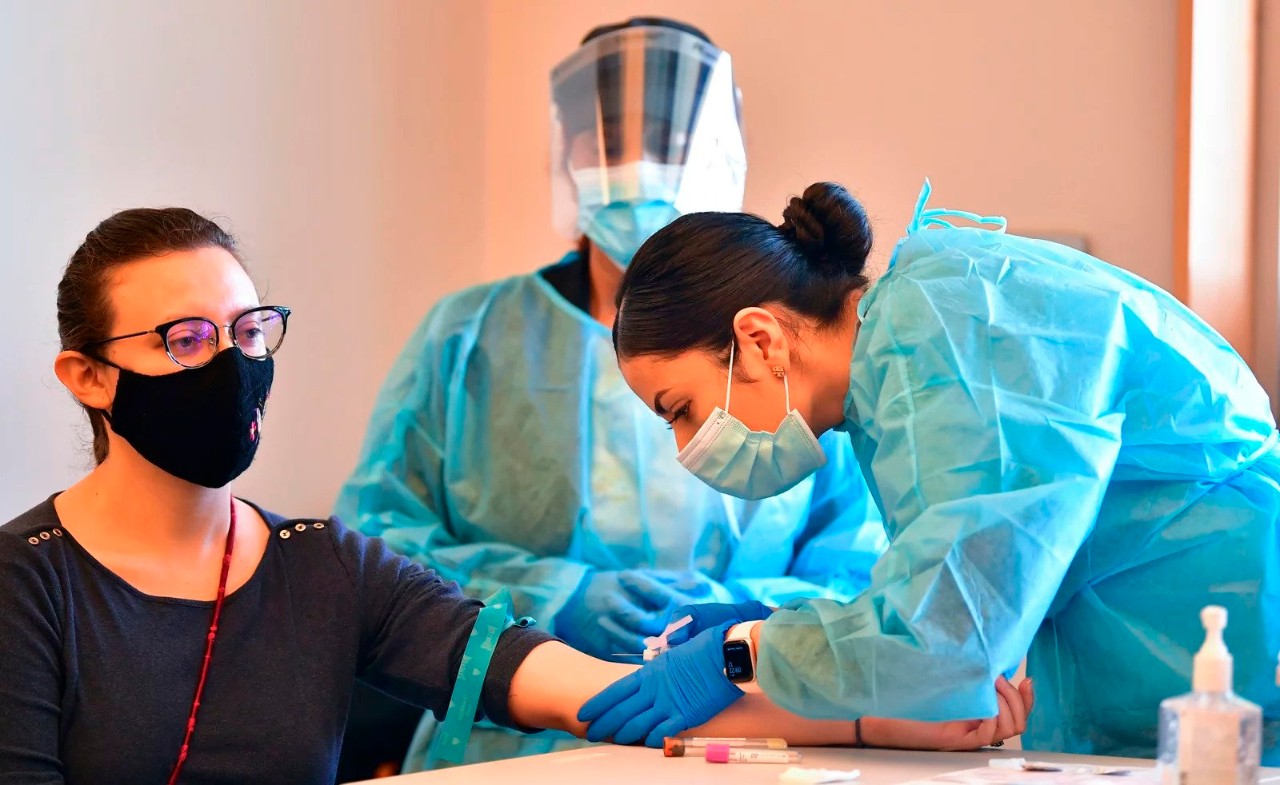
NPR: Coronavirus FAQ: Should I get my antibodies checked after I get vaccinated?
UC expert says no, that more work needs to be done

Each week, NPR answers "frequently asked questions" about life during the coronavirus pandemic. Recently, a fully-vaccinated reader submitted a question about whether or not they should get an antibody test to check their immunity to COVID-19. One of the experts NPR turned to was Carl Fichtenbaum, MD, of the Division of Infectious Diseases at the UC College of Medicine.

Carl Fichtenbaum, MD, of the UC College of Medicine Division of Infectious Diseases/Photo/Joe Fuqua II/UC Creative + Brand
While it might be tempting to take an antibody test to find out whether your COVID vaccine worked, Fichtenbaum and other immunology experts say there is little to be gained, for now, from an antibody test, for a number of reasons.
Fichtenbaum says that while there are antibody tests to verify protection from vaccines for diseases such as mumps and measles, "those took decades to develop, and with COVID-19 we're only at a year and a half."
Researchers have developed some tests and are working on perfecting them, but more work remains to be done, says Fichtenbaum, and for now the Centers for Disease Control and Prevention does not recommend checking for antibodies after vaccination. Their reasoning includes the fact that, while there are several COVID-19 antibody tests being used by commercial labs, most look for antibodies that are different than the ones produced by the vaccines in use, so they won't offer much information.
Read the entire NPR story here.
Lead image Frederic J. Brown/AFP via Getty Images
Impact Lives Here
The University of Cincinnati is leading public urban universities into a new era of innovation and impact. Our faculty, staff and students are saving lives, changing outcomes and bending the future in our city's direction. Next Lives Here.
Stay up on all UC's COVID-19 stories, or take a UC virtual visit and begin picturing yourself at an institution that inspires incredible stories.
Related Stories
‘Designer drug’ shows early neuroprotective signal in acute ischemic stroke
October 28, 2025

Medscape highlighted new trial results led by the University of Cincinnati's Eva Mistry that found an experimental drug shows promise in protecting injured brain cells for patients with acute ischemic stroke.
Is menstrual fluid ‘the most overlooked opportunity’ in women’s health?
October 27, 2025

The Guardian recently reported that period blood has long been thought of as ‘stinky and useless’, but startups are exploring using the fluid to test for a wide range of health conditions — including endometriosis.
What is squalane, and how does it work to moisturize skin?
October 27, 2025

The University of Cincinnati's Kelly Dobos was featured in a Women's Health article discussing squalane, an ingredient being increasingly used in moisturizing skincare products.