Forbes: UC telehealth drone can make house calls
A multidisciplinary team of researchers is engineering new technology

Telehealth medicine has become increasingly popular during the COVID-19 pandemic as doctors and patients turned to virtual appointments as a means to communicate more safely.
Forbes highlighted research by a multidisciplinary team of inventors at the University of Cincinnati that is aiming to improve the technology to make these virtual interactions more meaningful.
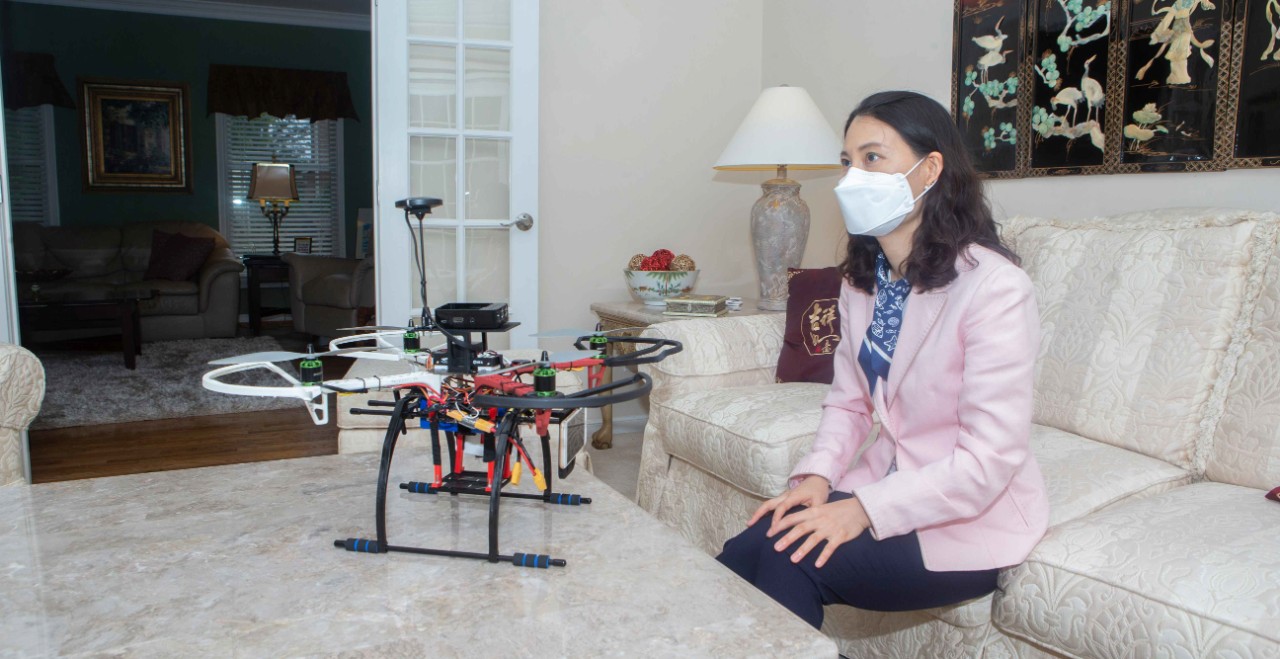
Inventors Victoria Wangia-Anderson, Manish Kumar, Seung-Yeon Lee and Debi Sampsel from three colleges at UC collaborated to develop a semi-autonomous drone that can be dispatched to people’s homes. The drones are big enough to carry medicine or medical supplies but small enough to maneuver the tight confines of a home using navigational algorithms developed by UC engineers.
Still in development, the drone has cameras and a display screen so patients can talk to health care professionals from the comfort of their home. The prototype carries a waterproof box the size of a small first-aid kit to deliver medical supplies or collect self-administered lab tests.
The researchers in UC’s College of Nursing, College of Allied Health Sciences and College of Engineering and Applied Science secured a UC Office of Research grant to develop a prototype to test the feasibility of dispatching a telehealth care delivery drone to a patient's home to provide health assessments or medical interventions.
Featured image at top: Seung-Yeon Lee, an associate professor of nutrition sciences in UC's College of Allied Health Sciences, sits across from a telehealth drone that allows patients to talk face-to-face to health care professionals from the comfort of their home. Photo/Joseph Fuqua II/UC Creative + Brand

UC's prototype telehealth drone. Photo/Joseph Fuqua II/UC Creative + Brand
Related Stories
‘Designer drug’ shows early neuroprotective signal in acute ischemic stroke
October 28, 2025

Medscape highlighted new trial results led by the University of Cincinnati's Eva Mistry that found an experimental drug shows promise in protecting injured brain cells for patients with acute ischemic stroke.
Is menstrual fluid ‘the most overlooked opportunity’ in women’s health?
October 27, 2025

The Guardian recently reported that period blood has long been thought of as ‘stinky and useless’, but startups are exploring using the fluid to test for a wide range of health conditions — including endometriosis.
What is squalane, and how does it work to moisturize skin?
October 27, 2025

The University of Cincinnati's Kelly Dobos was featured in a Women's Health article discussing squalane, an ingredient being increasingly used in moisturizing skincare products.