Vanity Fair: Spiders play mind games
UC biologist explains how jumping spiders display surprising intelligence

Vanity Fair turned to University of Cincinnati spider expert Nathan Morehouse to explain the surprising intelligence demonstrated by certain spiders.
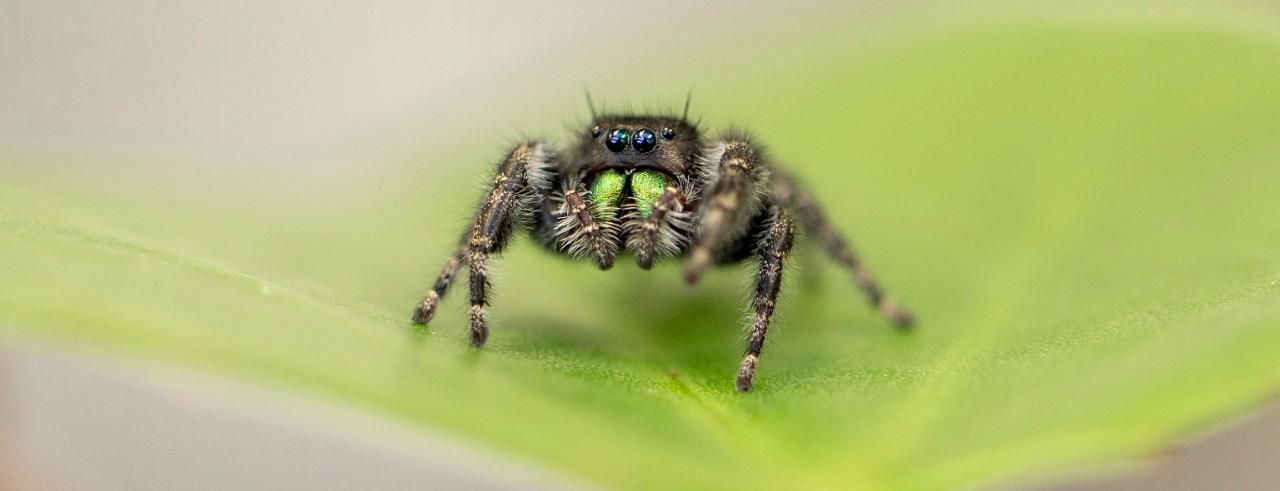
While people often associate intelligence with brain size, the tiny brains of these Tic Tac-sized spiders seem to support complex mental processes.
Nathan Morehouse, an associate professor of biological sciences in UC's College of Arts and Sciences, told Vanity Fair that jumping spiders, in particular, demonstrate smarts.
“Jumping spiders are remarkably clever animals,” Morehouse told Vanity Fair. “I always find it delightful when something like a humble jumping spider punctures our sense of biological superiority.”
One kind of jumping spider, Portia, hunts other spiders. BBC Earth chronicled how the spider uses a variety of hunting tactics to reach prey depending on the scenario — in some cases luring the prey closer by plucking its web like a captured fly. The spider also has an uncanny ability to study its environment to plot the best path to reach unsuspecting spiders by dropping down a line of silk above them.
“Even amongst this surprisingly intelligent group, Portia stands out as being oddly brilliant,” Morehouse said. “They are, after all, hunting very dangerous prey, so caution and cleverness are useful tools.”
Morehouse, who studies the visual acuity of spiders around the world in his lab, is director of UC's new Institute for Research in Sensing. The institute will host the second of eight public talks on senses 7 to 9 p.m. Nov. 18 at Lunken Airport's Greater Cincinnati Airmen Club. The night's topic: biomimicry and the future of sensing.

UC associate professor Nathan Morehouse studies the sensory abilities of spiders around the world. He is director of UC's Institute for Research in Sensing. Photo/Jay Yocis/UC Creative + Brand
Featured image at top: A jumping spider. Photo/Joseph Fuqua II/UC Creative + Brand
Related Stories
‘Designer drug’ shows early neuroprotective signal in acute ischemic stroke
October 28, 2025

Medscape highlighted new trial results led by the University of Cincinnati's Eva Mistry that found an experimental drug shows promise in protecting injured brain cells for patients with acute ischemic stroke.
Is menstrual fluid ‘the most overlooked opportunity’ in women’s health?
October 27, 2025

The Guardian recently reported that period blood has long been thought of as ‘stinky and useless’, but startups are exploring using the fluid to test for a wide range of health conditions — including endometriosis.
What is squalane, and how does it work to moisturize skin?
October 27, 2025

The University of Cincinnati's Kelly Dobos was featured in a Women's Health article discussing squalane, an ingredient being increasingly used in moisturizing skincare products.