WCPO I-Team: Warehouses not required to offer storm shelters
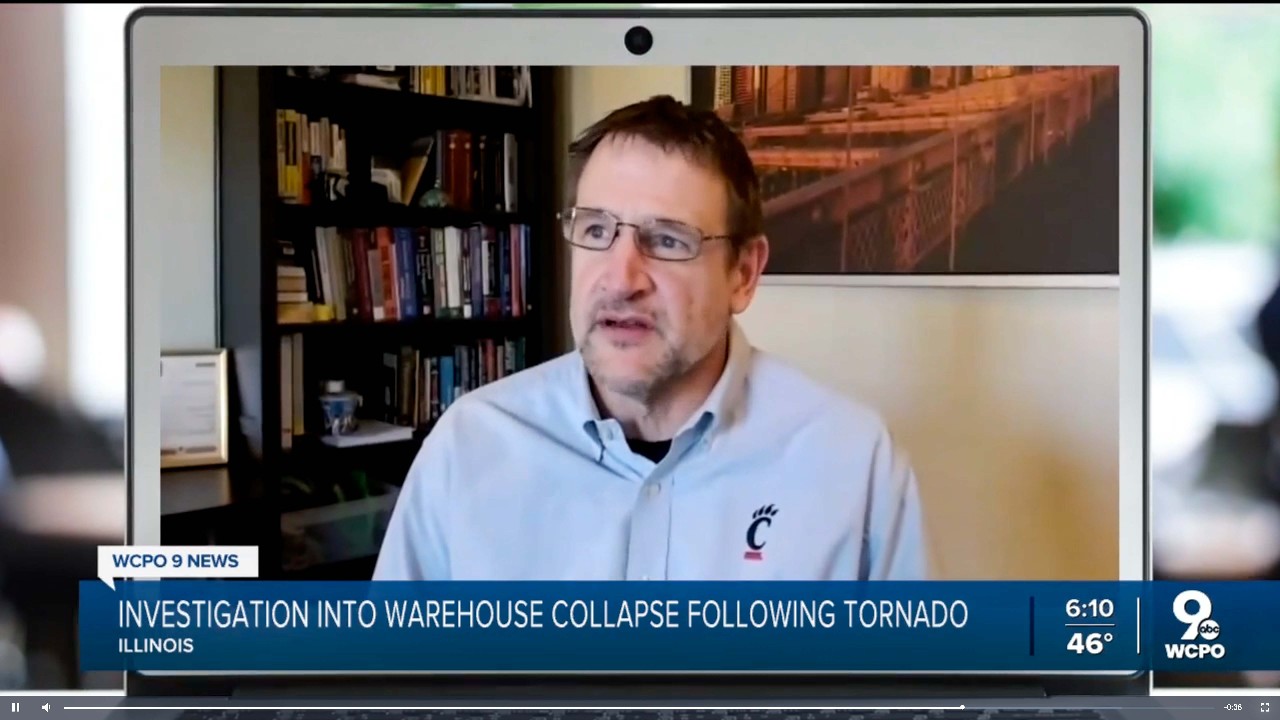
UC associate professor James Swanson explains construction standards after deadly storms

WCPO's I-Team turned to a University of Cincinnati construction expert to explain how commercial construction standards measure up against deadly storms like last week's tornadoes that killed factory and warehouse workers.
Tornadoes swept across the Midwest on Friday, killing more than 90 people in Kentucky and Illinois. Six people were killed at a warehouse in Illinois while another eight people died at a candle factory in Kentucky.

UC associate professor James Swanson.
WCPO spoke to James Swanson, an associate professor of civil engineering in UC's College of Engineering and Applied Science. He has studied how structures hold up to wind and has conducted research on bridges, steel construction and other civil engineering topics.
Swanson said warehouses should contain hardened shelters designed to withstand storm damage. Today's construction takes wind storms into account, Swanson said. If building codes are followed, workers should be safe from all but the most extreme storms, Swanson told WCPO.
"The highest winds that we would see in the state of Ohio, for example, are in the order of 70 to 80 miles per hour and we design for about 105," Swanson said. "I think the codes are fairly well-developed in this case and I feel like they're appropriate."
Featured image at top: UC associate professor James Swanson talks to WCPO over web chat about the deadly storms that swept across the Midwest on Friday. Photo/WCPO
UC: birthplace of co-op
UC is the birthplace of co-op, the model in which students divide the year between full-time classroom instruction and full-time employment in their chosen field. UC's nationally ranked co-op program helps build your resume while funding your degree and discovering your career.
Related Stories
‘Designer drug’ shows early neuroprotective signal in acute ischemic stroke
October 28, 2025

Medscape highlighted new trial results led by the University of Cincinnati's Eva Mistry that found an experimental drug shows promise in protecting injured brain cells for patients with acute ischemic stroke.
Is menstrual fluid ‘the most overlooked opportunity’ in women’s health?
October 27, 2025

The Guardian recently reported that period blood has long been thought of as ‘stinky and useless’, but startups are exploring using the fluid to test for a wide range of health conditions — including endometriosis.
What is squalane, and how does it work to moisturize skin?
October 27, 2025

The University of Cincinnati's Kelly Dobos was featured in a Women's Health article discussing squalane, an ingredient being increasingly used in moisturizing skincare products.