Reuters Health: Stroke treatment effective for patients with disability, dementia

The American Heart Association and American Stroke Association have published new guidance stating people with a disability or dementia who experience a stroke should receive appropriate treatment, which could allow for a return to prestroke levels of function.
The researchers explained that subgroups of patients, such as those with pre-existing disability, were not included in early trials that helped develop endovascular thrombectomy (EVT), or the removal of a blood clot using imaging guidance, as a standard of care for stroke treatment. However, new data shows comparable safety to perform EVT on patients with dementia or disability.
Stacie Demel, DO, PhD, assistant professor of clinical neurology and rehabilitation medicine in the University of Cincinnati College of Medicine and a UC Health physician at the UC Gardner Neuroscience Institute, commented on the statement for Reuters Health.
"Prior to referring a patient for EVT, an understanding of a patient's baseline functional status plays a central role in the decision regarding taking a patient for (the) procedure," Demel said. "Blindly excluding patients with physical disability or dementia will result in inequitable stroke treatment across populations. However, in lieu of strong evidence to either treat or defer treatment, it is the obligation of the treating physician to be cognizant of bias and to engage and educate the patient and/or the family in decision making."
Read the Reuters Health article.
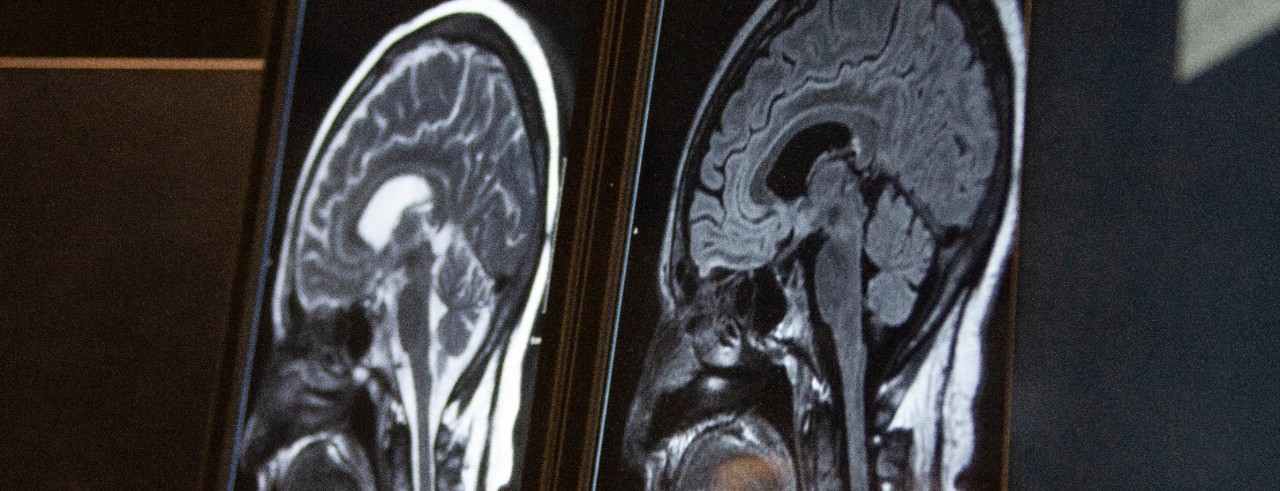
Featured photo at top of MRI brain scan. Photo/Ravenna Rutledge/University of Cincinnati.
Related Stories
‘Designer drug’ shows early neuroprotective signal in acute ischemic stroke
October 28, 2025

Medscape highlighted new trial results led by the University of Cincinnati's Eva Mistry that found an experimental drug shows promise in protecting injured brain cells for patients with acute ischemic stroke.
Is menstrual fluid ‘the most overlooked opportunity’ in women’s health?
October 27, 2025

The Guardian recently reported that period blood has long been thought of as ‘stinky and useless’, but startups are exploring using the fluid to test for a wide range of health conditions — including endometriosis.
What is squalane, and how does it work to moisturize skin?
October 27, 2025

The University of Cincinnati's Kelly Dobos was featured in a Women's Health article discussing squalane, an ingredient being increasingly used in moisturizing skincare products.