NatGeo: Do spiders dream?
UC biologist Nathan Morehouse explains why spiders might

Spiders might be a nightmare for arachnophobes, but do they have them?
A new study by the University of Konstanz suggests as much. Researchers found that jumping spiders experience a sleep-like state with rapid eye movements similar to those observed when we dream.
Rapid-eye-movement sleep has been observed in other animals, particularly mammals, but also fish, birds and reptiles.

UC associate professor Nathan Morehouse works with students in his biology lab. Photo/Provided
National Geographic turned to University of Cincinnati biologist Nathan Morehouse to explain why spiders might dream. If spiders dream, it's “likely to be in most ways completely different from our own,” Morehouse told NatGeo.
Morehouse is director of UC's Institute for Research in Sensing, which examines the myriad ways we and animals perceive the world. He was not part of the sleep study but has examined the vision of jumping spiders around the world.
In his lab in UC's College of Arts and Sciences, he and his students have demonstrated how jumping spiders have amazing color vision. He calls them “walking retinas.”
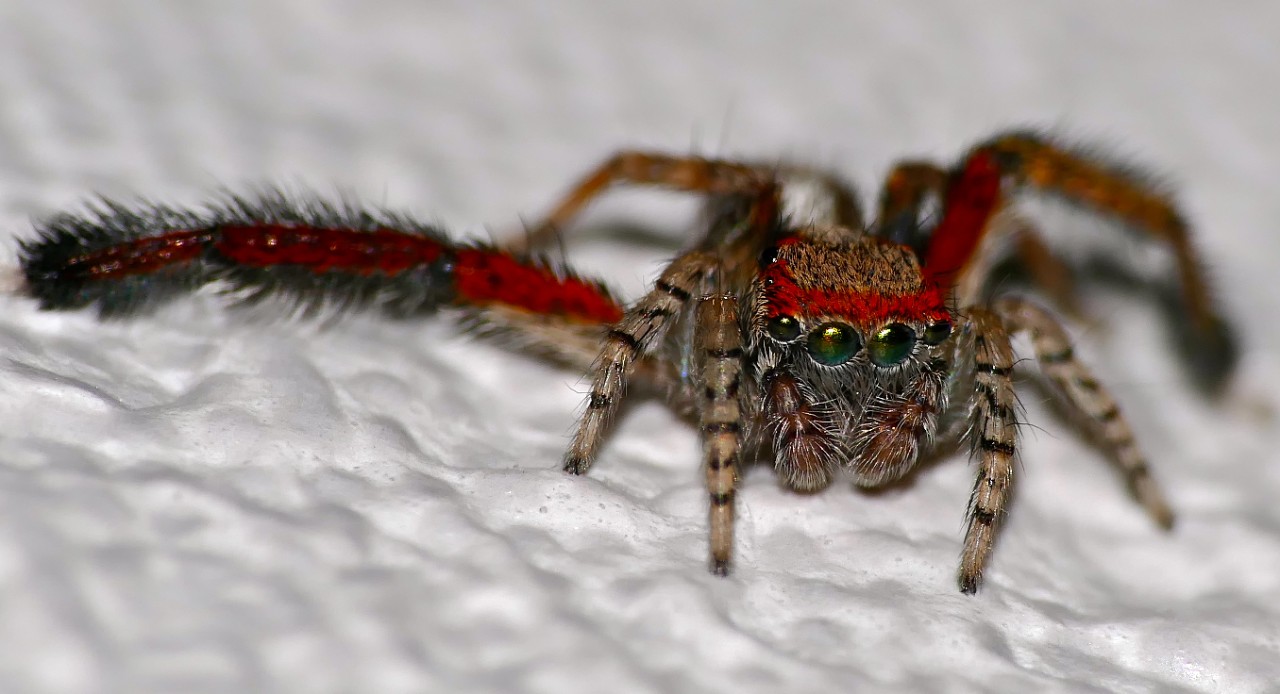
Jumping spiders are known for their solicitous postures, staring up at you like an expectant puppy with two enormous eyes that provide high-resolution vision. But they also have six smaller eyes that provide a 360-degree, monochromatic view of the world that’s very sensitive to motion, Morehouse said.
So why would spiders need REM sleep?
Morehouse said one of the leading theories about REM sleep is that it allows animals to hone essential survival skills.
Read the National Geographic story.
Featured image at top: The brightly colored jumping spider Saitis barbipes. Photo/Bernard Dupont/Wikimedia Commons

UC biologist Nathan Morehouse is director of UC's Institute for Research in Sensing, which hosted a series of public talks about sensing in the past year, including one at the American Sign Museum. Photo/Michael Miller
Next Lives Here
UC offers an education that’s both rigorous and relevant. Choose any of hundreds of academic programs, many nationally ranked, all with opportunities for real-world learning. From study abroad and co-ops to artistic performances and portfolios, you can graduate with transcripts and a resume.
Related Stories
‘Designer drug’ shows early neuroprotective signal in acute ischemic stroke
October 28, 2025

Medscape highlighted new trial results led by the University of Cincinnati's Eva Mistry that found an experimental drug shows promise in protecting injured brain cells for patients with acute ischemic stroke.
Is menstrual fluid ‘the most overlooked opportunity’ in women’s health?
October 27, 2025

The Guardian recently reported that period blood has long been thought of as ‘stinky and useless’, but startups are exploring using the fluid to test for a wide range of health conditions — including endometriosis.
What is squalane, and how does it work to moisturize skin?
October 27, 2025

The University of Cincinnati's Kelly Dobos was featured in a Women's Health article discussing squalane, an ingredient being increasingly used in moisturizing skincare products.