Medscape: Our wearable future
UC engineering professor explains how new sweat sensors will improve lives

Medscape turned to a biomedical engineering professor at the University of Cincinnati to explain what the future holds for wearable technology for its two-part series.
UC College of Engineering and Applied Science professor Jason Heikenfeld told Medscape that advances in technology are allowing doctors to measure how quickly patients metabolize drugs so they get a safer and more effective dose.

UC biomedical engineering professor Jason Heikenfeld is developing the next generation of wearable technology in his Novel Devices Lab. Photo/Andrew Higley/UC Marketing + Brand
These advances will make our current pharmacy system look like something from the Stone Age, Heikenfeld said.
"We're going to be like, you went to a store and your 85-year-old grandmother who weighs 95 pounds, and you who are 32 and overweight, got the same bottle of X that says 'take this many every four hours up to this dose,'" Heikenfeld said. "It doesn't make any sense."
In part two of Medscape's series Our Wearable Future, Heikenfeld elaborated on what's in store for the next generation of wearable tech.
Noninvasive skin sensors one day could replace time-consuming and costly visits to labs to draw blood, he said. Likewise, advances in sweat-sensor technology could give patients more discretion to conduct in-home testing. (Related: Wireless sensor fits like a second skin.)
"If there was a people's choice award for biofluids, sweat would win," Heikenfeld said. "We don't want to do blood, we don't want to drool in a cup, we don't want to mess with a urine stick. Tears, forget it."
Read Medscape's series Our Wearable Future.
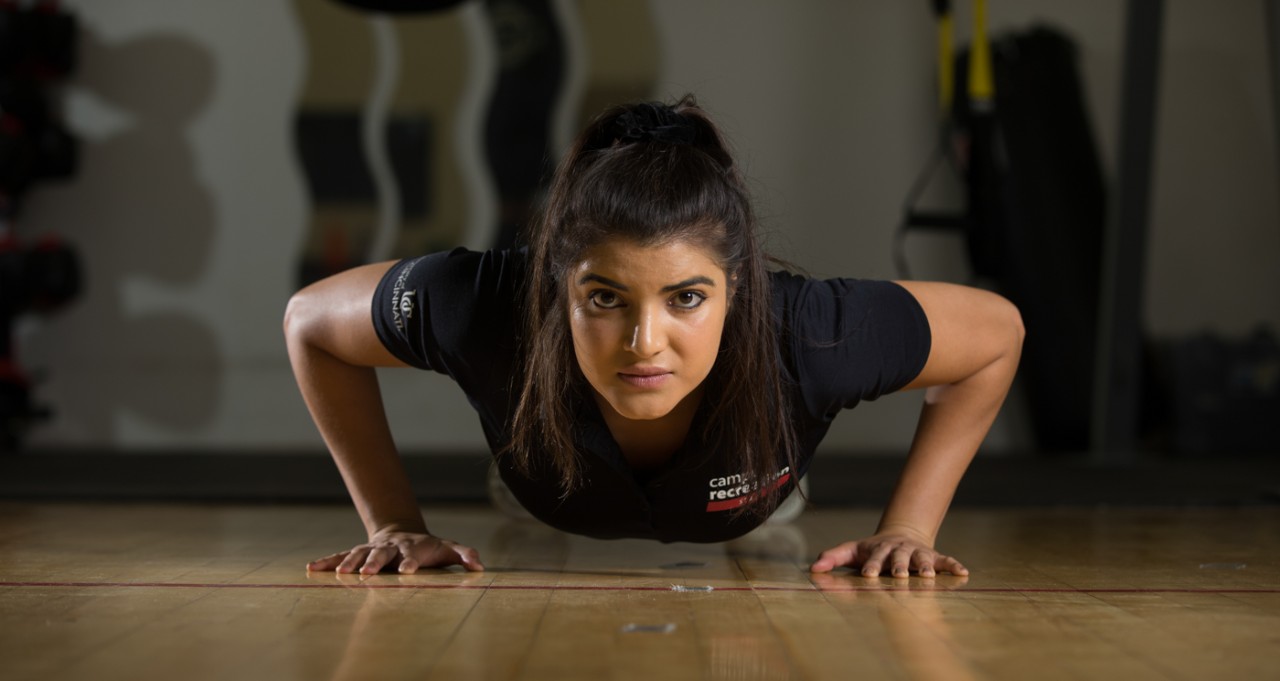
Featured image at top: A UC student works out in a gym. New wearable technology will improve the way we track health and fitness. Photo/Lisa Ventre/UC
Related Stories
‘Designer drug’ shows early neuroprotective signal in acute ischemic stroke
October 28, 2025

Medscape highlighted new trial results led by the University of Cincinnati's Eva Mistry that found an experimental drug shows promise in protecting injured brain cells for patients with acute ischemic stroke.
Is menstrual fluid ‘the most overlooked opportunity’ in women’s health?
October 27, 2025

The Guardian recently reported that period blood has long been thought of as ‘stinky and useless’, but startups are exploring using the fluid to test for a wide range of health conditions — including endometriosis.
What is squalane, and how does it work to moisturize skin?
October 27, 2025

The University of Cincinnati's Kelly Dobos was featured in a Women's Health article discussing squalane, an ingredient being increasingly used in moisturizing skincare products.