Discover: Did giant sea lizard rule oceans 66M years ago?
UC paleontologist Takuya Konishi explains significance of new mosasaur discovery

Discover turned to University of Cincinnati paleontologist Takuya Konishi to explain the significance of a new species of mosasaur described by the University of Bath.
Konishi, who was not part of the discovery, is an expert in mosasaurs and other marine reptiles that terrorized oceans during the Cretaceous Period more than 65 million years ago.

UC College of Arts and Sciences assistant professor Takuya Konishi studies mosasaurs and other ancient marine reptiles. Photo/Joseph Fuqua II/UC
Nicholas Longrich of the University of Bath led a study about a newly identified species of mosasaur they called Thalassotitan atrox (which means merciless sea giant) found in Morocco that had conical teeth like a killer whale. It was as big as an orca, too, at 30 feet.
Konishi told Discover that the specimen resembles another mosasaur called Prognathodon overtoni.
“The bulk of the features are basically found in this other species of mosasaur,” Konishi told Discover. “It’s just 10 million years older. The morphological consistency between the two mosasaurs likely implies just a continuation of that same kind of niche for Prognathodon.”
When it comes to the world's largest marine reptiles, location might not be as important a factor to identification, he said.
“They are large predators, and 10 million years would've given ample time for any large marine reptiles to achieve global distribution, keeping their original niche wherever they ended up,” he told Discover.
Konishi and UC graduate Alexander Willman and University of Alberta professor Michael Caldwell in 2021 identified an 18-foot-long mosasaur they called Ectenosaurus everhartorum after paleontologists Mike and Pamela Everhart. The mosasaur inhabited the Western Interior Seaway 80 million years ago in what is now western Kansas.
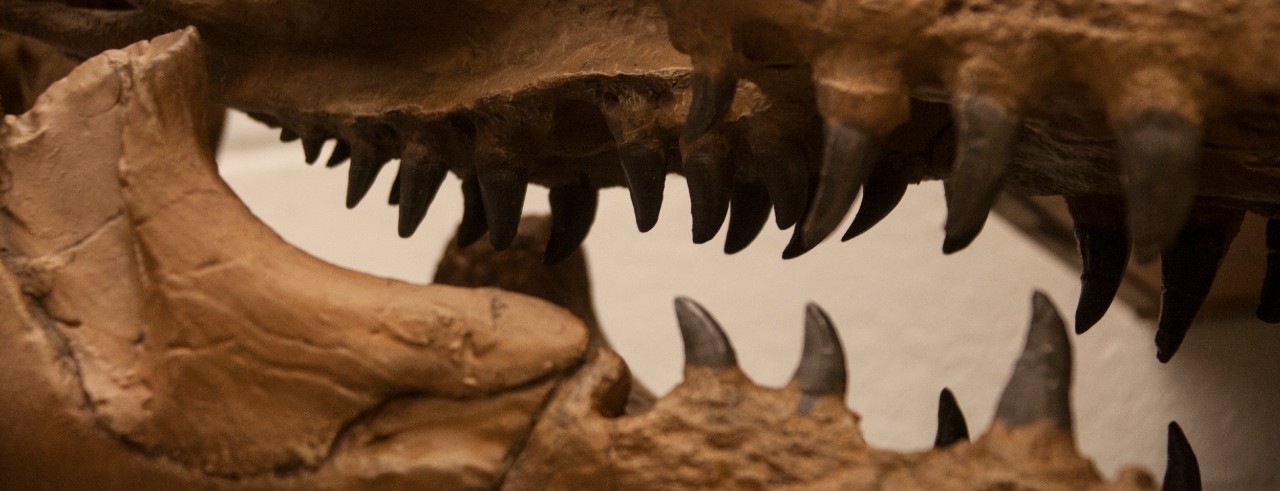
Featured image at top: The teeth of a mosasaur. Photo/Joseph Fuqua II/UC

UC College of Arts and Sciences assistant professor Takuya Konishi studies ancient marine reptiles such as mosasaurs. Photo/Joseph Fuqua II/UC
Related Stories
‘Designer drug’ shows early neuroprotective signal in acute ischemic stroke
October 28, 2025

Medscape highlighted new trial results led by the University of Cincinnati's Eva Mistry that found an experimental drug shows promise in protecting injured brain cells for patients with acute ischemic stroke.
Is menstrual fluid ‘the most overlooked opportunity’ in women’s health?
October 27, 2025

The Guardian recently reported that period blood has long been thought of as ‘stinky and useless’, but startups are exploring using the fluid to test for a wide range of health conditions — including endometriosis.
What is squalane, and how does it work to moisturize skin?
October 27, 2025

The University of Cincinnati's Kelly Dobos was featured in a Women's Health article discussing squalane, an ingredient being increasingly used in moisturizing skincare products.