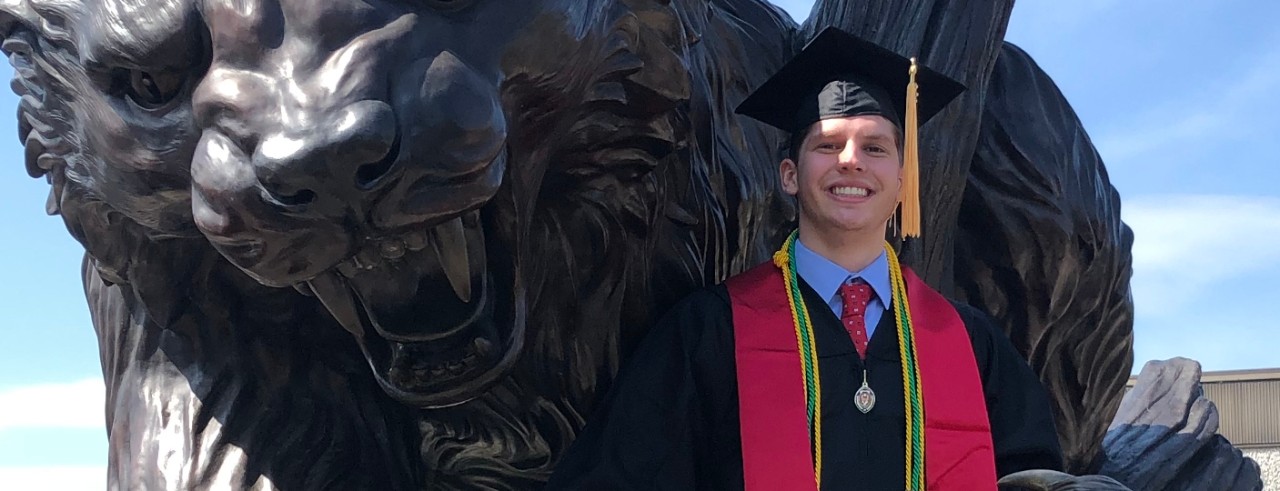
Spectrum News: Pediatric stroke survivor provides care at Cincinnati Children's Hospital
UC College of Nursing graduate shares story of pediatric stroke and rare genetic disorder

One morning in Dec. 2017, David Moskowitz, a 17-year-old senior at Sycamore High School, woke up to feel his lips tingling, and throughout the day that feeling spread up the right side of his face, but he thought nothing of it at the time.
But after lacrosse practice, when the feeling continued, he consulted family, who immediately took him to Cincinnati Children's Hospital. In a profile produced by Spectrum News, they reported that MRI testing revealed Moskowitz suffered a stroke, had an inoperable brain malformation, or AVM, and was diagnosed with a rare genetic disorder called HHT.
Moskowitz spent nearly a month in the ICU receiving treatments, including radiation, but had trouble speaking, moving and lost some of his vision. Several months later, under the supervision of Sudahakar Vadivelu, DO, his surgeon, Moskowitz was on the road to recovery.
His health battle would lead to an outpouring of support at his team's lacrosse matches and on social media with the hashtag, #DAVIDSTRONG.
Moskowitz told Spectrum News it took him a full year to get back to normal, but over the next four years, with a healthy mind, body and spirit, he earned a bachelor’s degree from the UC College of Nursing.
After a Co-op at Cincinnati Children's pediatric intensive care unit, his story would come full circle by being hired at Children's and, at times, working with Vadivelu.
“It's cool to see a role model for me in the ICU and a guy who took care of me in my darkest days. And now he's with me in my better days and we get to work together," said Moskowitz. "So it's an awesome experience."
Moskowitz said he will continue to increase pediatric stroke awareness in the future through community events, and he says he wouldn't be where he is today without a close support team.
“I was a cocky 17-year-old, and I learned very quickly that I would have never made it through that experience without the support systems that I had, my family, my friends, and the community being by my side," he said. "I love patients that I can connect with and just go through a shift and know that I created a bond with someone and made their day a little better when they're facing those dark times."
Read more about his story and time at UC here.
Photo/David Moskowitz
Next Lives Here
The University of Cincinnati is classified as a Research 1 institution by the Carnegie Commission and is ranked in the National Science Foundation's Top-35 public research universities. UC's medical, graduate and undergraduate students and faculty investigate problems and innovate solutions with real-world impact. Next Lives Here.
Related Stories
‘Designer drug’ shows early neuroprotective signal in acute ischemic stroke
October 28, 2025

Medscape highlighted new trial results led by the University of Cincinnati's Eva Mistry that found an experimental drug shows promise in protecting injured brain cells for patients with acute ischemic stroke.
Is menstrual fluid ‘the most overlooked opportunity’ in women’s health?
October 27, 2025

The Guardian recently reported that period blood has long been thought of as ‘stinky and useless’, but startups are exploring using the fluid to test for a wide range of health conditions — including endometriosis.
What is squalane, and how does it work to moisturize skin?
October 27, 2025

The University of Cincinnati's Kelly Dobos was featured in a Women's Health article discussing squalane, an ingredient being increasingly used in moisturizing skincare products.