WLW: UC geologist explains risks of Hawaii eruption
Hawaii's Mauna Loa erupted for the first time in 38 years

WLW's Eddie & Rocky Show turned to University of Cincinnati geologist Craig Dietsch to explain the significance of the eruption of Mauna Loa in Hawaii.
The volcano erupted for the first time in 38 years, spilling lava for more than a mile.
Dietsch is chairman of the Department of Geosciences in UC's College of Arts and Sciences. He studies geologic phenomena around the world. His students often go with him as they did earlier this year on a field trip to Minnesota and Thunder Bay, Ontario. Related Read: School of Rocks.
"It's super-exciting because Mauna Loa is the world's largest active volcano," Dietsch told co-host Rocky Boiman and guest host Jason Williams
"It has a plumbing system that goes down to the Earth's mantle. The magma it generates is very dry, so it does not explode," Dietsch said. "Instead, lava oozes out of the ground and flows down the mountain. If you had heat-proof running shoes, you could outrun it."
Dietsch teaches a class titled "Earthquakes, Volcanoes and Society."
While 38 years seems like a long time, it's a blink in geologic scale, he said.
"For geologists, 38 years is no time at all," Dietsch said.
Listen to WLW's Eddie & Rocky.
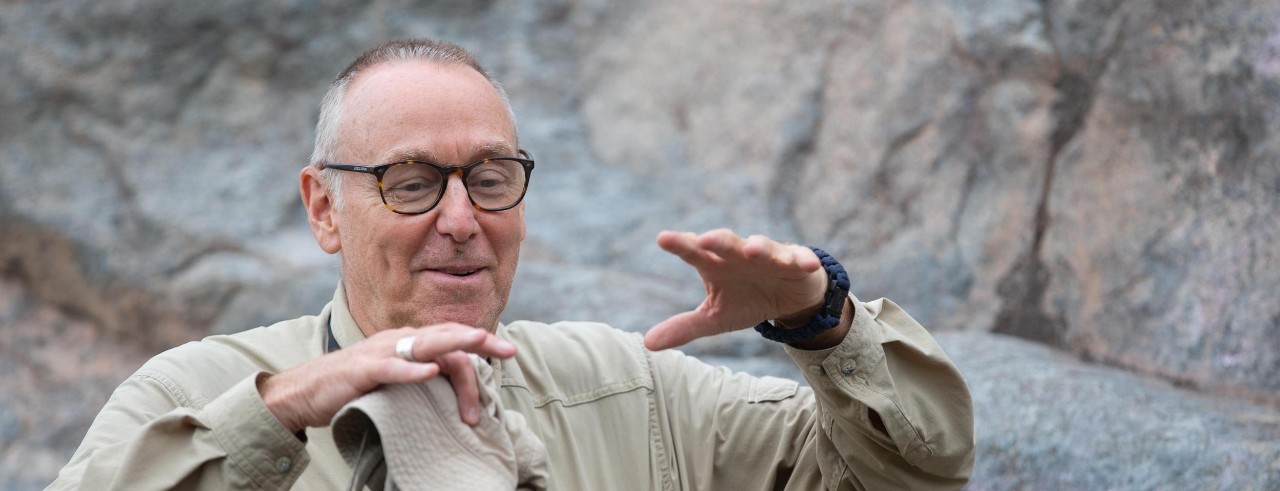
Featured image at top: UC geologist Craig Dietsch leads geology students on a field trip to Thunder Bay, Ontario. Photo/Andrew Higley/UC Marketing + Brand

UC geology students take part in a field trip to northern Minnesota and Thunder Bay, Ontario, in 2022. Photo/Andrew Higley/UC Marketing + Brand
Related: School of Rocks
Read the UC News feature on UC Geosciences' 2022 class field trip to northern Minnesota and Thunder Bay, Ontario: School of Rocks.
Related Stories
‘Designer drug’ shows early neuroprotective signal in acute ischemic stroke
October 28, 2025

Medscape highlighted new trial results led by the University of Cincinnati's Eva Mistry that found an experimental drug shows promise in protecting injured brain cells for patients with acute ischemic stroke.
Is menstrual fluid ‘the most overlooked opportunity’ in women’s health?
October 27, 2025

The Guardian recently reported that period blood has long been thought of as ‘stinky and useless’, but startups are exploring using the fluid to test for a wide range of health conditions — including endometriosis.
What is squalane, and how does it work to moisturize skin?
October 27, 2025

The University of Cincinnati's Kelly Dobos was featured in a Women's Health article discussing squalane, an ingredient being increasingly used in moisturizing skincare products.