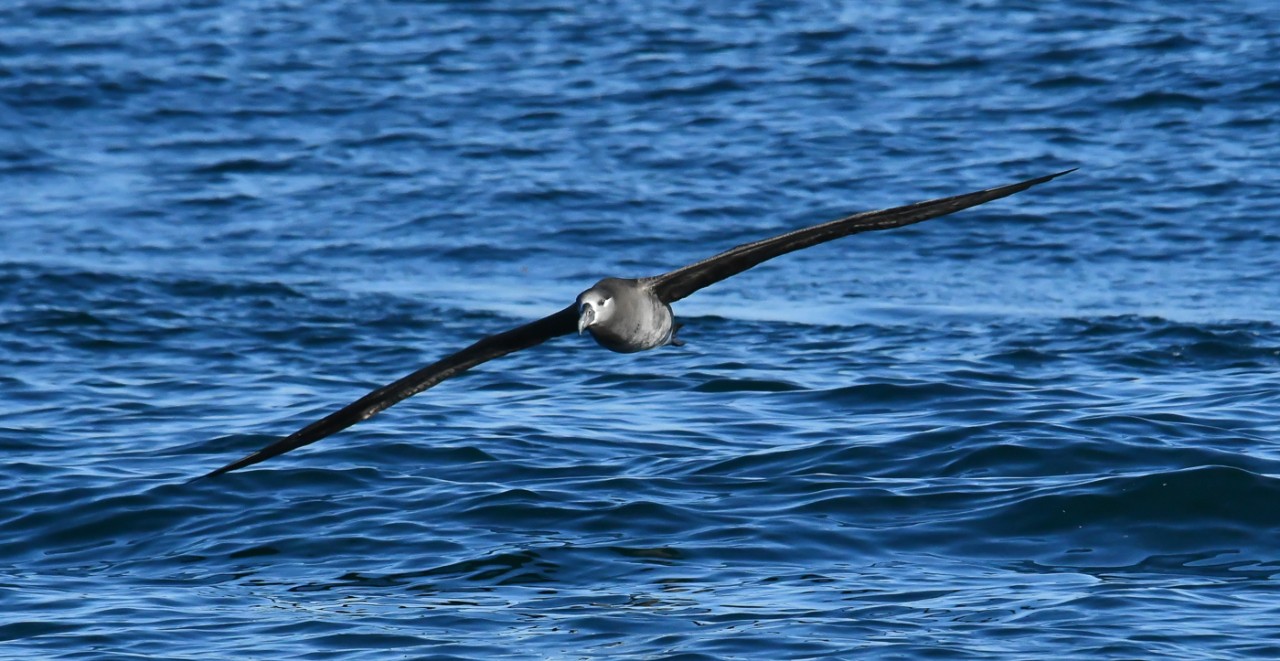
SIAM News: How the albatross optimizes long-range flight
UC aerospace experts explain physics behind effortless flight

How do albatrosses soar for days over the ocean while expending almost no energy?
An aerospace engineering student and his professor at the University of Cincinnati say they harness the wind by executing a series of deft aerial maneuvers that save them energy as they travel the vast ocean.

UC aerospace student Sameer Pokhrel. Photo/Provided
UC College of Engineering and Applied Science graduate student Sameer Pokhrel and Sameh Eisa, an assistant professor of aerospace engineering, broke down the complicated physics behind the bird's graceful flight for SIAM News, the science magazine for the Society for Industrial and Applied Mathematics.
Albatrosses have enormous wings. The wandering albatross has the largest wingspan of any living bird at 12 feet. They use these long wings to get lift on the ocean breeze.
According to Pokhrel and Eisa, albatrosses fly into the wind, gaining elevation through wind shear, or the increase in wind speed typically observed at higher elevations. They trade kinetic energy for potential energy during the climb.
When the bird's air speed slows, they execute a deft high-altitude turn and descend with a tail wind that propels them. During the descent, they trade the gained potential energy with kinetic energy to increase speed and momentum.

UC assistant professor Sameh Eisa. Photo/Provided
At the bottom of their decent, near the ocean's surface, the birds make another graceful turn into the wind to repeat the complex series of maneuvers.
Pokhrel and Eisa say albatrosses minimize the energy they need to expend by optimizing this soaring pattern, which they described as an extremum seeking control system. In Eisa's Modeling, Dynamics and Control Lab, the researchers created a computer model that replicates the optimized soaring patterns that come so naturally to albatrosses.
The researchers said the lessons we learn about dynamic soaring from albatrosses can help optimize long-distance flights with drones and other aircraft.
Pohkrel presented his analysis to the Society for Industrial and Applied Mathematics Conference on the Life Sciences in July.
Featured image at top: A black-footed albatross glides over the Pacific Ocean. Photo/Michael Miller
Related Stories
‘Designer drug’ shows early neuroprotective signal in acute ischemic stroke
October 28, 2025

Medscape highlighted new trial results led by the University of Cincinnati's Eva Mistry that found an experimental drug shows promise in protecting injured brain cells for patients with acute ischemic stroke.
Is menstrual fluid ‘the most overlooked opportunity’ in women’s health?
October 27, 2025

The Guardian recently reported that period blood has long been thought of as ‘stinky and useless’, but startups are exploring using the fluid to test for a wide range of health conditions — including endometriosis.
What is squalane, and how does it work to moisturize skin?
October 27, 2025

The University of Cincinnati's Kelly Dobos was featured in a Women's Health article discussing squalane, an ingredient being increasingly used in moisturizing skincare products.