WLWT: UC works with art museums to identify fakes and forgeries
Project uses latest science tools to study art in a new way

WLWT highlighted a novel collaboration between art museums and geologists, chemists and art historians at the University of Cincinnati to examine precious artworks using the latest scientific tools.
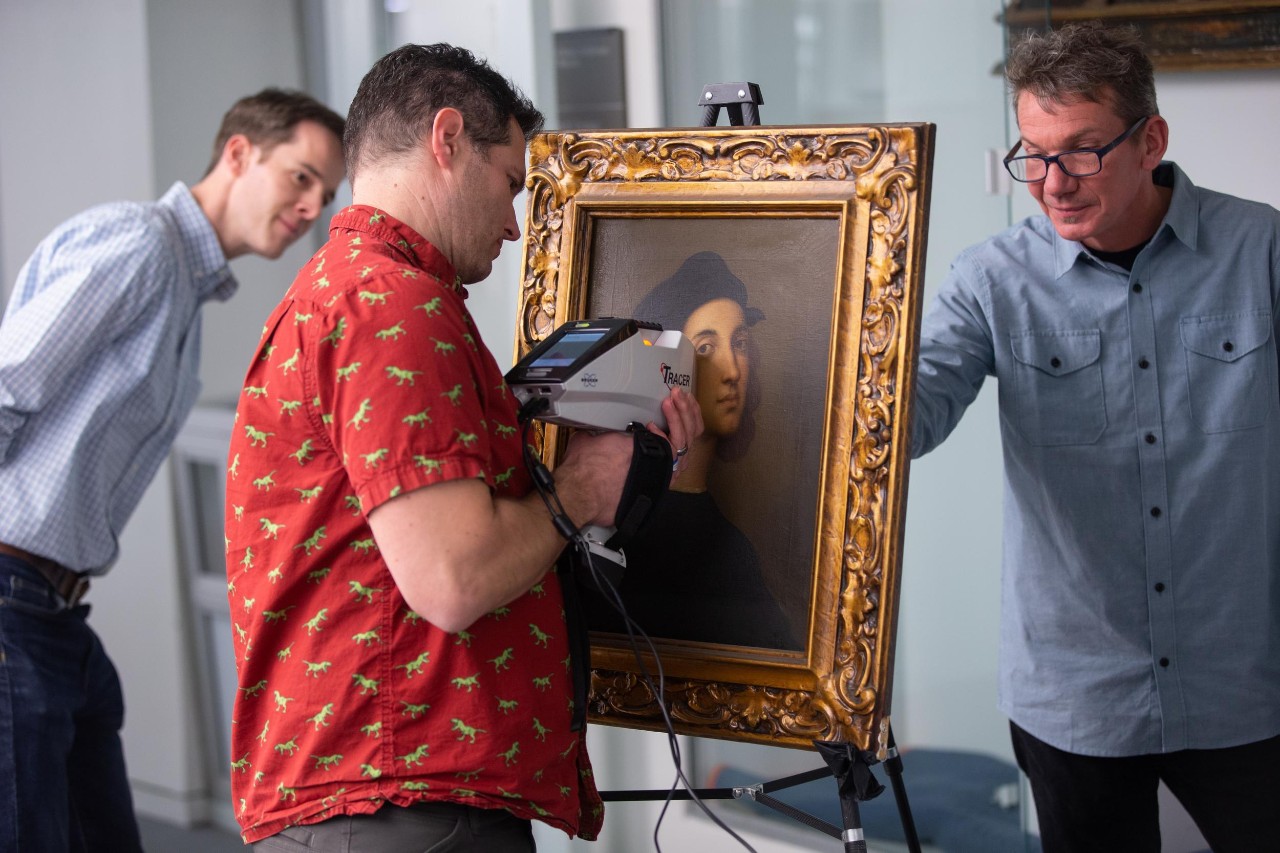
UC worked with the Taft Museum of Art to use tools such as Xray fluorescence spectroscopy to study the pigments in two paintings in the hopes of learning more about the masterpieces.
Art historian Christopher Platts in UC's College of Design, Architecture, Art, and Planning, and UC College of Arts and Sciences geologist Daniel Sturmer and chemists Pietro Strobbia and Lyndsay Kissell examined "Panel with the Crucifixion" and "Landscape with Canal" in Taft's collection.
The first was a painting on a wood panel in the style of Italian Renaissance artist Bernardo Daddi. UC's chemical analysis revealed more modern pigments in the painting.
UC's experts hoped to shed light on the landscape painting's suspicious signature. The painting was signed John Constable, but experts long have suspected the work was created by contemporary Frederick Waters Watts. UC's analysis was inconclusive.
UC researchers say these tools can help historians pin down the dates the artworks were created and potentially identify a fake or fraud. The Taft Museum of Art included the paintings in an exhibit titled Fakes, Forgeries and Followers in the Taft Collection that runs through Feb. 5.

UC geologist Daniel Sturmer uses XRF spectroscopy to study a painting in the style of Italian Renaissance master Bernardo Daddi in the conservation lab of the Taft Museum of Art. Photo/Andrew Higley/UC Marketing + Brand
Related Stories
‘Designer drug’ shows early neuroprotective signal in acute ischemic stroke
October 28, 2025

Medscape highlighted new trial results led by the University of Cincinnati's Eva Mistry that found an experimental drug shows promise in protecting injured brain cells for patients with acute ischemic stroke.
Is menstrual fluid ‘the most overlooked opportunity’ in women’s health?
October 27, 2025

The Guardian recently reported that period blood has long been thought of as ‘stinky and useless’, but startups are exploring using the fluid to test for a wide range of health conditions — including endometriosis.
What is squalane, and how does it work to moisturize skin?
October 27, 2025

The University of Cincinnati's Kelly Dobos was featured in a Women's Health article discussing squalane, an ingredient being increasingly used in moisturizing skincare products.