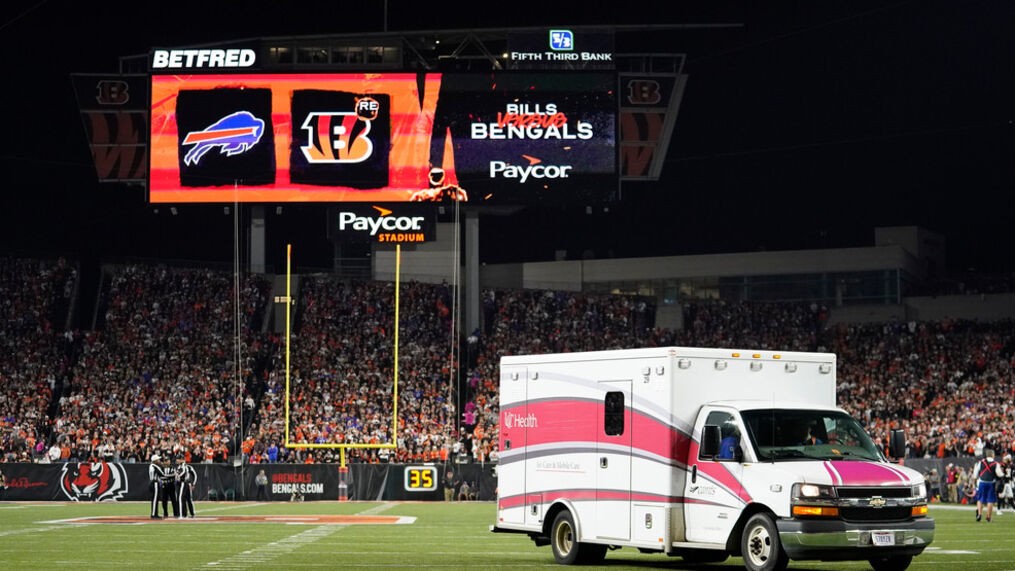
Washington Post: Damar Hamlin is awake, has made a ‘fairly remarkable recovery,’ doctors say
UC doctors say quick medical response on the field was key

Buffalo Bills safety Damar Hamlin has made “substantial improvement” as part of a “fairly remarkable recovery” after he collapsed during Monday night’s football game in Cincinnati and went into cardiac arrest on the field, his doctors said Thursday. The news conference at University of Cincinnati Medical Center received widespread coverage, including in a story published by the Washington Post.
“There has been substantial improvement in his condition over the past 24 hours,” Timothy Pritts, MD, PhD, a professor in the Department of Surgery at the University of Cincinnati College of Medicine, said at a news conference. “We had significant concern about him after the injury and after the event that happened on the field. But he is making substantial progress. As of this morning, he is beginning to awaken, and it appears that his neurological condition and function is intact.”

William Knight IV, MD, left and Timothy Pritts, MD, PhD, right of the UC College of Medicine/Photo/UC Health
“It’s been a long and difficult road for the last three days,” said William Knight IV, MD, professor in the school’s Department of Emergency Medicine. “He has been very sick and has made a fairly remarkable recovery and improvement.”
Knight said that Hamlin, 24, is showing overall clinical improvement “related to not just his vital signs but a lot of his other individual organ recovery.”
When Hamlin asked about the winner of Monday’s game, Pritts said, those with him at the time responded that Hamlin had won in life.
“It’s not only that the lights are on,” Pritts said. “We know that he’s home. And it appears that all the cylinders are firing, which is greatly gratifying for all of us.”
The doctors treating Hamlin cautioned that many steps remain in his recovery.
“He continues to be critically ill,” Pritts said, “and continues to undergo intensive care...He still has significant progress that he needs to make. But this marks a really good turning point in his ongoing care...There are many, many steps still ahead of him. From our standpoint, we would like to see him continue to improve, to be completely breathing on his own and then to be ready to be discharged from the hospital.”
Read the entire story online. (Note: subscription may be required to read.)
See the entire news conference.
Lead photo/Joshua Bickel/AP photo
Related Stories
‘Designer drug’ shows early neuroprotective signal in acute ischemic stroke
October 28, 2025

Medscape highlighted new trial results led by the University of Cincinnati's Eva Mistry that found an experimental drug shows promise in protecting injured brain cells for patients with acute ischemic stroke.
Is menstrual fluid ‘the most overlooked opportunity’ in women’s health?
October 27, 2025

The Guardian recently reported that period blood has long been thought of as ‘stinky and useless’, but startups are exploring using the fluid to test for a wide range of health conditions — including endometriosis.
What is squalane, and how does it work to moisturize skin?
October 27, 2025

The University of Cincinnati's Kelly Dobos was featured in a Women's Health article discussing squalane, an ingredient being increasingly used in moisturizing skincare products.