Indianapolis Star: Carmel replacing Callery pear trees
Indiana city is taking proactive steps to replace invasive trees

The Indianapolis Star turned to a University of Cincinnati biologist to explain how a nonnative tree was able to reproduce in the wild.
Callery pear trees were introduced to the United States from China. Hearty and fast growing, the trees with the pretty white spring blossoms became a favorite of landscapers and nurseries in the 1960s when they were planted across neighborhoods and commercial developments.
Theresa Culley, a professor and head of the Department of Biological Sciences in UC's College of Arts and Sciences, said the Bradford pear tree is a clone and can't reproduce with other Bradford pear trees.
But this variety was notorious for weak trunks that split when they grew too top heavy, so U.S. horticulture introduced sturdier varieties. And these varieties could pollinate Bradford pear trees.
“Really, it’s the fact that people started to plant a mix of different cultivated varieties that caused the problem,” Culley told the Indianapolis Star.
“If you get a different tree it sends its pollen to Bradford, suddenly Bradford recognizes a different genetic individual and fertilizes,” Culley said.
Soon wild pear trees began showing up along highways and in forest clearings, Culley said.

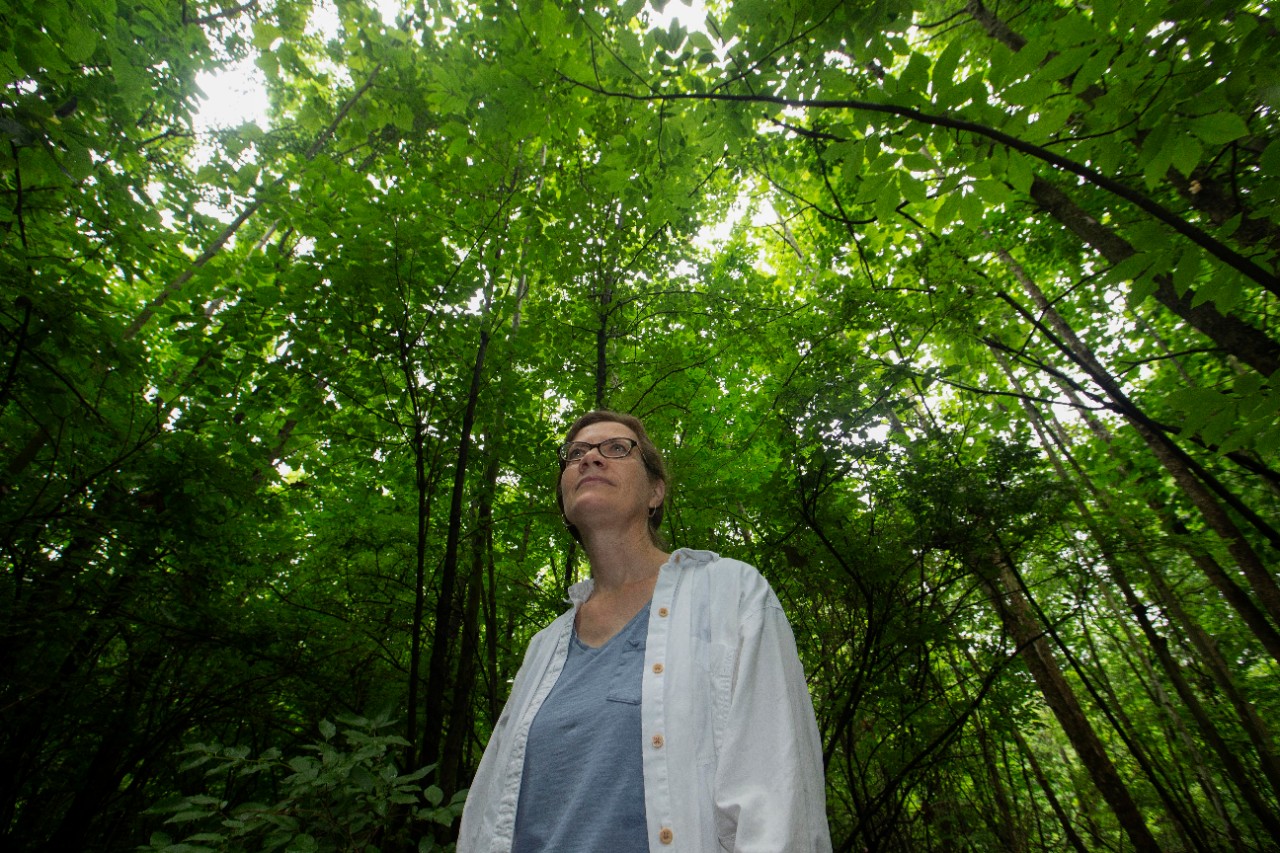
University of Cincinnati Professor Theresa Culley advises the state of Ohio about nonnative invasive plants that could pose economic or environmental burdens. Photo/Joseph Fuqua II/UC
One Indiana city, Carmel, is replacing Callery pear trees with native species. The city cut down dozens of pear trees in one neighborhood this year alone.
Ohio banned the sale or distribution of Callery pear trees to protect native forests.
Culley serves on the Ohio Invasive Plants Council and the Ohio Invasive Plant Advisory Committee, which advises the Ohio Department of Agriculture on regulation.
To date, the committee has identified more than three dozen nonnative plants that are not permitted to be sold or planted in the state because of their potential to cause economic or environmental harm. These include purple loosestrife, Japanese stiltgrass and amur honeysuckle, another plant that is taking over many Ohio forests.
Read the Indianapolis Star story.
Featured image at top: University of Cincinnati Biology Department Head Theresa Culley stands in a grove of wild-growing Callery pear trees at the Harris Benedict Nature Preserve. Photo/Joseph Fuqua II/UC
Related Stories
‘Designer drug’ shows early neuroprotective signal in acute ischemic stroke
October 28, 2025

Medscape highlighted new trial results led by the University of Cincinnati's Eva Mistry that found an experimental drug shows promise in protecting injured brain cells for patients with acute ischemic stroke.
Is menstrual fluid ‘the most overlooked opportunity’ in women’s health?
October 27, 2025

The Guardian recently reported that period blood has long been thought of as ‘stinky and useless’, but startups are exploring using the fluid to test for a wide range of health conditions — including endometriosis.
What is squalane, and how does it work to moisturize skin?
October 27, 2025

The University of Cincinnati's Kelly Dobos was featured in a Women's Health article discussing squalane, an ingredient being increasingly used in moisturizing skincare products.