Spectrum News: UC study provides window into woodpecker's world
UC geography student says maintaining wooded corridors helps animals survive in fragmented habitat

Spectrum News highlighted a geography study at the University of Cincinnati that examined the unique habitat needs of pileated woodpeckers in southwest Ohio.
UC College of Arts and Sciences Professor Susanna Tong and doctoral student Ruijia Hu compared 10 years of pileated woodpecker sightings with geographic data identifying the mature wooded habitat the birds prefer.

A pileated woodpecker. Photo/Michael Miller
Pileated woodpeckers are the largest woodpeckers in North America.
They prefer mature woodlands with dead timber that conceals grubs and other preferred food.
While they are listed today as a species of least concern, that hasn't always been the case. The birds declined across the United States as mature forest was cut down for agriculture.
The researchers concluded that the woodpeckers can survive in increasingly fragmented urban forests if there are wooded corridors that help them get from patch to patch.
“For nesting, pileated woodpeckers would like maple trees, hickory trees, and oak trees,” Hu said. “And they really need mature trees to make the nest.”
Hu presented her findings this year to the American Association of Geographers’ conference in Denver.
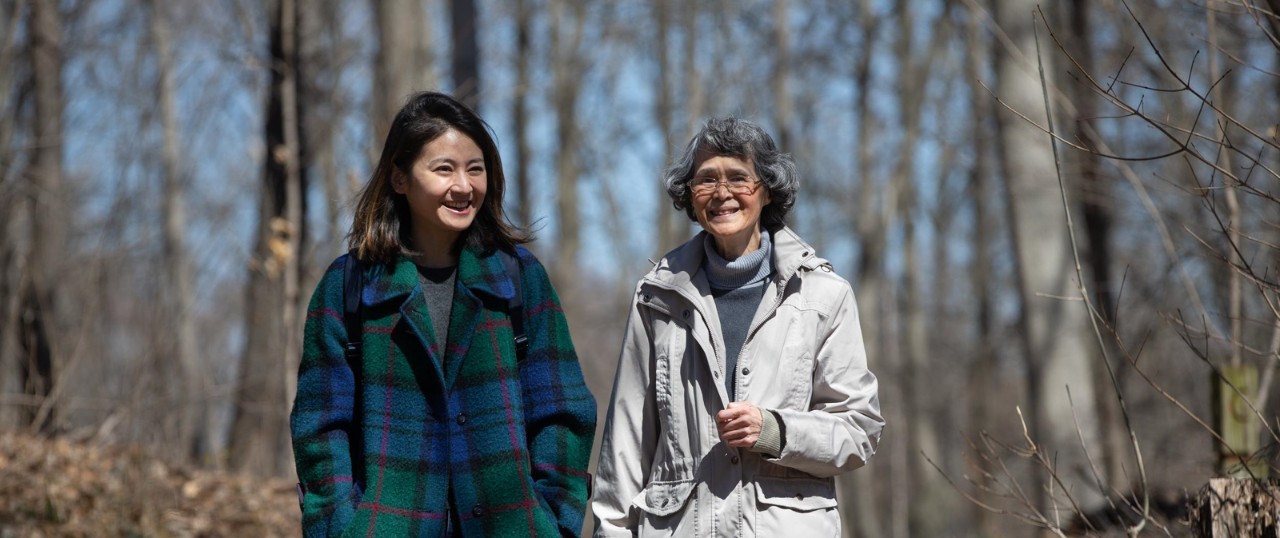
Featured image at top: UC geography student Ruijia Hu, left, and Professor Susanna Tong look for pileated woodpeckers in Burnet Woods. Photo/Andrew Higley/UC Marketing + Brand

UC doctoral student Ruijia Hu studies evidence of woodpecker activity in the trunk of a tree at Burnet Woods. Photo/Andrew Higley/UC Marketing + Brand
Related Stories
‘Designer drug’ shows early neuroprotective signal in acute ischemic stroke
October 28, 2025

Medscape highlighted new trial results led by the University of Cincinnati's Eva Mistry that found an experimental drug shows promise in protecting injured brain cells for patients with acute ischemic stroke.
Is menstrual fluid ‘the most overlooked opportunity’ in women’s health?
October 27, 2025

The Guardian recently reported that period blood has long been thought of as ‘stinky and useless’, but startups are exploring using the fluid to test for a wide range of health conditions — including endometriosis.
What is squalane, and how does it work to moisturize skin?
October 27, 2025

The University of Cincinnati's Kelly Dobos was featured in a Women's Health article discussing squalane, an ingredient being increasingly used in moisturizing skincare products.