WLWT: Doctor from UC College of Medicine discusses air quality impacts from wildfire smoke
UC expert says the smoke could cause serious health problems

Smoke from wildfires in Canada recently caused serious visibility and, more importantly, serious health concerns across much of the eastern part of the United States, including the Tristate. WLWT-TV interviewed George Leikauf, PhD, of the Division of Pulmonary, Critical Care and Sleep Medicine of the UC College of Medicine about the local impact of the smoke.
Leikauf was asked if this was something the average person in Cincinnati should be concerned about.
“Yes," he said. "People with any heart disease, with lung problems particularly can be affected very strongly by the unhealthy air pollution like that," he said.
As for what is in the smoke blowing south from Canada, Leikauf the main thing that is traveling is particles.

George Leikauf, PhD, of the Division of Pulmonary, Critical Care and Sleep Medicine at the UC College of Medicine
“The small particles that are less than two and a half microns or micrometers are able to penetrate all the way into the deepest part of your lung and absorbed into your body so they can travel to different parts of your body. When that happens it aggravates the cells in your lung, and they release mediators that cause problems for all kinds of things. For example, your airways will restrict if you have asthma or your heart will be beating at a higher rate and be stressed. These particles are dangerous. Besides that there are a lot of other chemicals in the fire, closer to the fire that are very dangerous.”
Leikauf says there are several things people should do to mitigate the impact of the smoky conditions.
“Limit your exercise outside, limit your time outside,” he says. “The N-95 mask actually blocks these particles that we’re talking about, so it’s a good thing for people to wear when you're outside. You can get air cleaners that you can put inside your home. You can actually build one if you take a box fan, just put a filter on the back, get some duct tape on the inside of the fan, it will actually help filter the air.”
Leikauf says one particularly problematic aspect of the smoke from the wildfires is the ability of the particles to get inside buildings.
“Unlike ozone which when you go inside you really reduce the concentration of ozone, these particles penetrate through into your home, about 70%," he says. "So, if you have an unhealthy condition, you can imagine 70% less is not enough.”
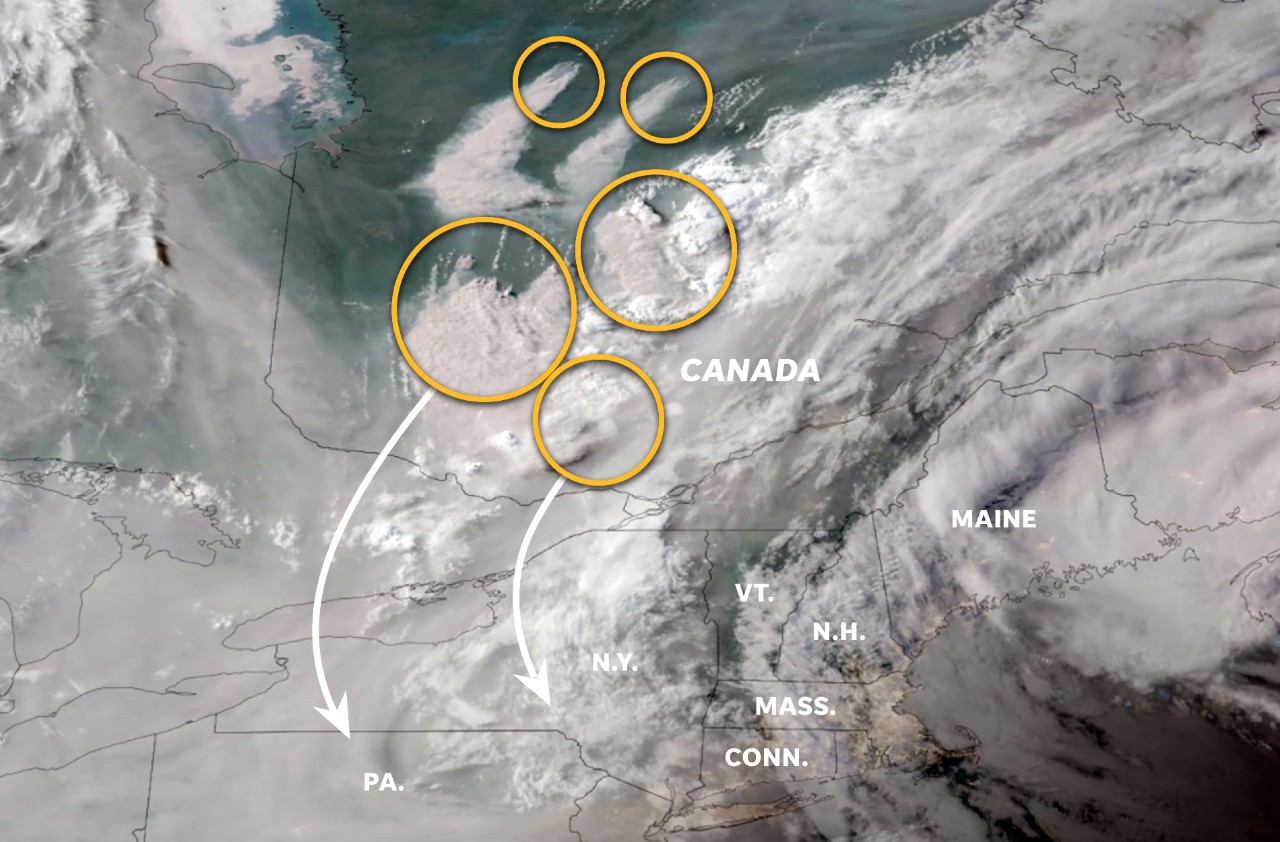
Illustration at the top of dispersion of smoke from wildfires in Canada/Janet Loehrke/USA TODAY/CIRA/NOAA via AP
Related Stories
‘Designer drug’ shows early neuroprotective signal in acute ischemic stroke
October 28, 2025

Medscape highlighted new trial results led by the University of Cincinnati's Eva Mistry that found an experimental drug shows promise in protecting injured brain cells for patients with acute ischemic stroke.
Is menstrual fluid ‘the most overlooked opportunity’ in women’s health?
October 27, 2025

The Guardian recently reported that period blood has long been thought of as ‘stinky and useless’, but startups are exploring using the fluid to test for a wide range of health conditions — including endometriosis.
What is squalane, and how does it work to moisturize skin?
October 27, 2025

The University of Cincinnati's Kelly Dobos was featured in a Women's Health article discussing squalane, an ingredient being increasingly used in moisturizing skincare products.